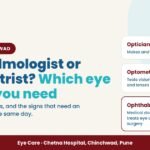
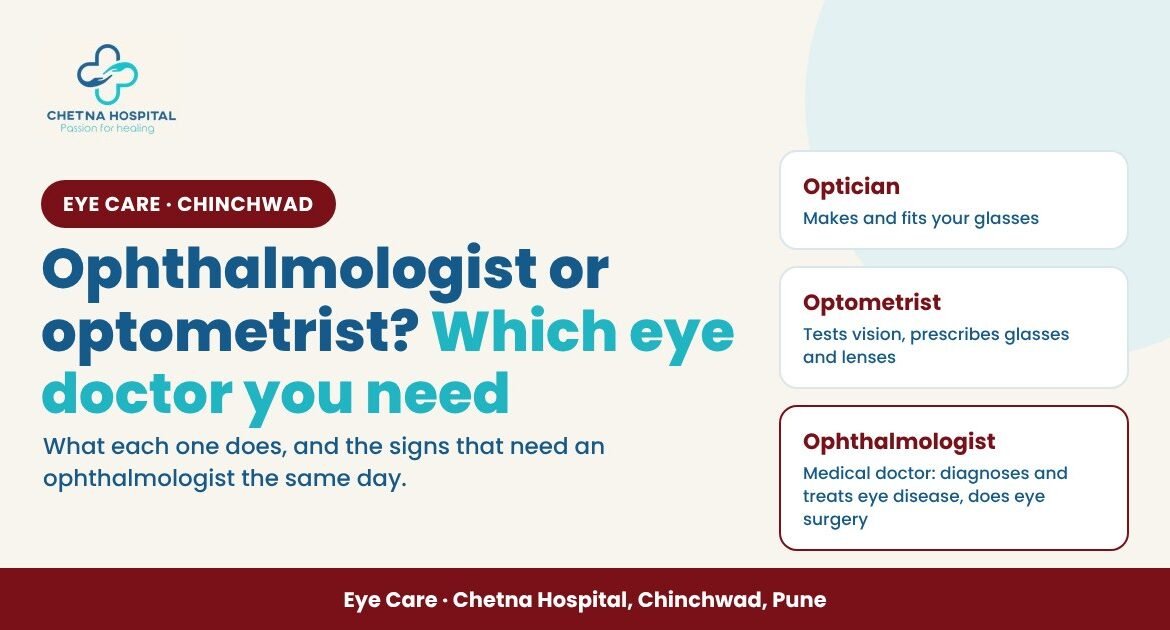
If you are searching for an “eye doctor near me” or an “ophthalmologist near me” in Chinchwad or PCMC, the first question is which kind of eye professional you actually need. An optometrist can test your vision and prescribe glasses. An ophthalmologist is a medical doctor who diagnoses and treats eye diseases and performs eye surgery. Some eye symptoms need an ophthalmologist the same day, and this guide lists them.
Ophthalmologist, optometrist and optician: what is the difference?
The three names sound alike, but the training and the work are different. The American Academy of Ophthalmology describes them like this:
- Ophthalmologist: a medical doctor who has specialised in eye care. An ophthalmologist examines the whole eye, diagnoses eye diseases, prescribes medicines and eye drops, and performs eye surgery such as cataract or glaucoma surgery. In India, an ophthalmologist first completes MBBS and then a postgraduate qualification in ophthalmology.
- Optometrist: an eye care professional trained to test vision and prescribe glasses and contact lenses. An optometrist can spot some eye problems and refer you to an ophthalmologist. Optometrists are not medical doctors and do not perform surgery.
- Optician: a technician who makes and fits glasses and contact lenses using the prescription from an optometrist or ophthalmologist.
| What you need | Who usually helps |
|---|---|
| Glasses or a new power for reading | Optometrist or ophthalmologist |
| New frames or lenses made from your prescription | Optician |
| Cataract, glaucoma or retina problems | Ophthalmologist |
| Diabetes and you need an eye check | Ophthalmologist |
| Eye injury, sudden vision loss, a painful red eye | Ophthalmologist, the same day |
| A child with a squint or poor vision | Ophthalmologist |
When should you see an ophthalmologist?
Book a visit with an ophthalmologist, an eye specialist who is a medical doctor, if any of these apply to you:
- You have diabetes. Diabetic retinopathy does not usually cause symptoms at first, so the NHS advises regular diabetic eye screening even when your eyesight seems fine. Read more in our guide on why diabetes affects your eyes.
- Your vision is slowly getting cloudy or blurry, colours look faded, or you find glare from lights difficult. These can be signs of a cataract. See our cataract treatment guide.
- You are at higher risk of glaucoma: you are over 40, a parent, brother or sister has glaucoma, or you have diabetes or high eye power. Glaucoma often has no early symptoms and is usually found at a routine eye test. Read about eye pressure and glaucoma.
- Your child has a squint, holds books very close, squints to see the board, or often rubs their eyes. A squint and lazy eye respond best to early treatment. See myopia signs in children.
- Your eyes stay red, itchy, watery or dry even after simple care, or you get eye pain or headaches with your vision.
- You have not had an eye test in 2 years. The NHS advises most people to have an eye test at least every 2 years, or more often if advised.
Eye symptoms that need an ophthalmologist the same day
Some eye problems cannot wait for a routine appointment. NHS guidance says to get help straight away for:
- Sudden loss of vision or sudden blurry vision, in one or both eyes
- Sudden flashes of light or a shower of new floaters, or a shadow moving across your vision, which can be signs of a retinal detachment
- A painful red eye, especially with blurred vision or sensitivity to light
- Sudden double vision
- Any injury to the eye, including a chemical splash
For a chemical in the eye, rinse with clean running water straight away and keep rinsing on the way to care. If sudden vision changes come with weakness on one side, a drooping face or slurred speech, these can be signs of a stroke: call 108 or 112 straight away. Do not drive yourself.
What happens during an eye examination with an ophthalmologist?
A full eye examination usually includes:
- A vision test to check how well you see at a distance and close up, and whether you need glasses.
- An eye pressure check, one of the tests used to look for glaucoma.
- A slit-lamp examination of the front of the eye, including the cornea and lens.
- A look at the retina and optic nerve, often after eye drops that widen the pupils. These drops can blur your vision for a few hours, so plan not to drive after the visit.
- Further tests if needed, such as an OCT scan of the retina.
Bring your current glasses, any old prescriptions or reports, and a list of your medicines. Tell the doctor if you have diabetes, high blood pressure or a family history of eye disease.
Frequently asked questions
Is an eye specialist the same as an ophthalmologist?
Usually, yes. “Eye specialist” is the everyday term most people use for an ophthalmologist, the medical doctor who treats eye diseases and performs eye surgery.
Can an optometrist treat eye infections or do surgery?
An optometrist can test your vision, prescribe glasses and spot signs of eye disease. For diagnosis and treatment of eye diseases, prescription medicines and any eye surgery, you need an ophthalmologist.
How often should I get my eyes checked?
The NHS advises most adults to have an eye test at least every 2 years. People with diabetes need regular diabetic eye checks, and your ophthalmologist may advise more frequent checks if you have glaucoma risk factors or other eye conditions.
Is blurry vision in one eye serious?
It can be. Blurry vision that comes on suddenly in one eye needs to be checked the same day. Blurry vision that develops slowly over months is often due to a change in eye power or a cataract, but it still needs an eye examination.
Eye care at Chetna Hospital, Chinchwad
Dr Rachana Tiwari is a consultant ophthalmologist at Chetna Hospital, Chinchwad. She sees adults and children for eye examinations, cataract, glaucoma and retina problems, and eye injuries. Read more about Dr Rachana Tiwari or about why regular eye check-ups matter.
Chetna Hospital, Consulting 1, Plot GP 116, Sambhaji Nagar Road, near Rotary Club, G Block, MIDC, Chinchwad, Pune 411019. Serving Chinchwad, Pimpri, Akurdi, Nigdi, Ravet, Wakad, Bhosari and nearby PCMC areas.
Sources: American Academy of Ophthalmology, “What is an ophthalmologist?” and “Difference between an ophthalmologist, optometrist and optician”; NHS, “Eye tests”, “Diabetic eye screening”, “Glaucoma”, “Detached retina” and “Vision loss”. This article is general health information, not a diagnosis. It was prepared with the help of AI writing tools.