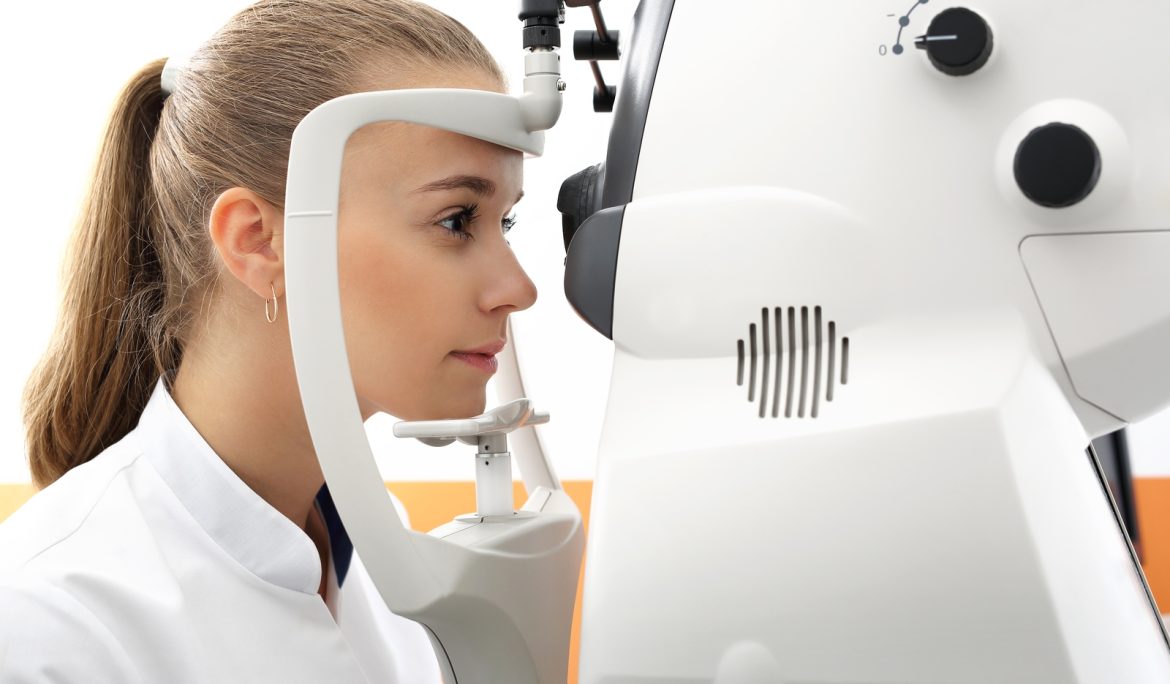
Perimetry, also known as visual field testing, is essential in diagnosing and managing various eye conditions. Visual field testing measures how far and how well you can see to the sides (your peripheral vision). It helps find early signs of glaucoma, some retinal diseases and some brain or nerve conditions. Repeat tests also show whether glaucoma treatment is stopping further vision loss.
How does perimetry work?
During a perimetry test, you sit in front of a bowl-shaped machine. You look at a central point while small lights flash at different places around the bowl. Each time you see a light, you press a button. Each eye is usually tested on its own. A computer records which lights you saw and maps any areas where you did not see them.
Types of Perimetry Tests
Several types of perimetry tests are available, each serving specific diagnostic purposes:
- Static Perimetry: Measures the sensitivity of your vision at various points in the visual field.
- Kinetic Perimetry: Uses moving stimuli to map out the visual field boundaries.
- Frequency Doubling Technology (FDT) Perimetry: Uses flickering striped patterns. It is often used as a quick screening test for glaucoma.
Treatment Options
Perimetry does not treat anything, but finding a problem early means treatment can start sooner. For example, glaucoma damage cannot be reversed, but eye drops, laser treatment or surgery can lower the pressure in the eye and help stop sight getting worse. Some retinal diseases are treated with laser or injections. Repeat perimetry tests show whether a condition is stable, so the eye doctor can change treatment if needed.
Myths and Facts About Perimetry
Myth: Perimetry is only necessary for older adults.
Fact: Perimetry can be needed at any age. People with a parent, brother or sister with glaucoma may be advised to have eye checks more often.
Myth: Perimetry tests are uncomfortable and lengthy.
Fact: Perimetry does not touch the eye and does not hurt. It usually takes a few minutes for each eye, though it needs concentration.
Myth: A normal perimetry test means your eyes are completely healthy.
Fact: While a normal test is good, it doesn’t rule out all eye conditions. Regular comprehensive eye exams are still necessary for monitoring eye health.
Dos and Don’ts for Perimetry Tests
Do: Follow the instructions given. Keep your eye on the central point, and say if you need a short break.
Do: Keep your follow-up appointments. Early glaucoma often causes no symptoms, so repeat tests can pick up changes you have not noticed.
Do: Tell the eye team about any medicines or eye drops you use, and bring your glasses or contact lens details.
Don’t: Worry about missing some lights. Everyone misses some, and the test allows for this.
Conclusion
Perimetry is a simple test that helps find and monitor eye conditions such as glaucoma. Chetna Hospital uses it to check and follow up eye conditions. Regular eye tests, at least every 2 years for most adults, help find problems early. Knowing what to expect can make the test easier.
For more information or to book a perimetry test, call the eye care (ophthalmology) department at Chetna Hospital on 91686 90442.
General health information, not a diagnosis. Reviewed and updated by Chetna Hospital’s content team, November 2026.