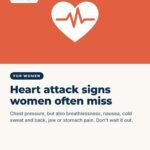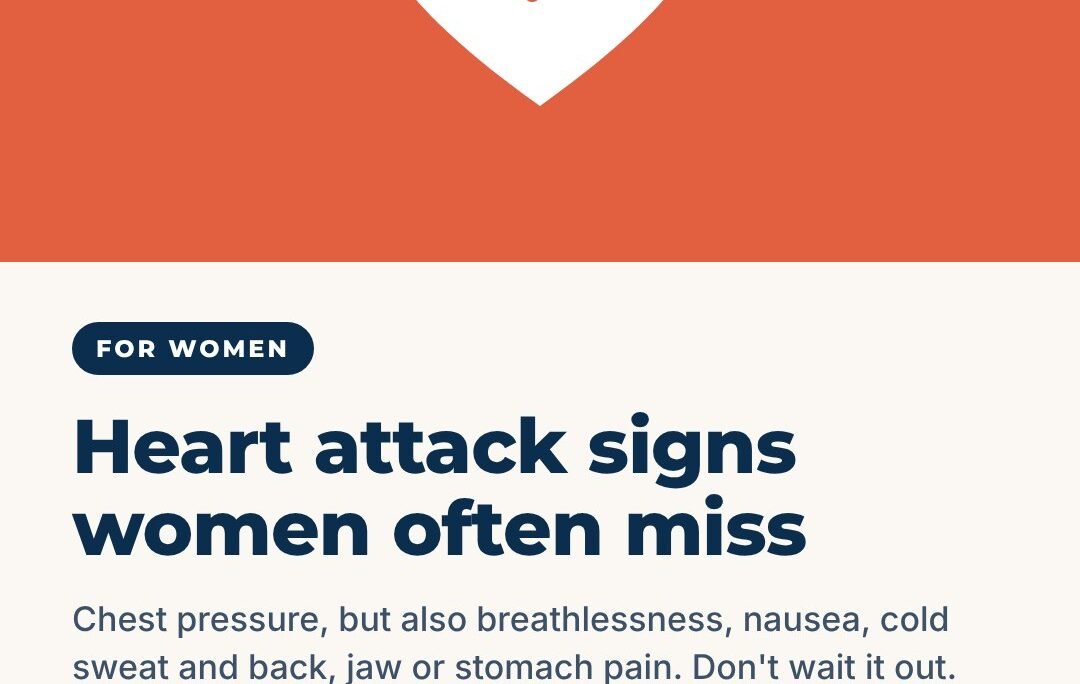
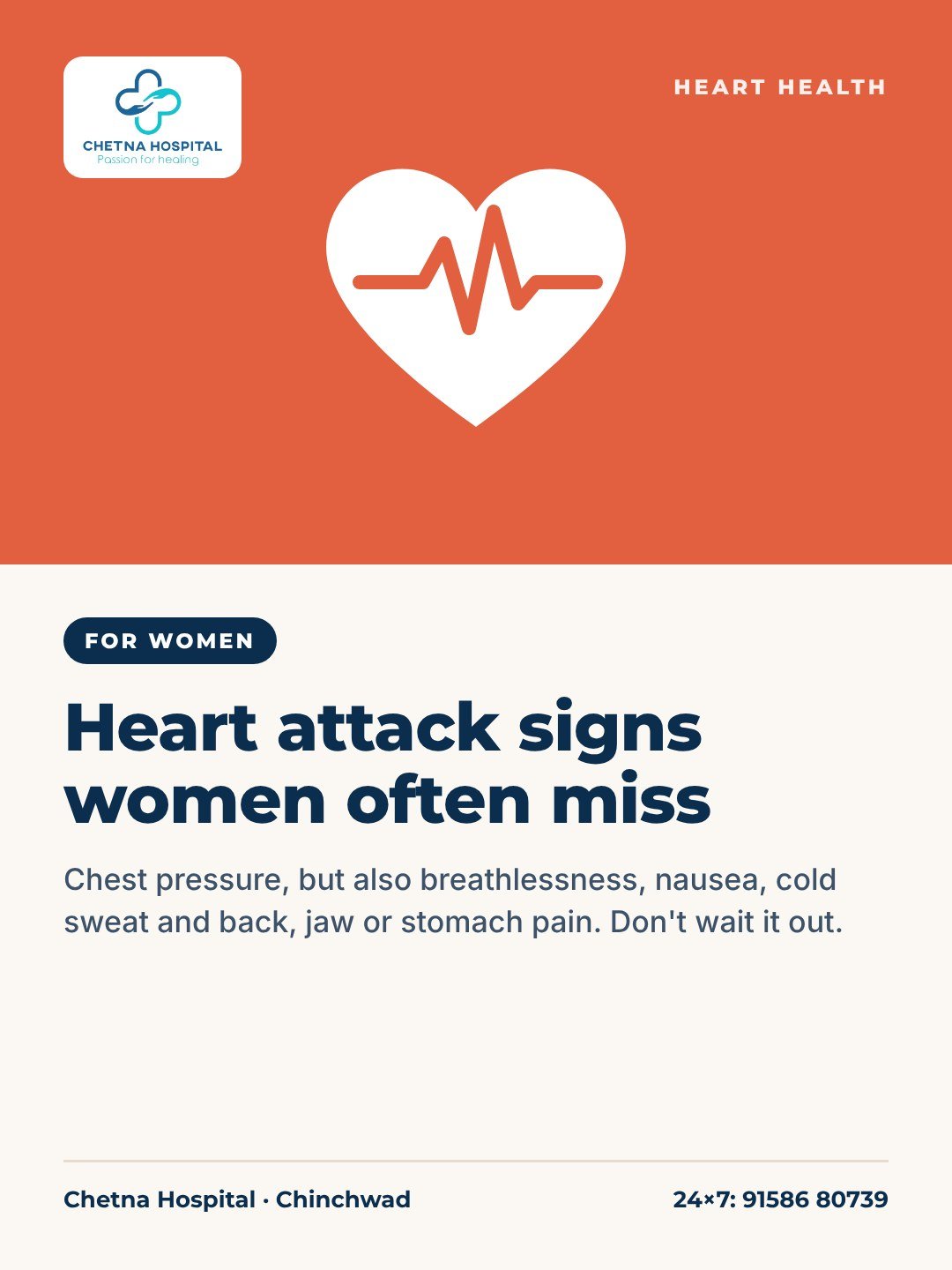
Chest pain or discomfort is the most common heart attack symptom in women, as in men, says the American Heart Association. But women may also have shortness of breath, nausea, a cold sweat, light-headedness, unusual tiredness, or pain in the back, shoulder, jaw, neck or stomach, and often put these down to acidity or flu. Any of these signs together, or chest discomfort lasting more than a few minutes, needs emergency help: in India call 108 or Chetna Hospital 24×7 on 91586 80739.
Call 91586 80739Book on GoogleWhatsApp
Key takeaways
- Chest pressure, squeezing or fullness is still the most common symptom in women.
- Women may also have breathlessness, nausea, cold sweat, tiredness and pain in the back, jaw, neck or stomach.
- The American Heart Association says women often mistake these signs for acid reflux, flu or normal ageing.
- Do not drive yourself to hospital: call 108 or Chetna 24×7 on 91586 80739.
- Tests such as an ECG, blood tests and sometimes a coronary angiogram find out whether it is a heart attack and where the blockage is.
In this article
- What is the most common heart attack symptom in women?
- Which other signs do women often have?
- Why are these signs missed?
- What should you do straight away?
- What happens at the hospital?
- How can women lower their heart risk?
- Frequently asked questions
In many homes, a mother or grandmother is the last to complain. A heavy chest gets called gas, breathlessness gets blamed on climbing stairs, and a cold sweat on the weather. This guide uses American Heart Association and NHS guidance to explain the heart attack signs that are easy to miss in women, and what to do in the first minutes. For a broader look at chest pain, read our guide to left-side chest pain.
What is the most common heart attack symptom in women?
The American Heart Association (AHA) says that, as in men, the most common symptom in women is chest pain or discomfort: uncomfortable pressure, squeezing, fullness or pain in the centre of the chest that lasts more than a few minutes, or goes away and comes back. Some women describe upper back pressure that feels like squeezing or a rope being tied around them.
Which other signs do women often have?
The AHA lists symptoms that women may have that are less often linked with heart attacks:
- shortness of breath, with or without chest discomfort
- pain or discomfort in one or both arms, the back, neck, jaw or stomach
- breaking out in a cold sweat
- nausea or upset stomach
- light-headedness
- unusual tiredness and weakness
- anxiety
The NHS adds that a heart attack can feel like indigestion, with a burning feeling and feeling full or bloated, and that skin may turn pale, blue or grey.
Why are these signs missed?
The AHA notes that women often put symptoms down to less serious conditions such as acid reflux, the flu or normal ageing, and that the signs may not be obvious. Even when the signs are subtle, the outcome can be serious if help is delayed. If a symptom is new, unusual for the person, or comes with sweating, breathlessness or nausea, treat it as a possible heart attack rather than waiting to see if it settles.
What should you do straight away?
- Call 108 for an ambulance, or Chetna Hospital 24×7 emergency on 91586 80739.
- Do not drive yourself to hospital, the NHS advises.
- Sit and rest, with the back supported, while help comes.
- Keep checking that the person is responding and breathing. If they stop responding and are not breathing normally, start CPR if you know how.
Take only medicines the emergency team or a doctor advises.
What happens at the hospital?
The NHS explains that an ECG and blood tests show whether someone is having a heart attack. An echocardiogram can check for heart damage, and a coronary angiogram shows exactly where blood flow to the heart is blocked. The blockage may be treated at the same time with coronary angioplasty, which opens the artery using a stent. Chetna Hospital’s Precision Cardiovascular Centre has a cath lab for coronary angiography and angioplasty.
How can women lower their heart risk?
The AHA advises:
- see a doctor to learn your risk of heart disease
- stop smoking
- aim for at least 150 minutes a week of moderate activity, such as brisk walking, or 75 minutes of vigorous activity, and include muscle-strengthening activity at least twice a week
- eat fruit, vegetables, whole grains, lean proteins, nuts and seeds, and limit processed foods, added sugar, salt and alcohol
Our article on symptoms of heart disease covers early warning signs to discuss at a check-up.
Consultation near you
Chetna Hospital, Chinchwad: First Floor, Plot GP 116, Sambhaji Nagar Road, near HP Pump, near Rotary Club, G Block, MIDC, Chinchwad, Pune 411019. Call 91586 80739 (24×7 emergency and ambulance). Directions.
Frequently asked questions
What does a heart attack feel like in a woman?
The American Heart Association says chest pain or discomfort is the most common symptom. Women may also have shortness of breath, nausea, a cold sweat, light-headedness, unusual tiredness, or pain in the back, shoulder, arm, jaw, neck or stomach.
Can a heart attack feel like acidity?
Yes. The NHS says a heart attack can feel like indigestion, with a burning feeling in the chest and feeling full or bloated. If it comes with sweating, breathlessness or nausea, get emergency help.
Can women have a heart attack without chest pain?
Chest pain is the most common symptom, but the AHA lists shortness of breath with or without chest discomfort, and other symptoms such as nausea and unusual tiredness, that women may have.
What should I do if I think someone is having a heart attack?
Call 108 for an ambulance or Chetna Hospital 24×7 on 91586 80739. Do not drive yourself. Sit and rest with the back supported, and start CPR if the person stops responding and is not breathing normally.
How is a blocked heart artery found?
The NHS says an ECG and blood tests show whether it is a heart attack, and a coronary angiogram shows where blood flow is blocked. The blockage may be treated at the same time with angioplasty.
Unusual breathlessness, tiredness or chest pressure? Don’t wait it out.
Call 91586 80739Book on GoogleWhatsApp

Your doctor: Dr Pritam R. Titar
Dr Pritam R. Titar, MBBS (B. J. Medical College, Pune), MD Medicine (Topiwala National Medical College and Nair Hospital, Mumbai), DrNB Cardiology. Interventional and consultant cardiologist at the Precision Cardiovascular Centre, Chetna Hospital, Chinchwad.
Sources
- American Heart Association, Heart attack symptoms in women (last reviewed 13 December 2024): https://www.heart.org/en/health-topics/heart-attack/warning-signs-of-a-heart-attack/heart-attack-symptoms-in-women
- NHS, Heart attack: https://www.nhs.uk/conditions/heart-attack/
This article is general health information and does not replace a medical consultation. In an emergency in India, call 108 for an ambulance, or call Chetna Hospital 24×7 on 91586 80739.
Last updated: 20 November 2026