High eye power can affect much more than the ability to see clearly. If your glasses number keeps increasing, distant objects appear blurred, you experience headaches or eye strain, or you have been diagnosed with high myopia, it is important to have a comprehensive eye examination rather than simply changing your glasses.
If you are looking for an eye specialist for high eye power in Chinchwad, an ophthalmologist can evaluate the cause and severity of the refractive error and check whether the eyes are otherwise healthy.
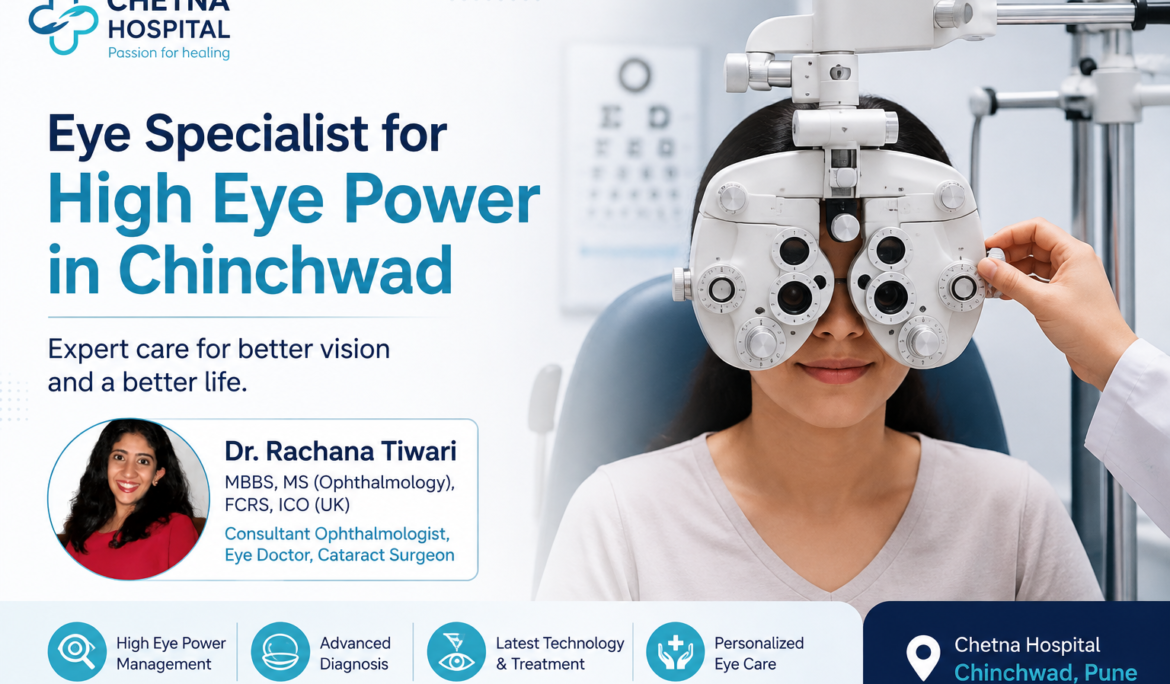
At Chetna Hospital in Chinchwad, Dr. Rachana Tiwari is a Consultant Ophthalmologist and Phaco-Refractive Surgeon with 16 years of experience. She has qualifications including MBBS, MS (Ophthalmology), FCRS and ICO (UK) and has training in ophthalmology, glaucoma and phaco-refractive eye surgery. Her clinical practice includes comprehensive eye care, refractive evaluation, glaucoma, dry eye and diabetic retinopathy management.
Dr. Rachana Tiwari – Chetna Hospital
What Does “High Eye Power” Mean?
“High eye power” is a commonly used term for a significant refractive error that requires a relatively strong spectacle or contact-lens prescription.
Eye power can occur because of:
- Myopia (short-sightedness)
- Hyperopia (long-sightedness)
- Astigmatism
- A combination of refractive errors
According to the American Academy of Ophthalmology, high myopia is generally considered to be around -6.00 diopters or more, while high refractive error can also include significant hyperopia and astigmatism.
High myopia deserves particular attention because increasing myopia can be associated with changes in the retina and other structures of the eye.
Common Types of High Eye Power
| Type of refractive error | What the patient may experience | Typical concern |
|---|---|---|
| High myopia | Difficulty seeing distant objects | Retinal and myopic changes may require monitoring |
| High hyperopia | Difficulty with near vision or eye strain | May require detailed refractive assessment |
| High astigmatism | Blurred or distorted vision | Corneal shape and refractive status may need evaluation |
| Mixed refractive error | Near and distance vision problems | Comprehensive eye examination is recommended |
Important: The exact significance of an eye-power number depends on the patient’s age, eye anatomy, symptoms and overall eye health. A prescription alone does not determine whether an eye is healthy.
When Should You See an Eye Specialist for High Eye Power?
A routine spectacle change may not be enough when your eye power is high or changing frequently.
Consider seeing an ophthalmologist if you have:
- Increasing spectacle power
- Blurred distance vision
- Difficulty seeing road signs or classroom boards
- Frequent headaches associated with visual tasks
- Eye strain
- Difficulty seeing clearly despite wearing glasses
- Distorted or reduced vision
- New flashes of light
- Sudden increase in floaters
- A curtain-like shadow in your vision
- A history of high myopia in the family
- Previous retinal problems
- Difficulty tolerating contact lenses
- Interest in refractive surgery such as LASIK or other procedures
Sudden flashes, a sudden shower of floaters, or a curtain/shadow over part of your vision can require urgent ophthalmic assessment, because retinal problems can sometimes present this way.
High Eye Power vs High Myopia: Are They the Same?
Not exactly.
“High eye power” is a general term patients use when their spectacle prescription is strong. High myopia specifically refers to significant short-sightedness.
For example, a patient may have:
- -2.00 D myopia
- -4.00 D myopia
- -6.00 D or greater myopia
- Myopia combined with astigmatism
The higher the myopic prescription, the more important it becomes to understand whether there are associated changes in the retina or other eye structures.
The American Academy of Ophthalmology notes that high myopia can be associated with complications such as retinal detachment, glaucoma and myopic macular changes.
Therefore, the goal of an eye examination is not simply:
“What is my glasses number?”
It is also:
“Why is my eye power high, is it changing, and are my eyes otherwise healthy?”
What Causes High Eye Power?
High refractive errors can develop for several reasons.
1. Genetics
A family history of myopia can increase the likelihood of developing significant myopia.
2. Eye Growth and Axial Length
Myopia can occur when the eye is longer than expected, causing incoming light to focus in front of the retina.
3. Astigmatism
An irregular or differently curved cornea can cause blurred or distorted vision and may contribute to a higher spectacle prescription.
4. Changes in the Lens
Certain changes within the eye’s natural lens can alter refractive power.
5. Other Eye Conditions
Some eye conditions can be associated with significant refractive errors. This is one reason why persistent or unusual changes in eye power should be evaluated by an ophthalmologist.
How Is High Eye Power Diagnosed?
A comprehensive examination can involve several steps.
1. Visual Acuity Testing
This checks how clearly you can see at different distances.
2. Refraction
The ophthalmologist or optometrist determines the appropriate spectacle prescription.
Depending on the patient’s age and circumstances, additional methods of refraction may be necessary.
3. Eye Pressure Measurement
Intraocular pressure may be checked as part of a comprehensive eye examination, particularly when glaucoma risk needs assessment.
4. Slit-Lamp Examination
A slit lamp allows the ophthalmologist to examine structures at the front of the eye.
5. Dilated Retinal Examination
For patients with significant myopia or relevant symptoms, examination of the retina can help identify abnormalities that may require monitoring.
6. Corneal Assessment
Patients considering refractive surgery may require detailed assessment of corneal shape and thickness.
7. Additional Imaging
Depending on clinical findings, an ophthalmologist may recommend investigations such as retinal imaging, corneal topography or other diagnostic tests.
Why Is a Retinal Examination Important in High Myopia?
High myopia is not only a problem of blurry distance vision.
As myopia becomes more severe, structural changes in the eye can increase the risk of certain complications.
These may include:
- Retinal tears
- Retinal detachment
- Myopic retinal degeneration
- Myopic macular changes
- Glaucoma
- Other retinal abnormalities
This does not mean that every person with high eye power will develop these conditions.
However, it explains why people with significant or progressive myopia may benefit from regular ophthalmic monitoring.
Can High Eye Power Be Reduced Permanently?
This depends on the cause, age, eye health and suitability for treatment.
Glasses and contact lenses correct the refractive error but do not necessarily change the underlying anatomy of the eye.
For selected adults, refractive procedures may provide an alternative to glasses or contact lenses.
Possible options may include:
- LASIK
- PRK
- Other laser refractive procedures
- Phakic intraocular lenses in selected cases
- Lens-based procedures in appropriate patients
However, not everyone with high eye power is a candidate for refractive surgery.
A proper pre-operative evaluation is necessary before deciding whether a procedure is appropriate.
High Eye Power and LASIK: What Should You Know?
Patients with high spectacle power often ask:
“Can I get LASIK?”
The answer cannot be determined from the spectacle prescription alone.
An ophthalmologist may need to assess:
- Age
- Stability of spectacle power
- Corneal thickness
- Corneal shape
- Tear-film health
- Overall eye health
- Retinal health
- Existing eye conditions
- Expectations and lifestyle
Corneal mapping or topography may be recommended as part of the evaluation.
A high prescription does not automatically mean that laser eye surgery is either suitable or unsuitable.
Why Choose an Ophthalmologist Instead of Only Changing Your Glasses?
An optical prescription can correct blurry vision, but an ophthalmologist can assess the health of the eye as well as the refractive error.
This distinction is particularly important when:
- The power is high
- The power is increasing
- Vision changes suddenly
- There are flashes or floaters
- There is a family history of eye disease
- You are considering refractive surgery
- You have diabetes or another condition affecting eye health
For patients searching for an eye specialist in Chinchwad for high eye power, comprehensive ophthalmic assessment can provide a more complete picture than a spectacle-power check alone
Eye Specialist for High Eye Power in Chinchwad – Dr. Rachana Tiwari
If you are searching online for an “eye specialist for high eye power near me,” “eye doctor for high power in Chinchwad,” “ophthalmologist in Chinchwad,” or “eye specialist in Pimpri-Chinchwad,” one option for comprehensive ophthalmic evaluation is Dr. Rachana Tiwari at Chetna Hospital.
Dr. Rachana Tiwari is a Consultant Ophthalmologist and Phaco-Refractive Surgeon with 16 years of experience.
Dr. Rachana Tiwari – Professional Profile
| Detail | Information |
|---|---|
| Doctor | Dr. Rachana Tiwari |
| Specialty | Consultant Ophthalmologist & Phaco-Refractive Surgeon |
| Qualifications | MBBS, MS (Ophthalmology), FCRS, ICO (UK) |
| Experience | 16 years |
| Key clinical areas | Comprehensive ophthalmology, refractive care, glaucoma, dry eye, diabetic retinopathy management |
| Location | Chetna Hospital, Chinchwad, Pimpri-Chinchwad |
| OPD | Monday–Saturday, 10 AM–1 PM and 5 PM–9 PM |
| Sunday | By appointment |
Her professional profile lists advanced training in Glaucoma at HV Desai Eye Institute, Pune, and Phaco-Refractive Eye Surgery at Wavikar Eye Institute, Mumbai.
View Dr. Rachana Tiwari’s official profile
Eye Care Services That May Be Relevant for Patients With High Eye Power
Depending on the patient’s symptoms and examination findings, an ophthalmologist may evaluate:
- Refractive errors
- High myopia
- Astigmatism
- Hyperopia
- Glaucoma
- Retina-related conditions
- Diabetic retinopathy
- Dry eye
- Corneal conditions
- Cataract
- Refractive surgery suitability
- General eye health
The appropriate tests and treatment depend on the individual patient’s examination.
High Eye Power in Children and Teenagers
High or rapidly increasing eye power in children deserves particular attention.
Parents may notice that a child:
- Sits very close to the television
- Holds books very close to the face
- Squints to see distant objects
- Has difficulty reading the classroom board
- Frequently complains of headaches
- Keeps changing spectacle power
- Avoids distance activities
Children can accommodate during refraction, which can affect the accuracy of the measurement. In appropriate cases, ophthalmologists may use cycloplegic refraction to obtain a more accurate assessment.
Myopia management in children is different from simply prescribing stronger glasses. The ophthalmologist may assess the child’s age, rate of progression, family history, eye anatomy and other risk factors before recommending a management approach.
What Should You Bring to Your Eye Appointment?
If you are visiting an eye specialist for high eye power, bring:
- Your current spectacles
- Previous spectacles if available
- Previous eye-test reports
- Previous prescription records
- Contact-lens details, if applicable
- Previous eye-surgery records
- Information about when your eye power started increasing
- A list of current medications, if relevant
If you have noticed a recent change in vision, tell the ophthalmologist when the change started and whether it happened suddenly or gradually.
Questions to Ask Your Eye Specialist About High Eye Power
During your consultation, consider asking:
“Is my eye power considered high?”
The answer depends on whether the prescription is myopic, hyperopic or astigmatic and on the overall clinical picture.
“Why is my power increasing?”
The cause can vary with age and individual eye anatomy.
“Do I need a retinal examination?”
Patients with significant myopia may require appropriate retinal assessment.
“Can I undergo LASIK?”
This requires a detailed suitability assessment rather than simply looking at the spectacle number.
“How often should I have my eyes checked?”
The appropriate interval depends on age, prescription, symptoms and associated eye conditions.
High Eye Power: When Is It an Emergency?
Most high-power problems are not emergencies.
However, seek urgent eye care if you suddenly develop:
- A sudden increase in floaters
- Flashes of light
- A dark curtain or shadow across your vision
- Sudden loss of vision
- Sudden distortion of vision
- Significant eye pain with vision changes
These symptoms should not be ignored.
High Eye Power in Chinchwad: Quick Guide
| Patient concern | What may be needed |
|---|---|
| New high spectacle power | Comprehensive refraction |
| Power increasing frequently | Ophthalmic evaluation |
| High myopia | Retinal and eye-health assessment where clinically indicated |
| Blurred or distorted vision | Comprehensive eye examination |
| Considering LASIK | Refractive surgery suitability assessment |
| Child with increasing power | Pediatric/myopia-focused ophthalmic evaluation |
| Flashes and floaters | Prompt retinal assessment |
| Diabetic patient with vision changes | Ophthalmic evaluation and retinal assessment |
“High eye power” is a general term used for a significant refractive error that requires a relatively strong spectacle or contact-lens prescription. High eye power may be due to myopia, hyperopia, astigmatism, or a combination of refractive errors. High myopia is generally considered to be around -6.00 diopters or more.
You should consider seeing an ophthalmologist if your spectacle power is increasing, your distance vision is blurred, you experience frequent headaches or eye strain, vision remains unclear despite wearing glasses, or you have distorted or reduced vision. An eye examination may also be appropriate if you have high myopia, previous retinal problems, or are considering refractive surgery.
No. “High eye power” is a general term patients use when their spectacle prescription is strong, while high myopia specifically refers to significant short-sightedness. A person can also have high hyperopia, astigmatism, or a combination of refractive errors.
High refractive errors can develop for several reasons, including genetics, eye growth and axial length, astigmatism, changes in the natural lens, and certain eye conditions. The cause can vary from person to person, which is why an ophthalmic evaluation may be useful when eye power is high or changing.
A comprehensive eye examination may include visual acuity testing, refraction, eye-pressure measurement, slit-lamp examination and, when clinically indicated, a dilated retinal examination. Patients considering refractive surgery may also require corneal assessment, including corneal shape and thickness evaluation. Additional imaging may be recommended depending on the clinical findings.
High myopia can be associated with structural changes in the eye and may increase the risk of problems such as retinal tears, retinal detachment, myopic retinal degeneration, myopic macular changes and glaucoma. This does not mean that every person with high eye power will develop these conditions, but appropriate ophthalmic monitoring may be important for people with significant or progressive myopia.
This depends on the cause, age, eye health and suitability for treatment. Glasses and contact lenses correct refractive error but do not necessarily change the underlying anatomy of the eye. Selected adults may be considered for refractive procedures such as LASIK, PRK, other laser procedures, phakic intraocular lenses or lens-based procedures. Not everyone with high eye power is suitable for refractive surgery.
A high spectacle prescription alone cannot determine whether LASIK is suitable. An ophthalmologist may assess the person’s age, stability of spectacle power, corneal thickness, corneal shape, tear-film health, overall eye health, retinal health, existing eye conditions, expectations and lifestyle. Corneal mapping or topography may also be recommended.
Seek urgent eye care if you suddenly develop a significant increase in floaters, flashes of light, a dark curtain or shadow across your vision, sudden loss of vision, sudden distortion of vision, or significant eye pain with vision changes. These symptoms should not be ignored.
Yes. High or rapidly increasing eye power in children deserves particular attention. Parents may notice that a child sits close to the television, holds books close to the face, squints to see distant objects, has difficulty seeing the classroom board, experiences headaches or frequently needs a stronger spectacle prescription. Depending on the situation, an ophthalmologist may use cycloplegic refraction and assess factors such as age, rate of progression, family history and eye anatomy.
Bring your current spectacles, previous spectacles if available, previous eye-test reports, prescription records, contact-lens details if applicable, previous eye-surgery records, information about when your eye power started increasing, and a list of current medications if relevant.
Dr. Rachana Tiwari is a Consultant Ophthalmologist and Phaco-Refractive Surgeon at Chetna Hospital, Chinchwad, Pimpri- Chinchwad. Her clinical areas include comprehensive ophthalmology, refractive care, glaucoma, dry eye and diabetic retinopathy management.
Conclusion
Having a high eye-power prescription does not mean that you should simply keep increasing the strength of your glasses without understanding why the prescription is high or changing.
A comprehensive eye examination can assess the refractive error while also checking the overall health of the eyes. This becomes particularly important in patients with high or progressive myopia, children with rapidly changing prescriptions, and people considering refractive surgery.
For patients searching for an eye specialist for high eye power in Chinchwad, Dr. Rachana Tiwari, Consultant Ophthalmologist and Phaco-Refractive Surgeon at Chetna Hospital, Pimpri-Chinchwad, provides comprehensive ophthalmic care including refractive and eye-health evaluation.
If you have a high spectacle prescription, worsening vision or concerns about changing eye power, consult an ophthalmologist to determine the appropriate examination and treatment for your eyes.
Book an eye consultation with Dr. Rachana Tiwari at Chetna Hospital, Chinchwad.