
Why Your Mouth Feels Like It’s Burning
If your tongue feels burned but looks completely normal, this is one of the most confusing experiences patients report at a dental clinic. You expect to see a sore, ulcer, or infection—but instead, everything appears healthy. This disconnect is exactly why Burning Mouth Syndrome (BMS) is often misunderstood.
From a dental perspective, the issue is not always visible damage. Instead, it often involves nerve sensitivity, saliva imbalance, or subtle oral environment changes. Think of it like a smoke alarm going off with no visible fire—the system is reacting, but the cause isn’t obvious on the surface.
Many patients come in saying, “My reports are normal, but my mouth feels on fire.” That’s a valid concern. In dentistry, we recognize that pain without visible lesions is still real pain. The goal is not just to check for disease but to understand why your mouth is reacting this way. Once you shift from “nothing is wrong” to “something functional is happening,” the path forward becomes clearer and far less frustrating.
If you are searching for burning mouth relief in Chinchwad, Nigdi, or Akurdi, you don’t have to suffer in silence. At NextGen Dental and Cosmetic Clinic (located within Chetna Hospital), our specialists use advanced diagnostics to identify why your mouth feels scalded, serving patients across the 15 km PCMC belt from Ravet to Pimple Saudagar.
Burning Mouth Syndrome Explained
What Is BMS in Dentistry?
In simple terms, Burning Mouth Syndrome is a chronic oral pain condition where patients feel burning, tingling, or scalding sensations—most commonly on the tongue—without visible signs like ulcers or infections. Dentists often encounter this when patients complain of discomfort but show a completely normal oral exam.
This condition is more common in women, especially after menopause, but it is not limited to a specific group. The symptoms can vary from mild irritation to intense burning that affects eating, speaking, and even sleep. What makes BMS unique is that it behaves more like a neurological oral condition than a traditional dental disease.
Why Dental Exams Look Normal
This is where trust often breaks down between patient and doctor. A dentist may say, “Your mouth looks fine,” but the patient feels anything but fine. The reason is simple: BMS does not damage oral tissues in the way infections or ulcers do.
Instead, it affects how nerves send and interpret pain signals. The oral cavity appears normal, but the sensory system is overactive. This is why BMS is called a diagnosis of exclusion—dentists must first rule out all visible and testable causes before confirming it.
Understanding this helps reduce anxiety. A normal exam is not dismissal—it’s actually an important step toward narrowing down the real cause.
Burning Mouth Syndrome Causes
Primary vs Secondary Causes
| Common Cause | Diagnostic Method at NextGen Dental |
| Nutritional Deficiency | Blood work referral (B12, Iron, Zinc) |
| Dry Mouth (Xerostomia) | Salivary flow assessment |
| Ill-fitting Dentures | Precision prosthetic alignment |
| Oral Candidiasis | Clinical swab & examination |
Primary BMS
Primary BMS is where dentistry overlaps with neurology. There is no visible oral issue, but the nerves controlling taste and pain become hypersensitive. Patients often describe it as a burning tongue with no clear reason.
This type is harder to treat because there is no single trigger. However, understanding that the problem lies in nerve signaling—not tissue damage—helps guide appropriate management.
Secondary BMS
Secondary BMS is more actionable. Dentists frequently identify contributing factors such as:
- Dry mouth, which reduces the saliva’s protective function
- Oral fungal infections, especially candidiasis
- Poorly fitting dentures or dental appliances are causing irritation
- Nutritional deficiencies affecting oral nerve health
The advantage here is clear: once the cause is treated, symptoms often improve significantly.
Symptoms Checklist
If you’re wondering whether your symptoms match BMS, check the following:
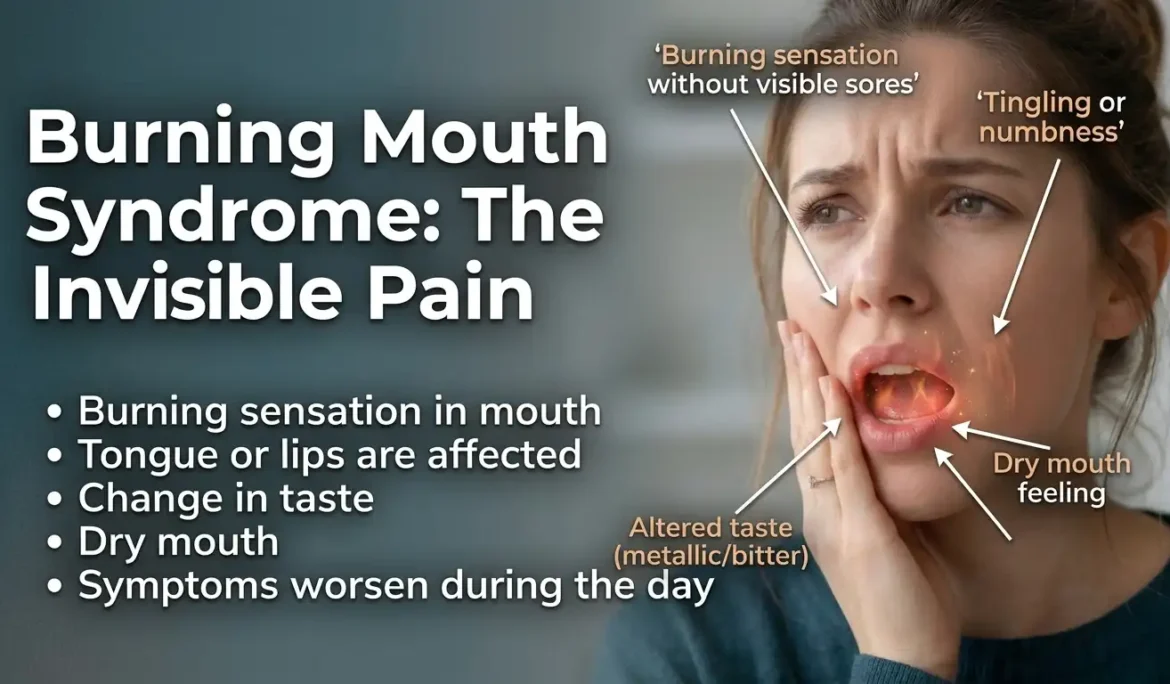
- Burning sensation on the tongue, but no visible sores
- Dry or sticky feeling in the mouth
- Metallic or bitter taste
- Tingling or numbness
- Symptoms worsen by evening
If you identify with four or more, BMS becomes a strong possibility. This checklist helps patients validate their experience before seeking dental evaluation.
Burning Mouth vs Oral Cancer
| Feature | Burning Mouth Syndrome | Oral Cancer |
|---|---|---|
| Appearance | Normal tissues | Visible lesions |
| Pain | Burning, widespread | Localized, persistent |
| Bleeding | No | Often present |
| Tissue damage | None | Progressive |
Warning Signs That Need an Immediate Dental Visit
- Non-healing ulcers
- Red or white patches
- Bleeding areas
- Thickened or raised lesions
These signs are not typical of BMS and require urgent dental examination. This comparison is critical because fear of cancer is one of the biggest reasons patients feel anxious about burning sensations.
Why Burning Mouth Gets Worse During the Day
This pattern is one of the most overlooked yet important clues. Many patients report minimal discomfort in the morning but intense burning by evening. From a dental perspective, three factors explain this:
- Reduced saliva over time, leading to dryness
- Continuous nerve stimulation increases sensitivity
- Daily stress accumulation amplifies perception
It’s similar to walking all day on sore feet—the longer the exposure, the more intense the discomfort becomes. Recognizing this pattern allows you to intervene earlier in the day rather than waiting until symptoms peak.
Anxiety & Burning Mouth
Dentists frequently notice a connection between stress, anxiety, and oral burning symptoms. However, this must be explained carefully: anxiety does not mean the pain is imaginary.
Instead, anxiety acts like a volume amplifier for nerve signals. It increases sensitivity, reduces saliva, and heightens awareness of discomfort. Many patients with BMS also report clenching, dry mouth, or sleep disturbances—all of which worsen symptoms.
The key takeaway is simple:
Your symptoms are real. Anxiety just makes them louder, not fake.
Best Treatments
Effective treatment depends on identifying the root cause. In dental practice, the most successful approaches include:
- Correcting vitamin deficiencies
- Managing dry mouth with saliva substitutes
- Treating oral infections
- Adjusting dentures or dental appliances
- Using prescribed medications for nerve pain
What doesn’t work is blindly trying random remedies without diagnosis. That often leads to frustration and delayed recovery.
Home Remedies That Actually Help
For immediate relief, patients can try:
- Sipping cold water regularly
- Chewing sugar-free gum
- Avoiding spicy and acidic foods
- Staying well hydrated
These methods don’t cure BMS, but they reduce irritation and improve comfort, especially during flare-ups.
How Long Does Burning Mouth Syndrome Last?
BMS can last from a few months to several years. Some cases resolve on their own, especially when linked to a reversible cause like deficiency or dental irritation.
The focus should shift from “quick cure” to long-term management and symptom control. With the right dental guidance, most patients see meaningful improvement.
Which Dentist or Specialist Should You See?
Book Your Consultation at
NextGen Dental and Cosmetic Clinic
Chetna Hospital, Chinchwad
Location: 1st Floor, Chetna Hospital, Near Chaphekar Chowk, Chinchwad, Pune 411033.
Primary Service Areas: 5 km (Chinchwad, Nigdi, Akurdi) | 15 km (Wakad, Hinjewadi, Ravet, Sangvi).
Contact: 📞 9168692087 / 9158681123
Start with a general dentist, who can evaluate oral health and rule out visible causes. If needed, referrals may include:
- Oral medicine specialist
- ENT specialist
- Neurologist
For expert care, you can consult:
A structured, multidisciplinary approach often delivers the best results.
Why Patients Feel Dismissed
Many BMS patients feel ignored because there are no visible signs. Dentists rely heavily on visual diagnosis, so invisible conditions can be challenging.
Additionally, BMS is relatively less common, and treatment often involves trial and error. This doesn’t mean your symptoms are unimportant—it simply means the condition requires a more nuanced and patient-centered approach.
Daily Dental Routine Plan for Relief
A consistent routine can significantly reduce symptoms:
- Morning: Hydration + gentle brushing + avoid strong toothpaste
- Afternoon: Avoid trigger foods + maintain hydration
- Night: Relaxation + avoid late irritants
Small habits, when repeated daily, create noticeable improvement over time.
Trigger Tracker Template
Track daily:
- Food intake
- Stress levels
- Sleep quality
- Symptom intensity
This helps identify patterns and gives both you and your dentist clearer direction.
When It Might NOT Be BMS
It may not be BMS if you notice:
- Visible ulcers
- One-sided persistent pain
- Bleeding lesions
- Sudden severe symptoms
These require immediate dental evaluation.
Get Relief Today at NextGen Dental & Cosmetic Clinic
- Expertise: Led by specialized dental surgeons at Chetna Hospital.
- Location: Room No. 4, 1st Floor, Chetna Hospital, Chinchwad, Pune 411033.
- Serving: Chinchwad, Nigdi, Akurdi (5km) | Wakad, Ravet, Hinjewadi (15km).
- Contact: 📞 9168692087 / 9158681123
Conclusion
Burning Mouth Syndrome is one of those conditions that sits between dentistry and neurology, making it easy to misunderstand and difficult to diagnose quickly. But once you recognize the pattern—normal-looking mouth with real discomfort—the confusion starts to fade. The focus should not be on chasing random cures but on identifying triggers, managing symptoms, and working closely with a dentist who understands the condition. With the right approach, what once felt overwhelming becomes manageable—and in many cases, significantly improved.
Frequently Asked Questions about Burning Mouth Syndrome in Pune
Burning Mouth Syndrome is a condition where you feel a burning or scalding sensation in your mouth—especially on the tongue—without visible sores or irritation. Dentists usually diagnose it after ruling out infections, deficiencies, or other oral conditions.
NextGen Dental at Chetna Hospital, Chinchwad, specializes in treating oral burning sensations using a multi-disciplinary approach.
Yes, our dental team evaluates prosthetic fits, fungal infections, and dry mouth—all common triggers for BMS.
Symptoms often worsen due to nerve fatigue, reduced saliva, and stress buildup throughout the day, making the mouth more sensitive by evening.
Sipping cold water, chewing sugar-free gum, staying hydrated, and avoiding spicy or acidic foods can provide temporary relief, though they don’t cure the condition.