Twisted your ankle and not sure if it is a sprain or broken? An X-ray is needed only when certain signs are present. Doctors usually advise one if the bony tip of either ankle bone hurts when pressed, if a mid-foot bone is tender, or if you could not take four steps after the injury. Otherwise it is usually a sprain.
Spine & Orthopaedics, Chetna Hospital, Chinchwad and Wakad, PCMC
Call 91586 80739 (Chinchwad)
Call 91687 46986 (Wakad)
Get Directions
WhatsApp
First Floor, Plot GP 116, Sambhaji Nagar Road, near HP Pump, near Rotary Club, G Block, MIDC, Chinchwad, Pune 411019
Key takeaways
- Most twisted ankles are sprains, not fractures.
- Pain on the bony tip of the ankle is a reason for an X-ray.
- A sprain needs rest at first, then exercises, or it can keep giving way.
- A crack sound, a bent-looking ankle or a numb foot needs same-day care.
In this article
- Why ankles twist at home
- Sprain or broken: do I need an X-ray?
- What the doctor checks, step by step
- When an X-ray is not needed
- The slides
- When to go the same day
- Where to get an ankle checked
- Questions patients ask
After a fresh ankle twist, most people ask the same thing: is it broken? In most cases, a careful examination answers that before any scan.
Why do ankles twist so often at home?
Reaching a high shelf usually means standing on a stool or a chair. Then you step down without looking, the foot lands on its outer edge, and the ankle turns inward. Stairs, uneven roads and sport cause the same twist.
In most cases the injury is a sprain. This means a ligament, the strong band that holds the ankle bones together, has stretched or torn.
Ankle sprain or broken: do I need an X-ray?
Not always. Doctors often use a simple, well-tested checklist called the Ottawa ankle rules. A BMJ editorial describes them as a safe way to decide who needs an ankle X-ray and who does not.
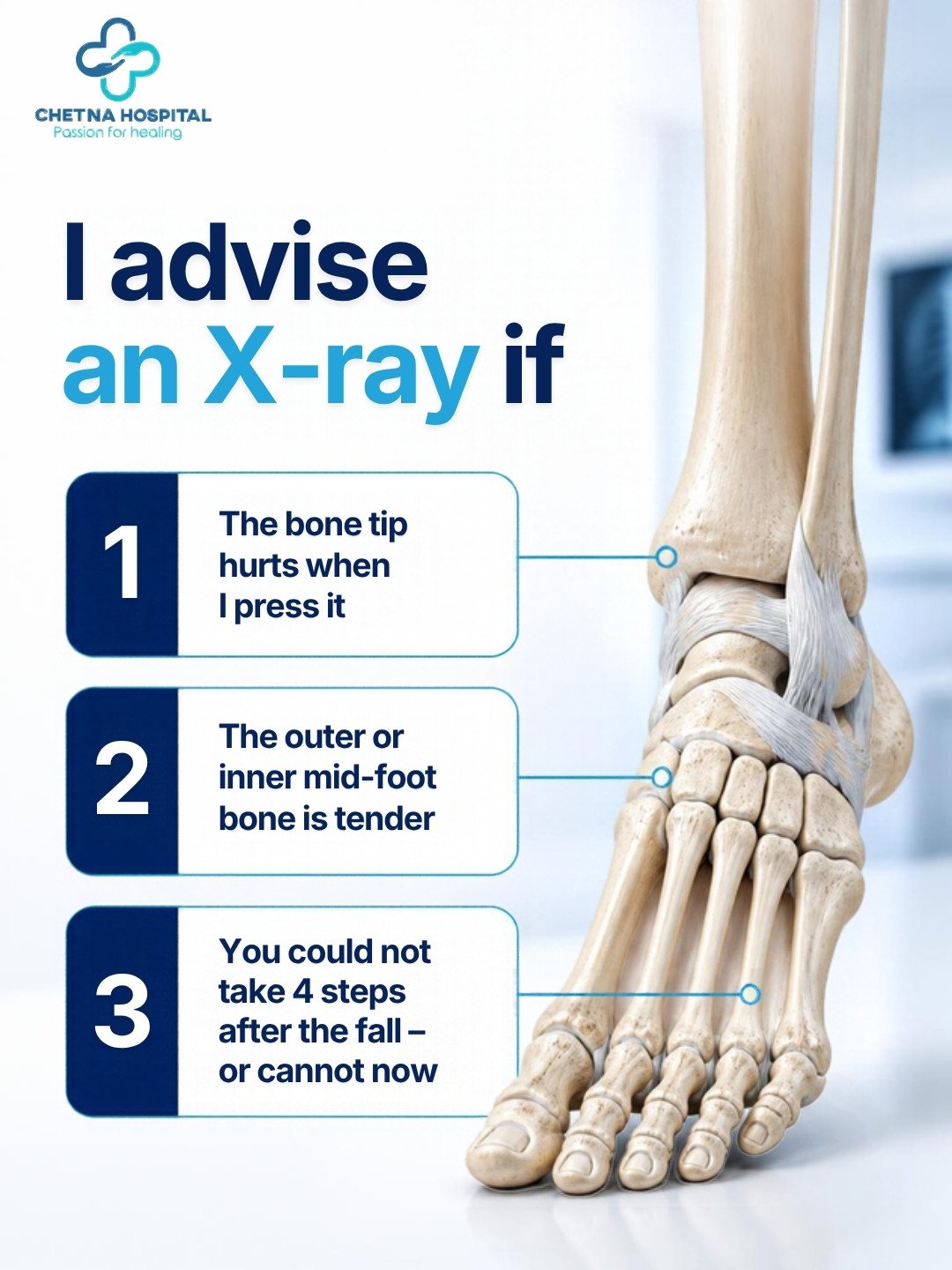
Under these rules, an X-ray is advised if any of these is true:
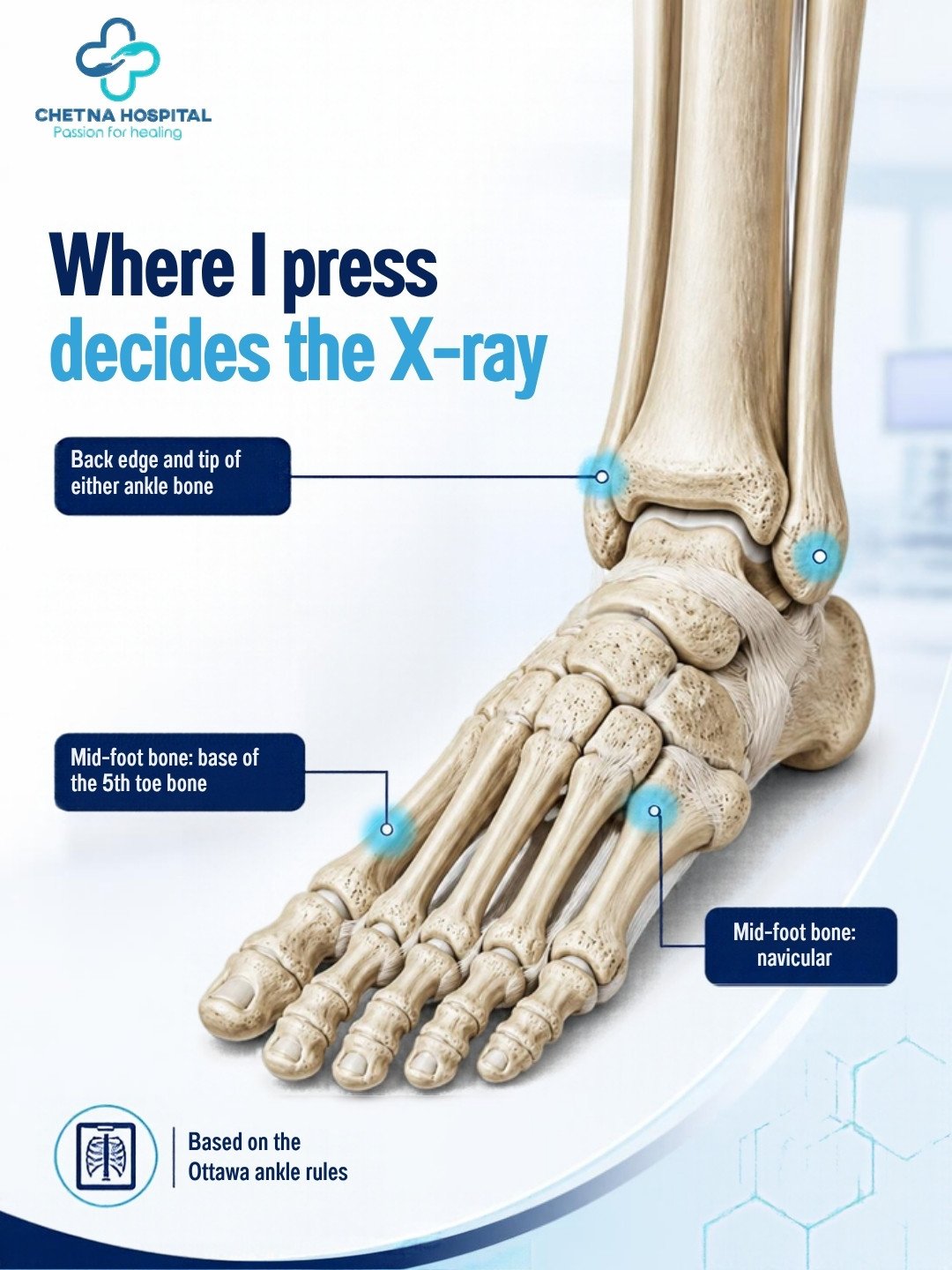
- The back edge or tip of the outer ankle bone hurts when pressed
- The back edge or tip of the inner ankle bone hurts when pressed
- The bone on the outer edge of the mid-foot (base of the fifth toe bone) is tender
- The bone on the inner mid-foot (navicular) is tender
- You could not take four steps right after the injury, or cannot take them in the clinic
What does the doctor check before an ankle X-ray?
First, the doctor asks how the foot turned and whether you heard a crack. Then they look for swelling, bruising and the shape of the ankle.
Next, they press on the bones in a fixed order, while the soft parts are checked separately. After that, you are asked to walk a few steps. Finally, the doctor checks the pulse and feeling in the foot.
If the checklist says yes, the X-ray shows whether a bone has cracked. However, an X-ray does not show ligaments. So if the ankle still feels unstable after some weeks, an MRI may help, as OrthoInfo from the AAOS also notes.
When is an ankle X-ray not needed?
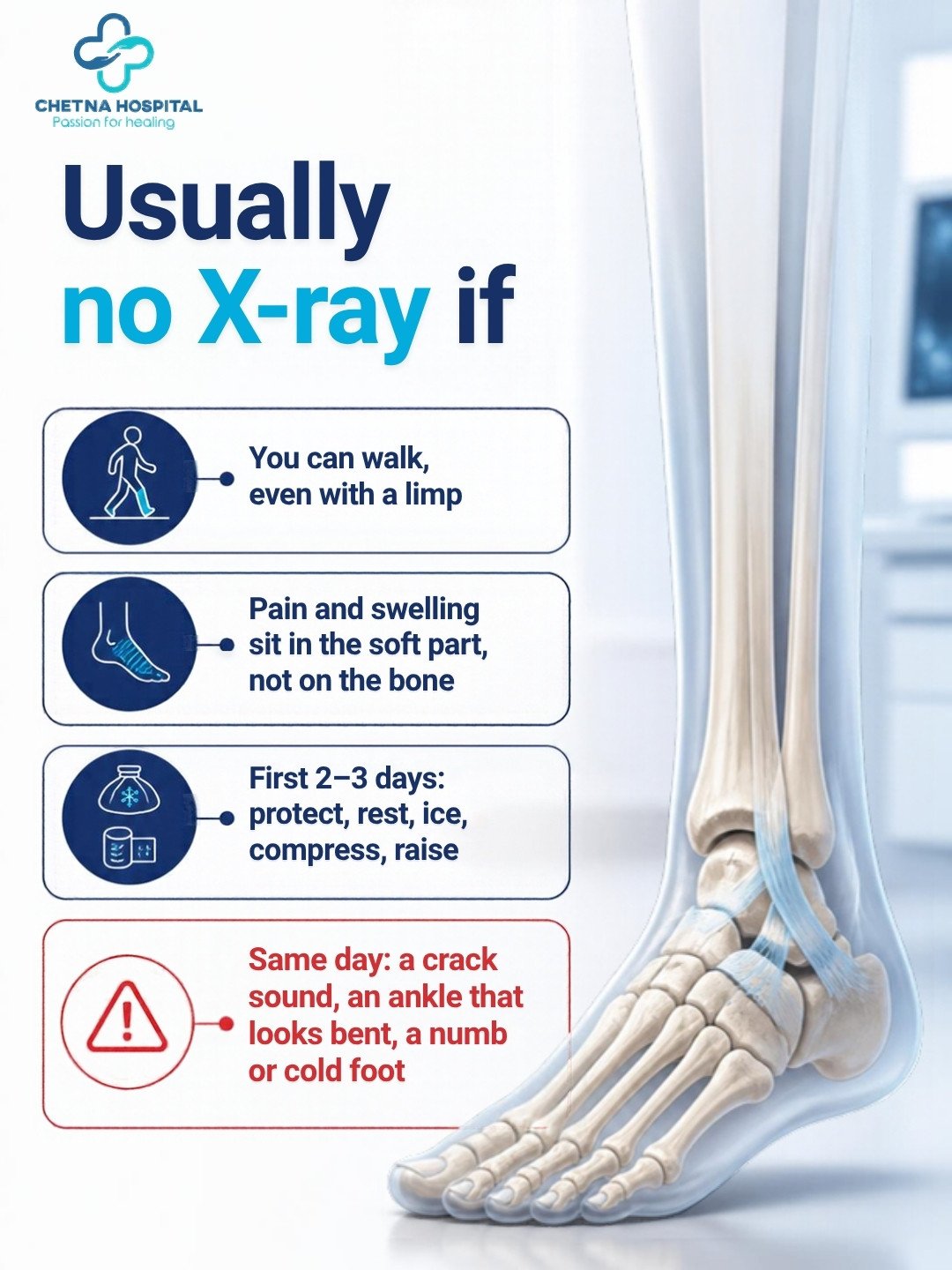
If you can walk, even with a limp, and the pain sits in the soft part in front of or below the ankle bone, an X-ray usually adds little. Instead, it is treated as a sprain.
For the first two to three days, the NHS advises protection, rest, ice wrapped in a cloth, a compression bandage and keeping the foot raised. Also, avoid heat and massage in the first couple of days, because they can increase swelling.
Then gentle movement starts as pain allows. After that comes the part most people skip: balance and strengthening exercises. Our orthopaedic rehabilitation and physiotherapy team guides this.
How long does an ankle sprain take to heal?
A normal X-ray rules out a fracture, not a torn ligament. The NHS says most sprains start to feel better within about two weeks. Severe sprains can take months, and a sprain that is not rehabilitated can keep rolling. See a doctor if it is not improving after two weeks.
If an older parent twisted a wrist instead, read our page on wrist fracture after 50.
Slides to save and share
Save these slides for the next time someone at home twists an ankle.
When should you go the same day?
Go to the emergency department the same day if a twisted ankle comes with:
- A crack or snap heard at the time of injury
- An ankle or foot that looks bent or out of shape
- Numbness, tingling, or a foot that is cold, blue or grey
- Severe pain, or being unable to put any weight on it
Where can you get a twisted ankle checked in Chinchwad and Wakad?
Chinchwad: Spine & Orthopaedics, First Floor, Plot GP 116, Sambhaji Nagar Road, near HP Pump, near Rotary Club, G Block, MIDC, Chinchwad, Pune 411019. Call 91586 80739.
Wakad: Unit 401–402, 4th Floor, MI Commercia Building, Wakad, Pune 411057. Call 91687 46986.
Patients come from Chinchwad, Pimpri, Akurdi, Nigdi, Ravet, Wakad, Hinjewadi, Pimple Saudagar, Thergaon, Tathawade, Punawale, Moshi and Bhosari. The same team also treats back and spine problems; read our guide on back pain in your 20s.
Ankle sprain or broken: questions patients ask
Do I need an ankle X-ray if I can walk?
Often not. If you can take four steps and the bony tips of the ankle are not tender, it is usually a sprain. However, a doctor should still examine it if pain or swelling is getting worse.
Can a sprain hurt more than a fracture?
Yes. A bad sprain can be very painful and swollen, so pain alone does not tell the two apart. Pressing on the bone and checking whether you can walk helps decide.
Should I massage a twisted ankle?
No, not in the first couple of days. Heat and massage can increase swelling. Instead, use rest, ice wrapped in a cloth, a compression bandage and keep the foot raised.
Where can I get a twisted ankle checked in Chinchwad?
The Spine & Orthopaedics team sees patients at First Floor, Plot GP 116, Sambhaji Nagar Road, Chinchwad, Pune 411019 (call 91586 80739) and at Unit 401–402, MI Commercia Building, Wakad, Pune 411057 (call 91687 46986).
Still swollen after two weeks? Have your ankle examined.
Call 91586 80739 (Chinchwad)
Call 91687 46986 (Wakad)
WhatsApp
Sources
- NHS. Sprains and strains.
- American Academy of Orthopaedic Surgeons, OrthoInfo. Sprained ankle.
- Heyworth J. Ottawa ankle rules for the injured ankle. BMJ 2003;326:405–406.
This article is general information, not a substitute for a consultation.