









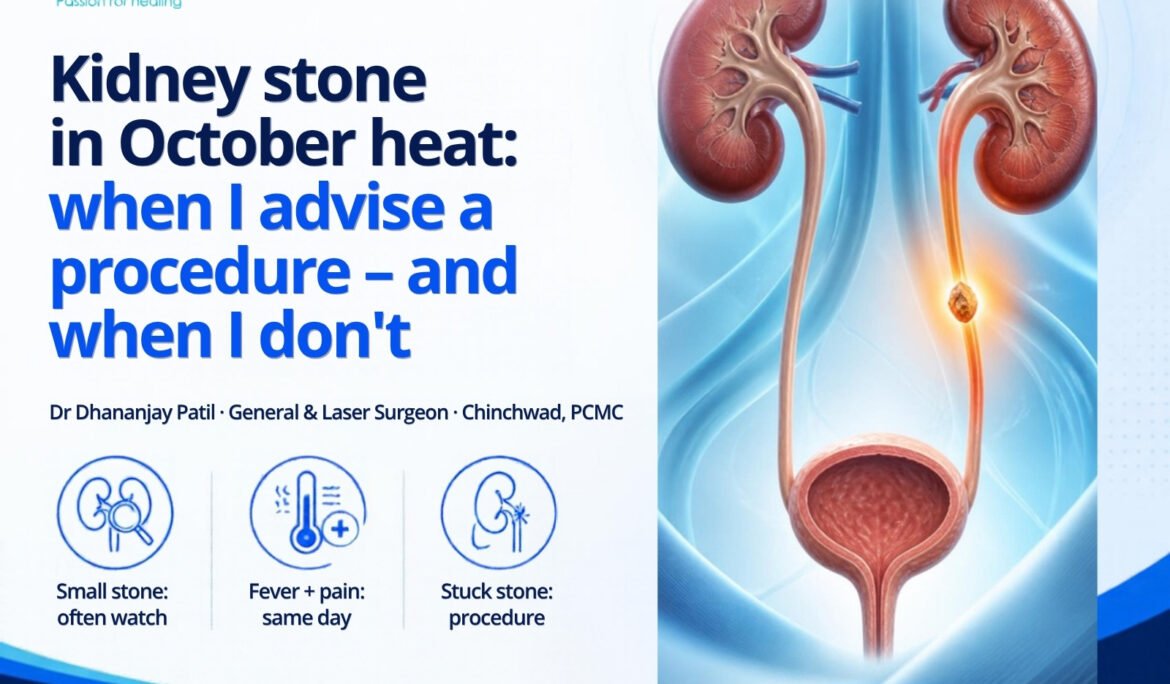
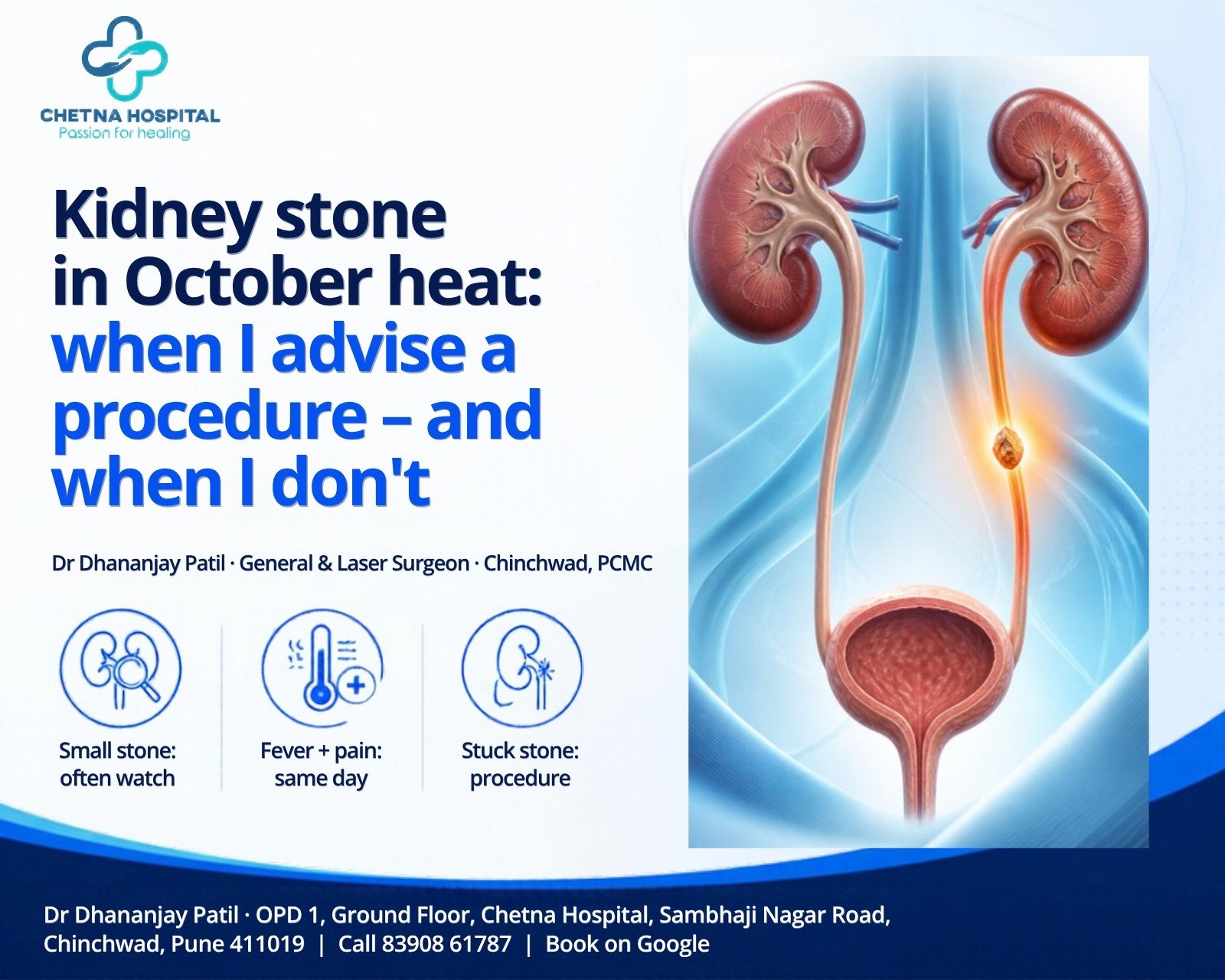
Not every kidney stone needs an operation. Dr Dhananjay Patil, general and laser surgeon in Chinchwad, PCMC, usually waits and watches a small stone when the pain is controlled, urine is passing and there is no fever. See a doctor the same day for fever or shivering with stone pain, vomiting, very little urine, or pain that medicines do not control.
Dr Dhananjay Patil – Kidney Stone, Piles & Hernia Surgeon in Chinchwad, PCMC
OPD 1, Ground Floor, Chetna Hospital, Sambhaji Nagar Road, next to Pimpri Chinchwad Sahakari Bank, Sambhajinagar, Chinchwad, Pune 411019
The first thing most people ask me, still holding their side, is not “what is it?” but “will I need an operation?” In the October heat, I hear that question in my Chinchwad OPD far more often than in the monsoon. My honest answer is: often no, sometimes yes, and the difference usually becomes clear within the first visit.
This guide by Dr Dhananjay Patil, Consultant General Surgeon at Chetna Hospital, explains how that decision is made: which stones I am happy to wait for, which ones I don’t wait on, and the warning signs that mean you should come to hospital the same day.
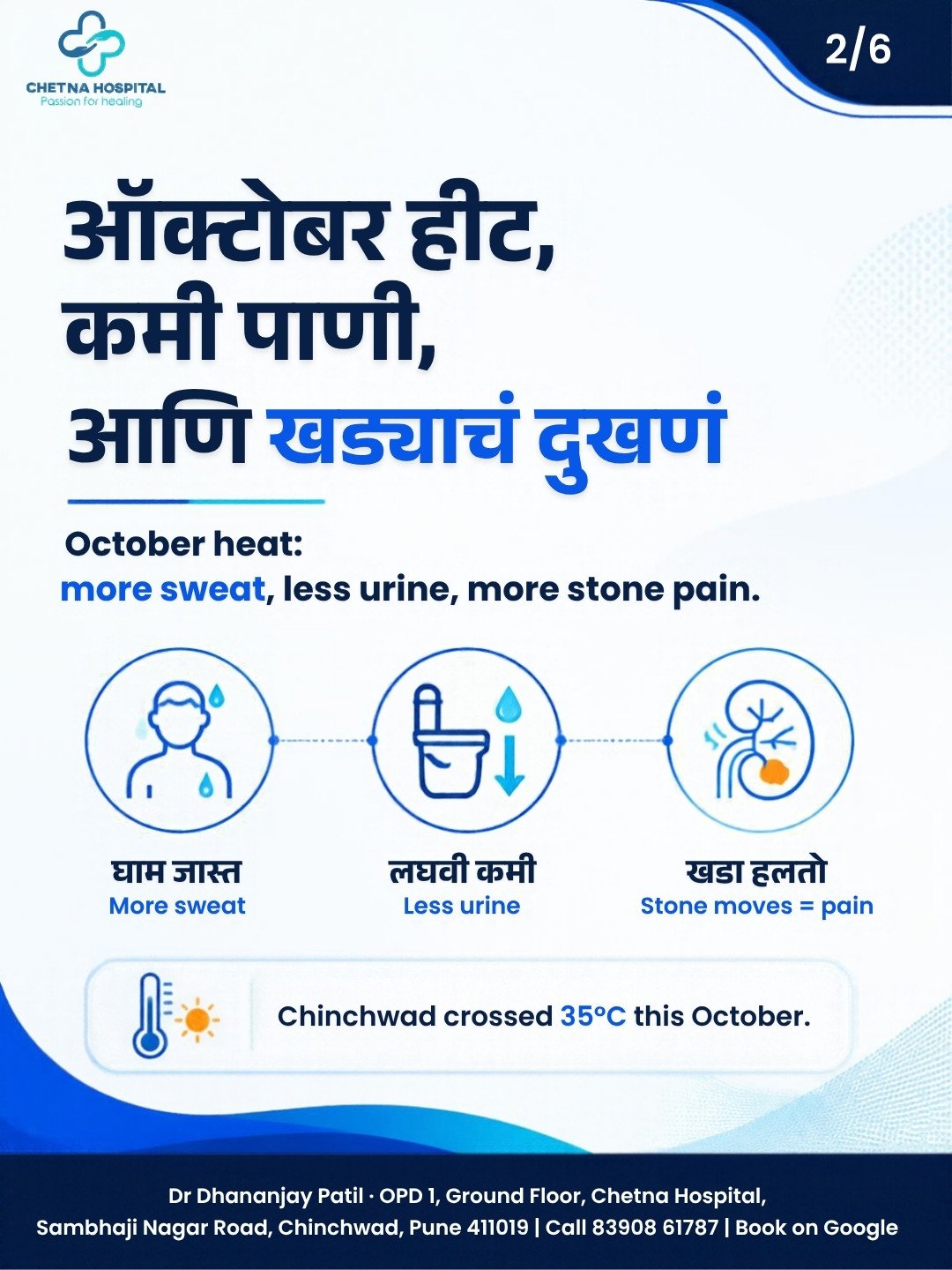
Why this is in the news now: Pune is going through an unusually hot October. Shivajinagar recorded 35.7°C, its highest October temperature since 2002, Chinchwad crossed 35°C, and the IMD expected 36–37°C in the days that followed. More sweat and less water mean more concentrated urine, which is when stones form and start to move.
Why does stone pain go up in hot weather?
When you sweat a lot and do not drink enough to replace it, you pass less urine and it becomes darker and more concentrated. Minerals in concentrated urine crystallise more easily. A stone that has been sitting quietly in the kidney can also slip into the ureter, the narrow tube that carries urine down to the bladder. That is when the pain starts.
The NHS describes the pain as severe, usually starting in the side or lower back and moving towards the groin, and often coming and going in waves. Some people also feel sick, need to pass urine often, or notice blood in the urine.
The stones I usually watch
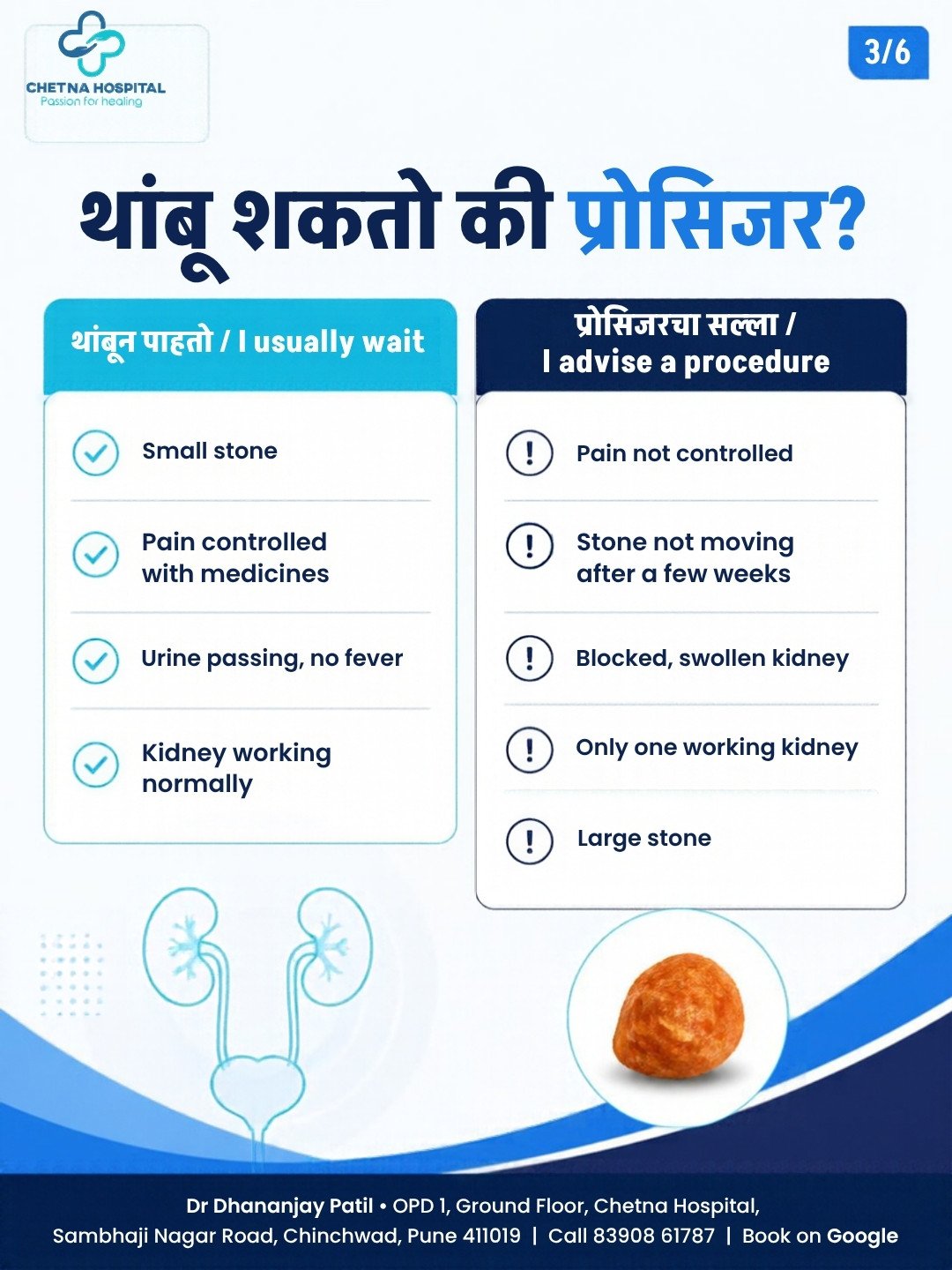
Many small stones pass on their own. The US National Institute of Diabetes and Digestive and Kidney Diseases (NIDDK) notes that small kidney stones may pass through the urinary tract without treatment, and the NHS says a stone treated at home can take a few weeks to pass. I am comfortable waiting when:
- The stone is small on the scan.
- The pain settles with the medicines I prescribe.
- Urine is passing and there is no fever.
- Kidney function tests are normal and the kidney is not badly swollen.
Waiting is not doing nothing. It means the right medicines, enough fluids, a clear plan for pain at night, and a repeat scan to confirm the stone has actually gone.
[Dr Dhananjay: confirm the stone size you usually treat with medicines alone, and how long you are willing to wait before advising a procedure.]
The stones I don’t wait on
I advise a procedure when waiting is likely to cost more than it saves. In my practice that usually means:
- Pain that keeps coming back and is not controlled with tablets.
- A stone that has not moved after a few weeks of trying.
- A blocked, swollen kidney on the scan.
- A patient with only one working kidney, or with falling kidney function.
- A larger stone that is unlikely to pass by itself.
Red flags: come to hospital the same day
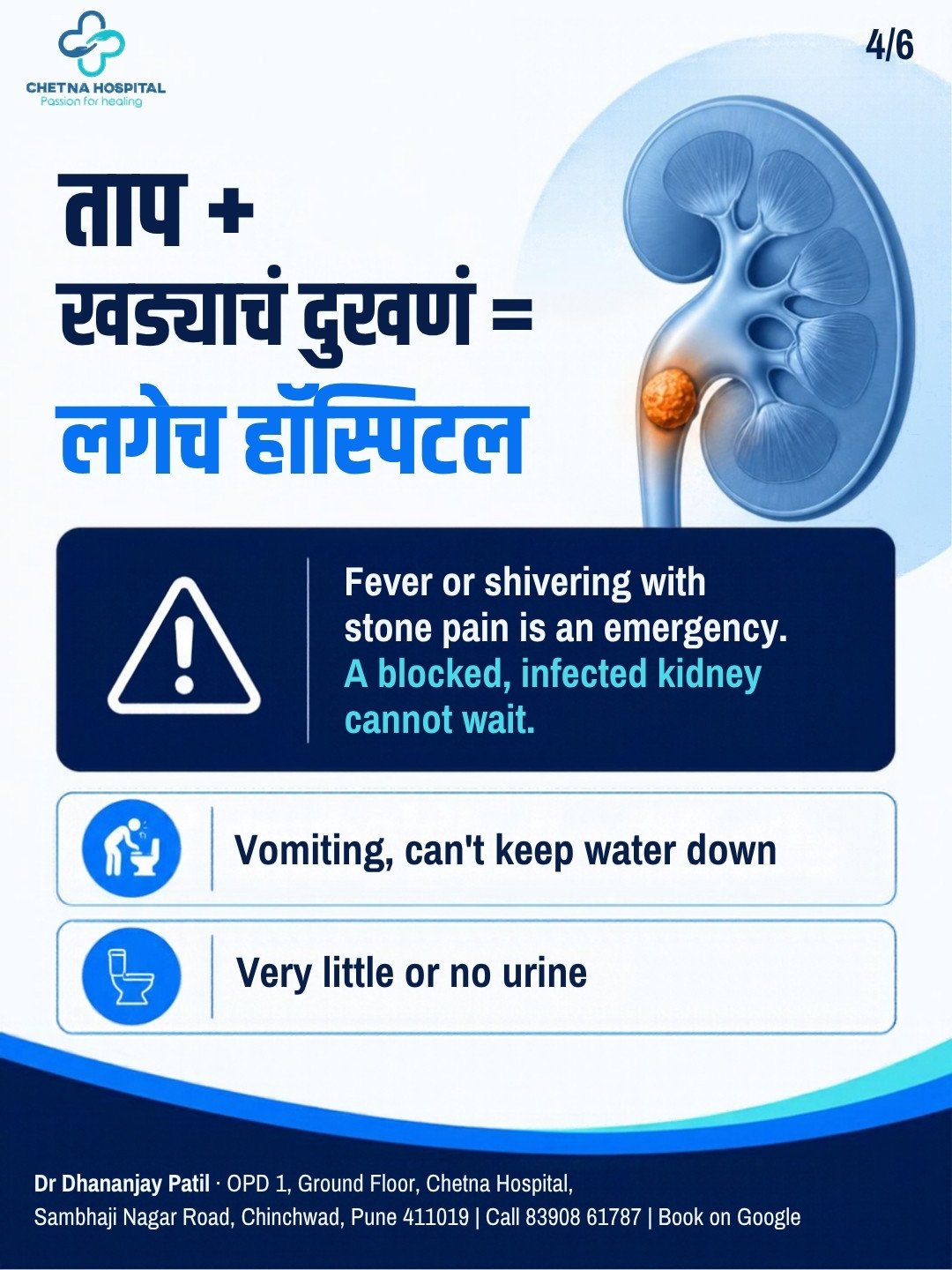
Fever or shivering with stone pain can mean the kidney is both blocked and infected. That combination needs urgent drainage and antibiotics, not a wait-and-see plan. Please come to hospital the same day, or go to emergency, if you have:
- Fever, chills or shivering along with stone pain.
- Vomiting and you cannot keep water down.
- Very little or no urine.
- Pain that does not ease even after the prescribed painkiller.
What the procedure options look like
When a stone does need treatment, the choice depends on its size, its position and your general health. The NHS and NIDDK describe three main approaches: shock wave lithotripsy, which breaks the stone from outside the body; ureteroscopy, where a thin scope is passed up through the urinary passage to remove or laser the stone; and percutaneous nephrolithotomy (PCNL), where larger stones are removed through a small cut in the back.
[Dr Dhananjay: confirm which of these you perform at Chetna Hospital (for example RIRS / ureteroscopy with laser, PCNL, DJ stent), and the usual hospital stay, before publishing.]
Which option suits you is a decision we make together in the clinic, after the scan. You can read more about our general surgery services and laparoscopic surgery at Chetna Hospital.
A pattern I see every October
The story is often similar. A man in his thirties who works on a shop floor or rides a two-wheeler across PCMC all day, drinking water only when he remembers. He had “a little side pain” a year ago that went away. Now, after a week of hot afternoons, it comes back at night, stronger. The scan shows a small stone that has slipped into the ureter. Many of these patients do well with medicines, fluids and a follow-up scan. The ones who worry me are those who wait at home with fever, or who stop coming once the pain eases and never confirm the stone has passed.
[Dr Dhananjay: confirm this pattern matches what you see, and add one line from your own OPD experience.]
While you wait: what actually helps
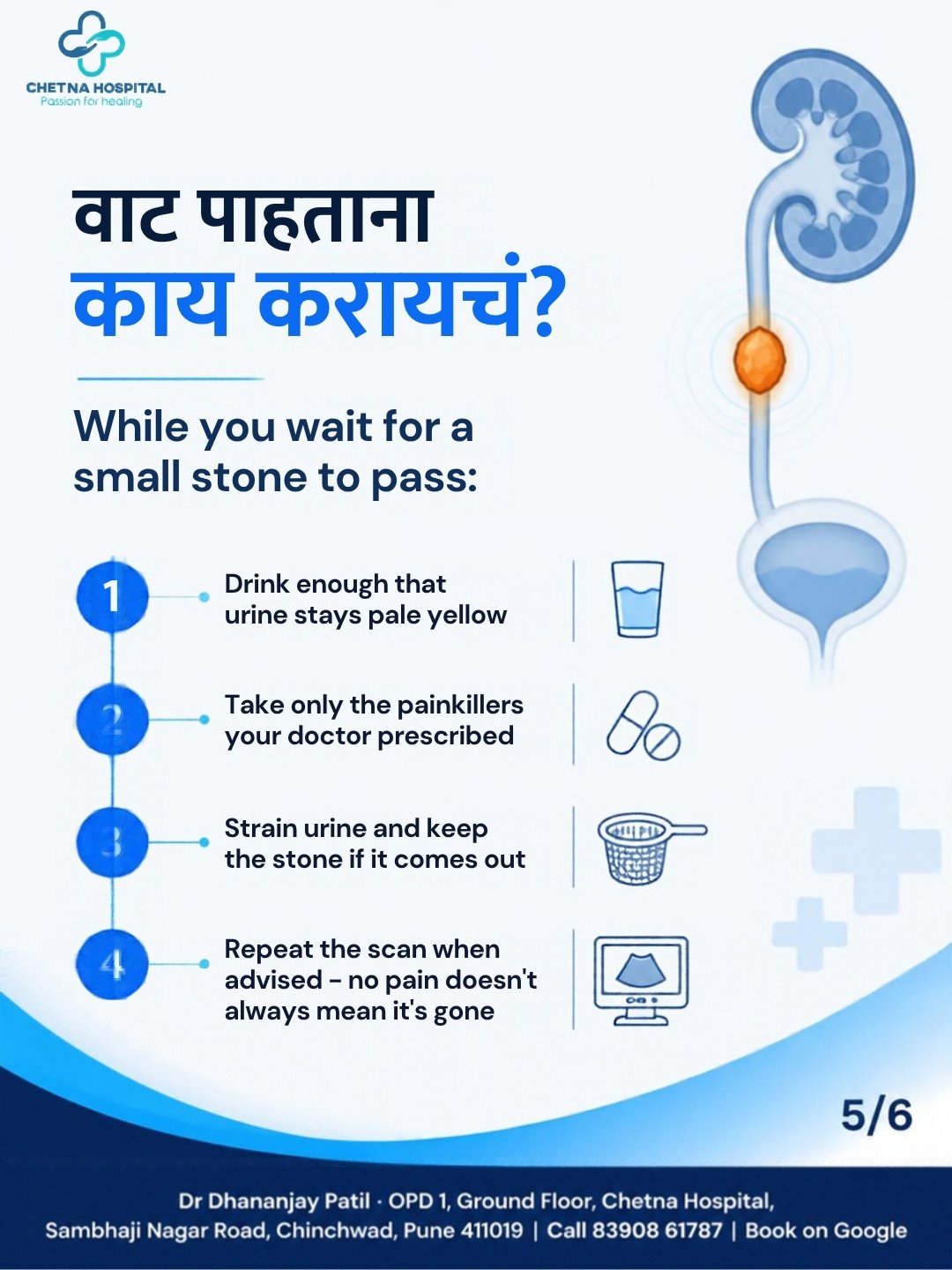
- Drink enough that your urine stays pale yellow. The NHS advises adults to drink 2.5 to 3 litres a day to prevent stones. If you have heart or kidney disease or a fluid limit, follow your own doctor’s advice instead.
- Use only the painkillers your doctor prescribed, and keep a dose ready for the night.
- Strain your urine through a tea strainer and keep the stone if it comes out. Testing it helps prevent the next one.
- Go back for the repeat scan. No pain does not always mean the stone has gone.
- Cut down on salt and fizzy drinks, and add fresh lemon to your water if you like it.
If your pain is higher up in the abdomen or not typical of a stone, read our guide on when abdominal pain needs a surgical evaluation. For people already on dialysis, fluid advice is different; see our page on dialysis in Pune.
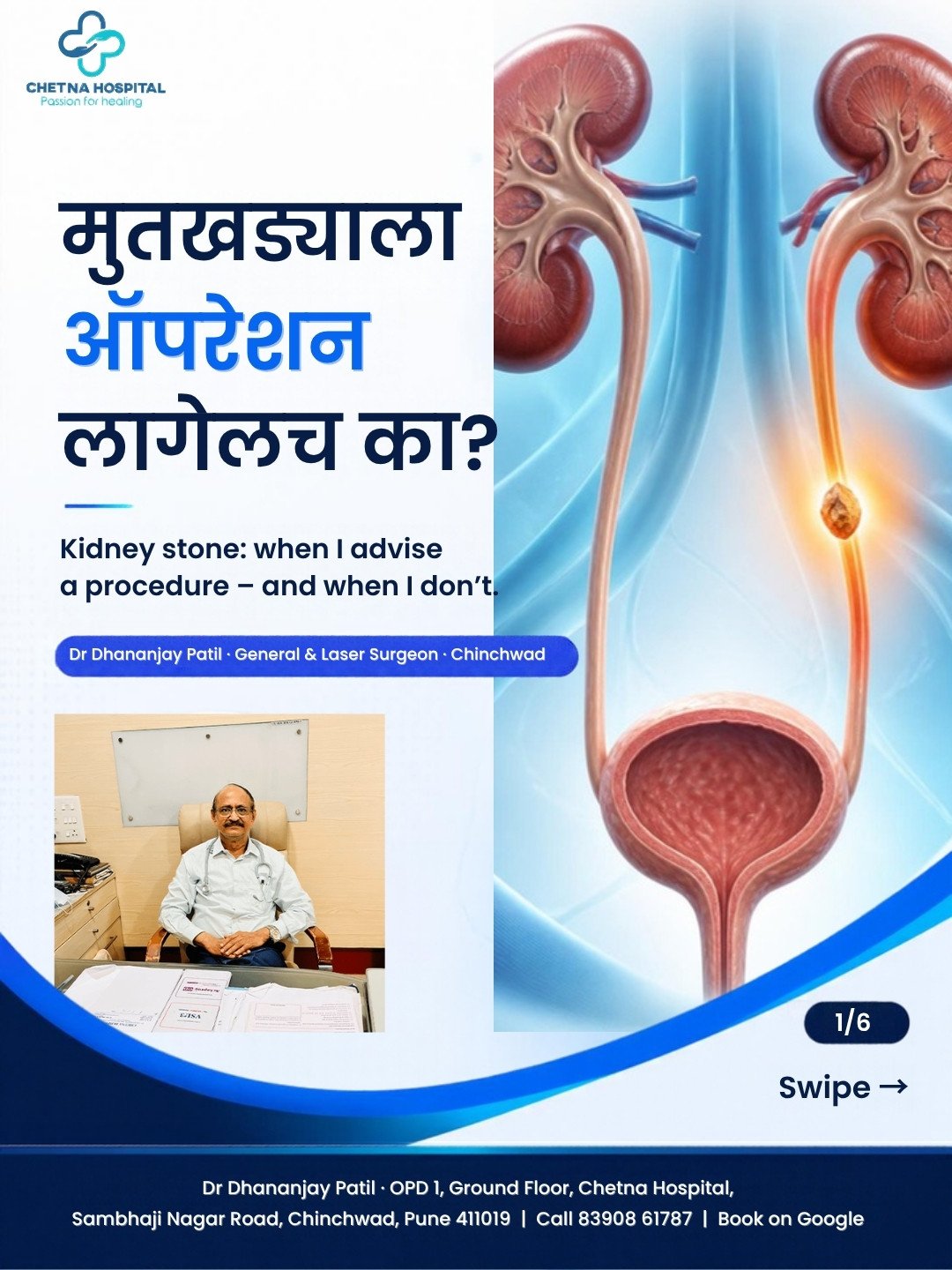
Swipe-through: the decision in six slides
These slides are from our Instagram post. Save them for the hot weeks.
What patients say
Excerpts from Google reviews on Dr Dhananjay Patil’s profile:
⭐⭐⭐⭐⭐
“I consulted Dr. Dhananjay Patil when I was hav[ing] on and off abdominal pain, burning while urinat[ing], blood in urine… Dr. Patil listened [to] my concerns carefully and explained the treatme[nt] and necessary care clearly.”
– Kundan, Google review, September 2026
⭐⭐⭐⭐⭐
“He listened carefully to my symptoms, explained the condition clearly, and advised the appropriate treatment and care.”
– Pratibha, Google review, September 2026
Read all reviews on Google → Individual experiences vary.
Consultation near you: kidney stone care in Chinchwad, PCMC
Dr Dhananjay Patil sees patients at OPD 1, Ground Floor, Chetna Hospital, Sambhaji Nagar Road, next to Pimpri Chinchwad Sahakari Bank, Sambhajinagar, Chinchwad, Pune 411019. OPD hours are Monday to Saturday, 10 am to 1 pm and 5 pm to 9 pm, and Sunday 10 am to 1 pm. Patients come from Chinchwad, Pimpri, Akurdi, Nigdi, Ravet, Wakad, Hinjewadi, Pimple Saudagar, Thergaon, Tathawade, Punawale, Moshi and Bhosari. He also treats hernia; read his guide to hernia symptoms, causes and surgery.
Frequently asked questions
Does every kidney stone need an operation?
No. Many small kidney stones pass on their own with enough fluids and the right medicines, usually over a few weeks. A procedure is advised when pain is not controlled, the stone does not move, the kidney is blocked or infected, there is only one working kidney, or the stone is too large to pass.
Why do kidney stones hurt more in hot weather?
In hot weather you sweat more and pass less, more concentrated urine. Minerals crystallise more easily, and a stone in the kidney can move into the ureter and cause sudden, severe pain in the side or back that spreads towards the groin.
Is fever with kidney stone pain an emergency?
Yes. Fever, chills or shivering with stone pain can mean the kidney is blocked and infected. This needs same-day hospital care for drainage and antibiotics. Vomiting with inability to drink, or very little urine, also needs urgent care.
How long does it take a small kidney stone to pass?
A small stone can take a few weeks to pass. A repeat scan confirms whether it has gone, because the pain can stop while the stone is still in the ureter.
Where can I get kidney stone treatment in Chinchwad, PCMC?
Dr Dhananjay Patil, Consultant General Surgeon (MBBS, MS General Surgery), sees patients with kidney stones at OPD 1, Ground Floor, Chetna Hospital, Sambhaji Nagar Road, Chinchwad, Pune 411019. Call or WhatsApp 83908 61787 to book a consultation.
Stone pain that keeps coming back? Get the scan and a clear plan.
OPD 1, Ground Floor, Chetna Hospital, Sambhaji Nagar Road, next to Pimpri Chinchwad Sahakari Bank, Chinchwad, Pune 411019
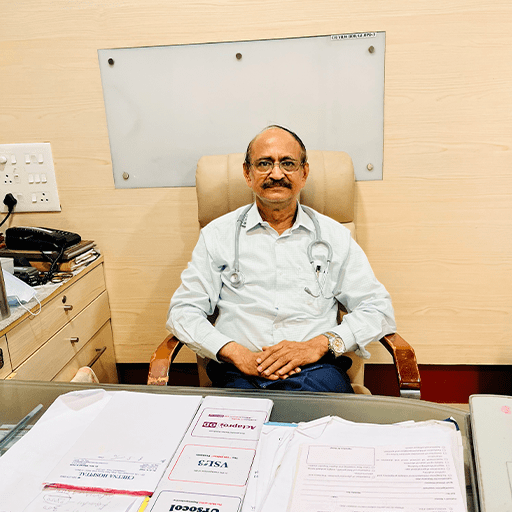
About the author: Dr Dhananjay Patil
Consultant General Surgeon
MBBS, MS (General Surgery)
Kidney stones, piles, fissure, fistula, hernia, gallbladder and general surgery at Chetna Hospital, Chinchwad. View full profile
Medically reviewed by Dr Dhananjay Patil. Last updated 13 October 2026.
Sources
- NHS. Kidney stones.
- National Institute of Diabetes and Digestive and Kidney Diseases (NIDDK). Treatment for kidney stones.
- Punekar News. Pune sizzles at 35.7°C, highest October temperature since 2002 (7 October 2026).
- The Bridge Chronicle. Pune October heat: 36–37°C forecast (8 October 2026).
This article is general health information and does not replace a consultation. Severe pain, fever or very little urine needs prompt medical care.