









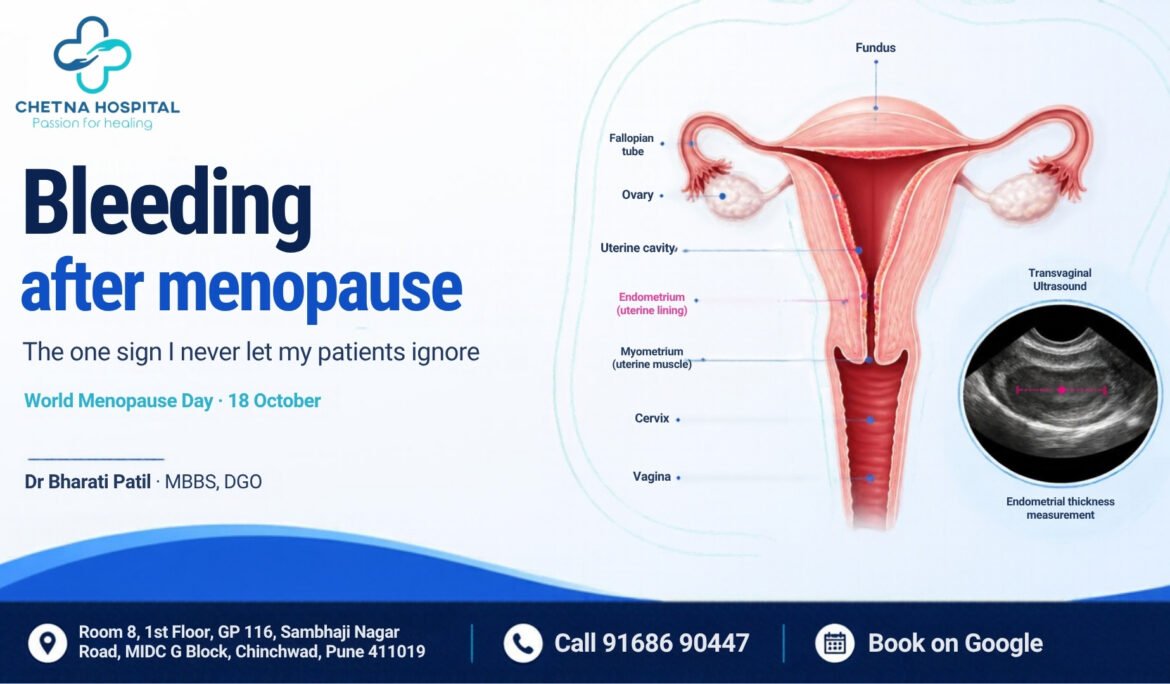
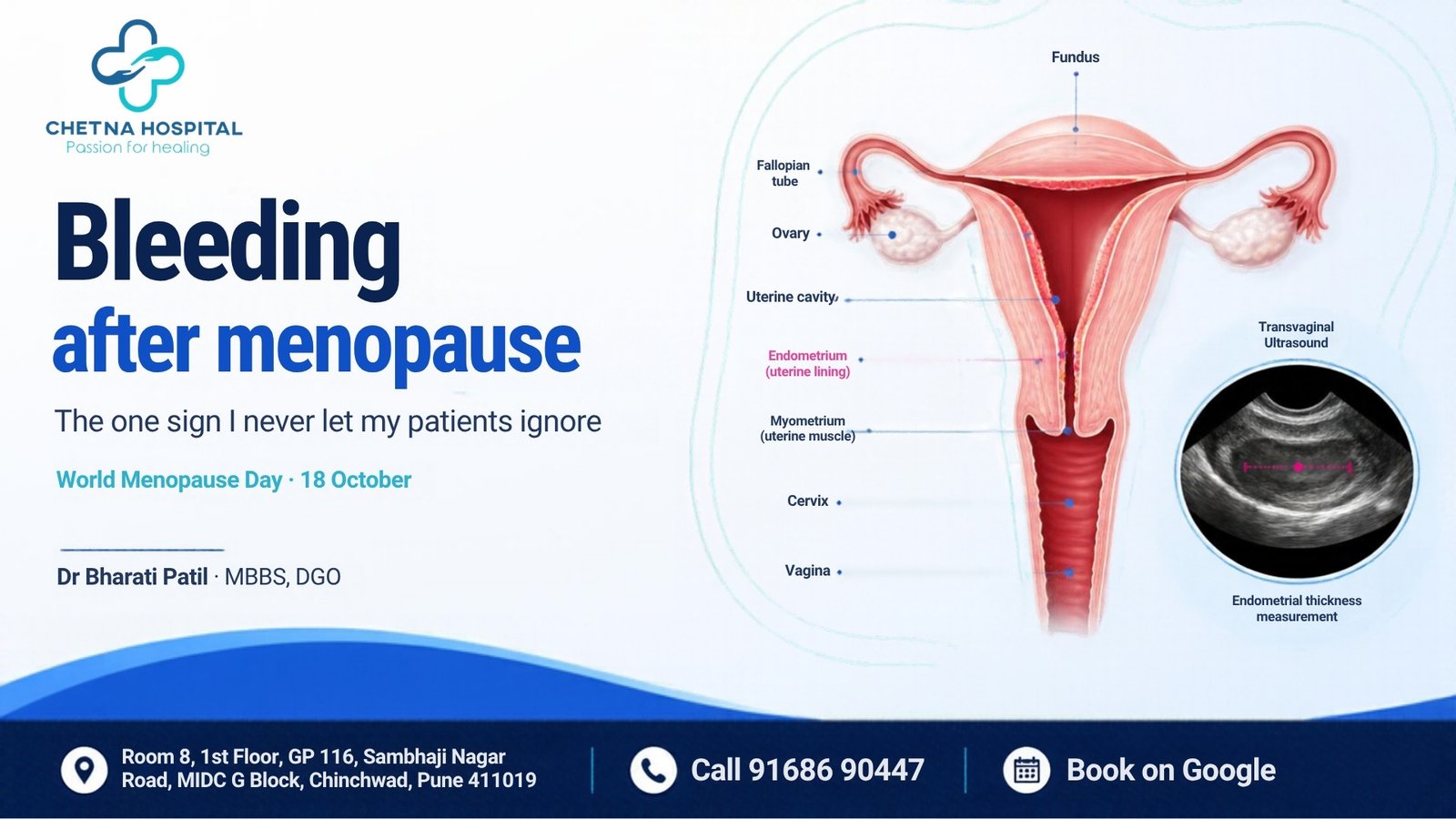
Bleeding after menopause means any bleeding or spotting that happens 12 months or more after your last period, even a single spot or pink-brown discharge. It is never normal and always needs a check by a gynaecologist. Most of the time the cause is simple, such as a thin, dry lining or a polyp, but it can be the first sign of womb (endometrial) cancer, which is why an early pelvic ultrasound matters.
Dr Bharati Patil – Obstetrician & Gynaecologist in Chinchwad, PCMC
“Doctor, one more small thing before I go.” When a woman in her fifties says this at the end of a consultation in my clinic in Chinchwad, I already have a guess. Very often the small thing is a few spots of blood, months or even years after her periods stopped. She has waited because it was light, because it stopped on its own, or because she felt shy to bring it up.
I want to change that habit. In this article I explain what counts as bleeding after menopause, why women delay, what the common causes are, and exactly what happens when you come in for a check. It is written for women in Pimpri-Chinchwad and their daughters, who are often the ones who push their mothers to see a doctor.
Why this is in the news now: 18 October is World Menopause Day, and October is the month many health groups use to talk openly about menopause.
Is it normal to have a little bleeding after menopause?
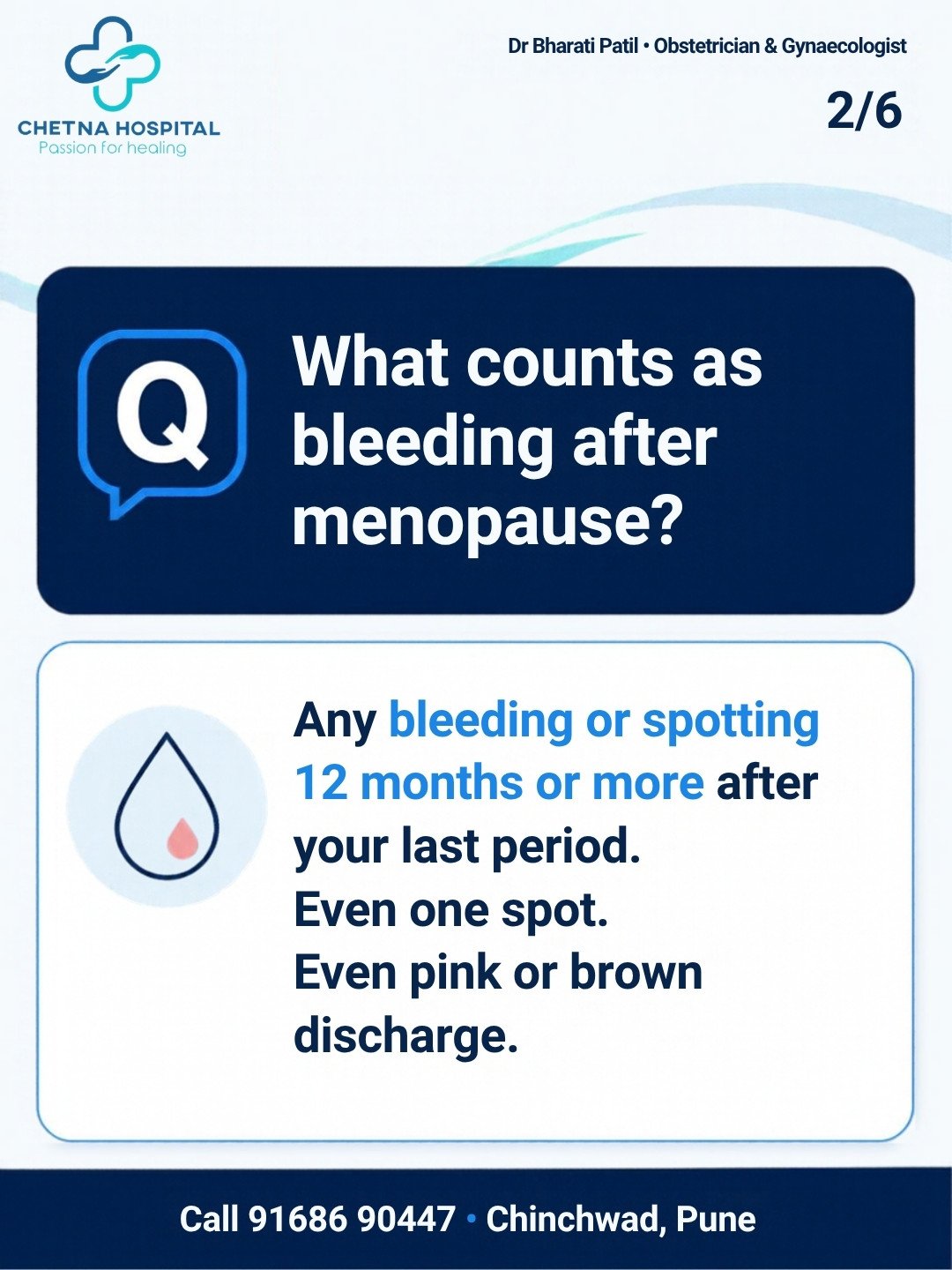
No. Once you have gone 12 full months without a period, you have reached menopause. From then on, any bleeding from the vagina is called postmenopausal bleeding. That includes:
- a few drops or spots on your underwear
- pink, red or brown discharge
- bleeding after intercourse
- bleeding that happens once and never again
The NHS advises that anyone with bleeding after menopause should see a doctor, even if it is only once and even if it is very light. I give my patients the same advice.
What if I am on hormone tablets?
Some women on hormone replacement therapy (HRT) get expected bleeding, depending on the type of HRT. Unexpected bleeding, or bleeding that changes pattern, still needs a review. Bring the name of your tablets with you. [Dr Bharati: confirm how you advise patients on HRT who notice new bleeding]
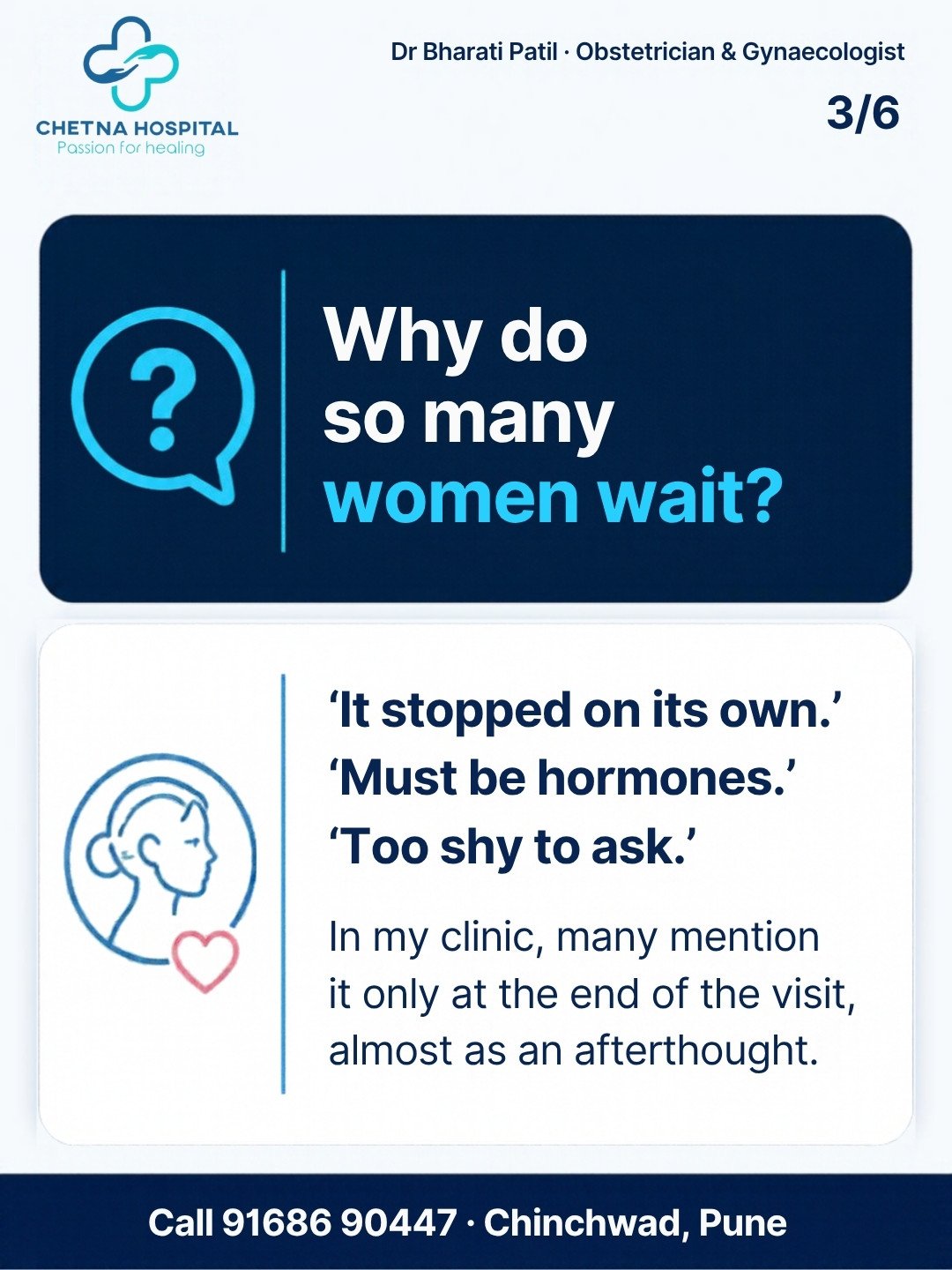
Why do so many women wait?
In my experience the delay is rarely about money or distance. It is about what women tell themselves:
- “It stopped on its own.” A single episode can still come from a cause that needs attention.
- “Must be hormones.” Hormone swings belong to the years before menopause, not after it.
- “I am too shy to talk about it.” Many women, especially when a son or husband brings them, find it hard to say the word bleeding.
A pattern I see in the clinic
A pattern I notice often: a woman comes in for something else entirely, such as a thyroid report, joint pain or a routine check, and the spotting comes up only when I ask a direct question. Usually she has noticed it more than once over a few weeks or months and decided it was not worth a separate visit. [Dr Bharati: confirm or add a typical example from your OPD, without identifying details] I now ask every woman past menopause, “Any spotting or discharge since your periods stopped?” You can save me the question by mentioning it first.
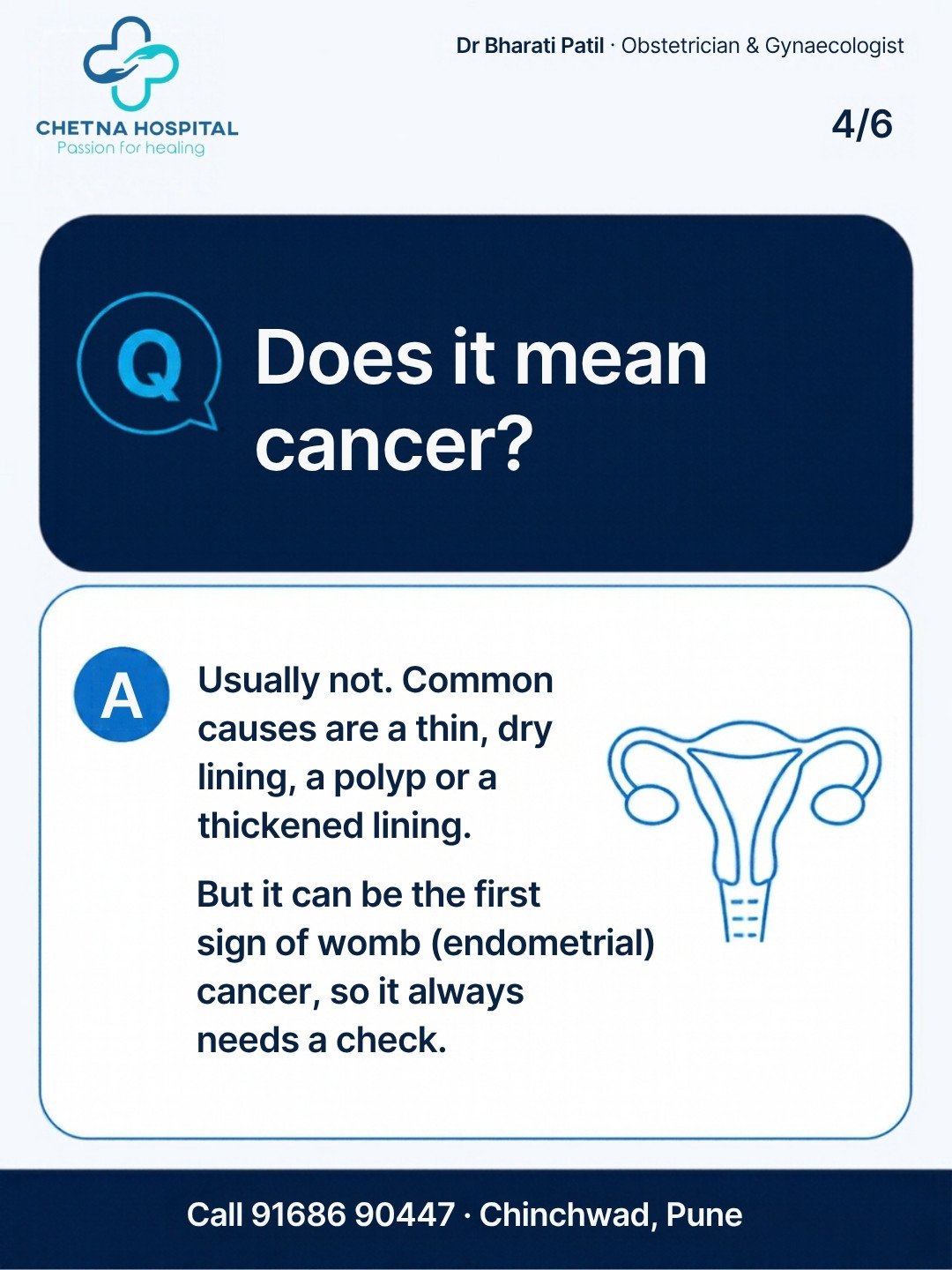
Does bleeding after menopause mean cancer?
Usually not, and I want to say that clearly so fear does not keep anyone at home. The common causes are:
- Thin, dry lining (atrophy): after menopause, oestrogen falls and the lining of the vagina and womb becomes thin and fragile, so it can bleed easily.
- Polyps: small, usually harmless growths in the womb or on the cervix.
- Thickened lining (endometrial hyperplasia): the lining grows thicker than it should. Some types can turn into cancer over time if not treated.
- HRT-related bleeding, as above.
Health services such as the HSE in Ireland point out that bleeding after menopause is the most common early sign of womb cancer. That is exactly why it should be checked early. Found early, womb cancer is often very treatable.
What happens when you come to see me?
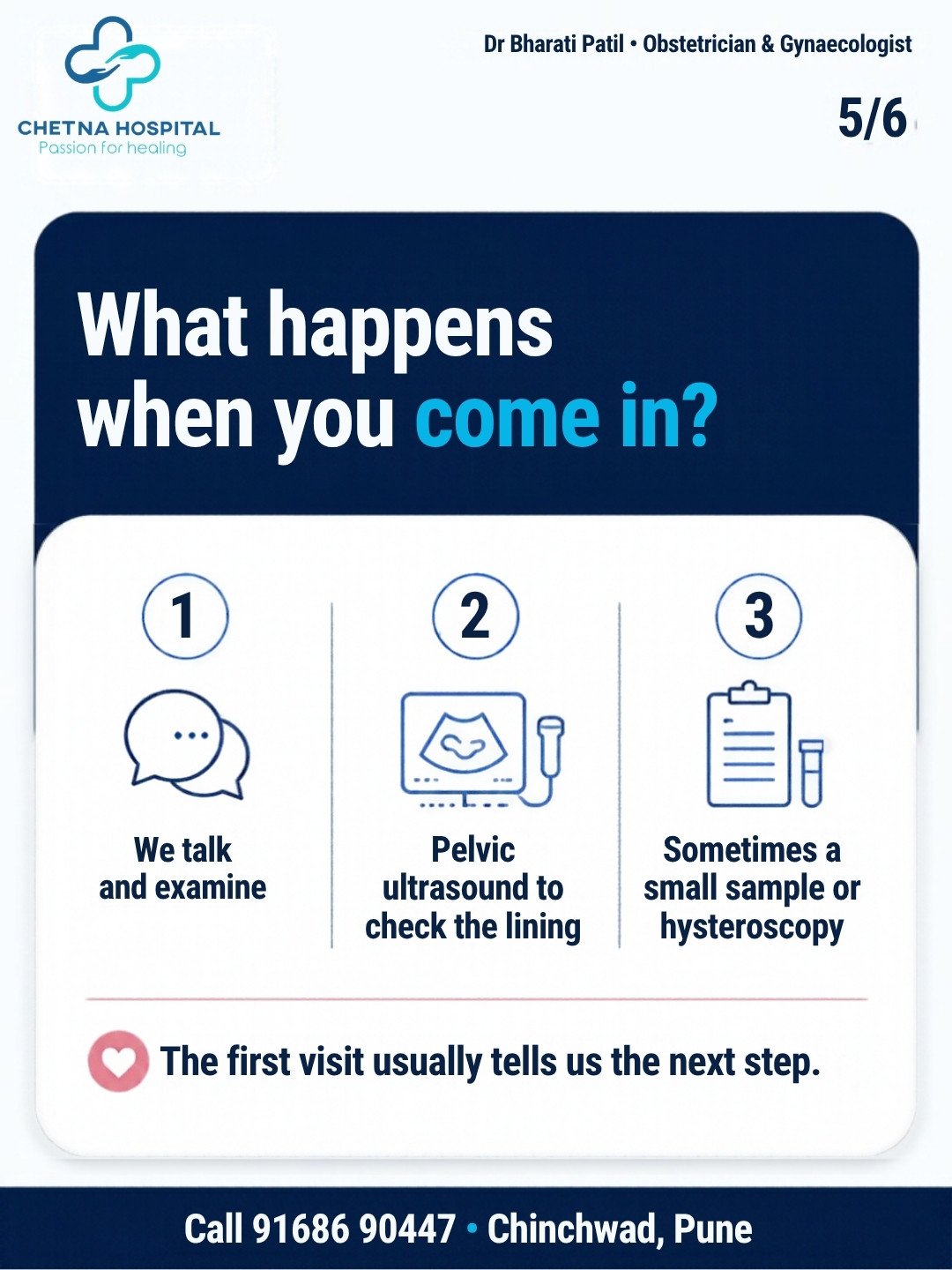
Women are often more afraid of the visit than of the bleeding. Here is what usually happens, step by step.
1. A conversation
When did your periods stop? When did the bleeding start, how much, how often? Any HRT, blood thinners, diabetes, high BP or weight changes? Any family history of cancer?
2. An examination
A gentle pelvic examination to look at the vagina and cervix. A lot of the time a thin, dry lining or a cervical polyp can be seen right away.
3. A pelvic ultrasound
A transvaginal or abdominal ultrasound measures the thickness of the womb lining. This is quick, done in the hospital, and is the single most useful test at this stage.
4. Sometimes, a small sample or hysteroscopy
If the lining is thick or the ultrasound is unclear, I may suggest an endometrial biopsy (a small sample of the lining) or a hysteroscopy, where a thin camera looks inside the womb. [Dr Bharati: confirm whether these are usually done as OPD or day-care procedures at Chetna Hospital]
The first visit usually tells us what the next step is. For many women that step is simple: a local cream for a dry lining, or removal of a polyp.
When should you not wait even a few days?
- Heavy bleeding, soaking pads
- Bleeding with fainting, dizziness or breathlessness
- Bleeding with fever or severe lower tummy pain
In these situations come to the hospital the same day.
Save these slides
This is the carousel I shared on our Instagram page this week. Save it or send it to your mother, aunt or neighbour.
What women say about Dr Bharati Patil
Excerpts from Google reviews on Dr Bharati Patil’s profile:
⭐⭐⭐⭐⭐
“She gives full attention to her patients. She listens patiently and ensures all concerns are addressed.”
– Pratibha K., Google review, May 2025
⭐⭐⭐⭐⭐
“Ma’am is really experienced and helpful. Ma’am helped us from the beginning and gave useful advices as and when required.”
– Yogita P., Google review, October 2023
Read all reviews on Google → Individual experiences vary.
Consultation near you: gynaecologist in Chinchwad, PCMC
Dr Bharati Patil consults at Room 8, First Floor, Plot No. GP 116, Sambhaji Nagar Road, near Rotary Club, G Block, MIDC, Chinchwad, Pune 411019 (Chetna Hospital). OPD hours are Monday to Saturday, 10 am to 1 pm and 4 pm to 8:30 pm. Women come to her from Chinchwad, Pimpri, Akurdi, Nigdi, Ravet, Wakad, Hinjewadi, Pimple Saudagar, Thergaon, Tathawade, Punawale, Moshi, Bhosari and Chikhali.
If you are in the years before menopause and unsure what is normal, read our guide on early perimenopause symptoms. For heavy or irregular bleeding before menopause, our article on causes of uterine fibroids may help. You can also see our gynaecology and maternity services and laparoscopic and hysteroscopic surgery.
Frequently asked questions
Is light spotting after menopause normal?
No. Any bleeding or spotting 12 months or more after your last period is not normal, even if it is light or happens only once. Most causes are not serious, but it should be checked by a gynaecologist with an examination and usually a pelvic ultrasound.
What is the most common cause of bleeding after menopause?
The most common cause is thinning and dryness of the vaginal and womb lining after oestrogen levels fall. Polyps and a thickened womb lining are other common causes. Less often, bleeding after menopause is an early sign of womb (endometrial) cancer.
Which test is done for postmenopausal bleeding?
The first test is usually a pelvic ultrasound, often transvaginal, to measure the thickness of the womb lining. Depending on the result, the gynaecologist may suggest an endometrial biopsy or a hysteroscopy to look inside the womb.
Should I wait to see if the bleeding happens again?
No. Book a check even after a single episode. Waiting does not make the cause go away, and if the cause is serious, finding it early makes treatment simpler.
Where can I see a gynaecologist for bleeding after menopause in Chinchwad, PCMC?
Dr Bharati Patil, Obstetrician and Gynaecologist (MBBS, DGO), consults at Room 8, First Floor, GP 116, Sambhaji Nagar Road, near Rotary Club, MIDC G Block, Chinchwad, Pune 411019. Call or WhatsApp 91686 90447 to book.
Noticed spotting after menopause? Don’t wait for it to happen again.

About the author: Dr Bharati Patil
Consultant Obstetrician & Gynaecologist
MBBS, DGO (JJ Hospital, Mumbai)
Pregnancy care, normal and caesarean delivery, laparoscopic and hysteroscopic gynaecology surgery at Chetna Hospital, Chinchwad. View full profile
Medically reviewed by Dr Bharati Patil. Last updated 12 October 2026.
Sources
- NHS. Post-menopausal bleeding.
- HSE (Health Service Executive, Ireland). Postmenopausal bleeding.
- Northern Care Alliance NHS Foundation Trust. What is postmenopausal bleeding (PMB)?
- Awareness Days. World Menopause Day, 18 October.
This article is general health information and does not replace a consultation. The cause of bleeding and the right treatment are decided after examination and tests.