








If you are searching for slipped disc treatment in Pune, you may already be dealing with lower back pain, pain travelling into your leg, numbness, tingling or difficulty sitting and walking.
A slipped disc can sometimes improve with non-surgical treatment. However, when a disc compresses a spinal nerve and causes persistent pain, numbness or weakness, a detailed spine evaluation becomes important.
The first question should not be:
“Do I need surgery?”
It should be:
“What is causing my symptoms, and which treatment is appropriate for my condition?”
At Chetna Hospital, Pimpri-Chinchwad, Dr. Nirmal Patil, Consultant Orthopaedic Spine Surgeon, evaluates patients with slipped disc, disc herniation, sciatica, spinal stenosis, cervical radiculopathy, degenerative spine conditions and other spinal disorders. His listed expertise includes minimally invasive and endoscopic spine procedures.
What Is a Slipped Disc?
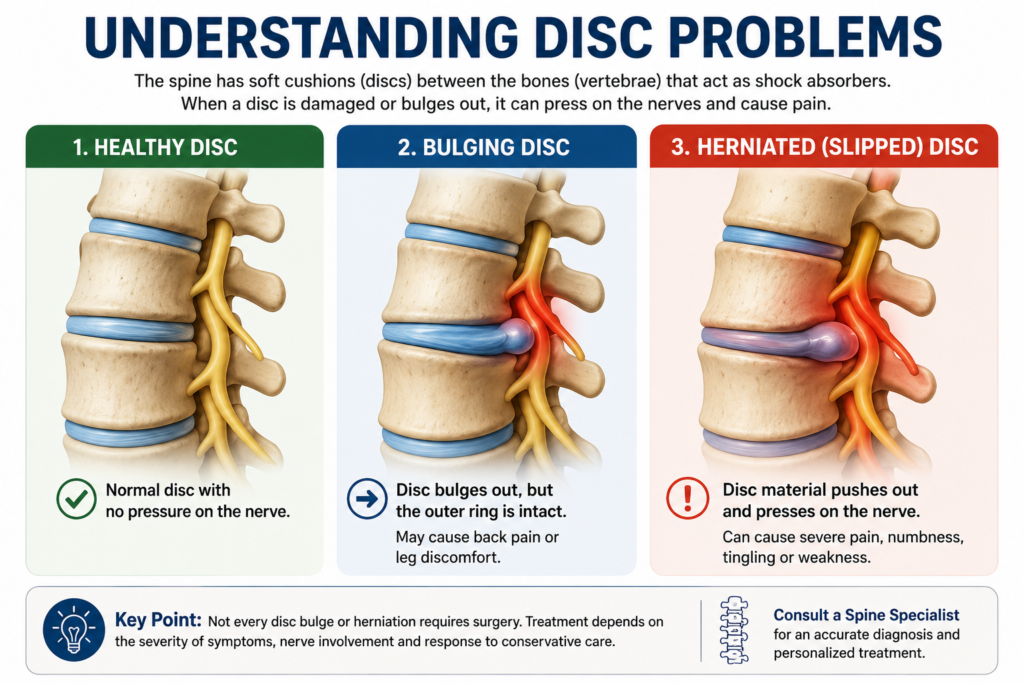
A slipped disc, commonly called a herniated disc, disc prolapse or disc herniation, occurs when the material inside an intervertebral disc pushes through a weakened outer portion of the disc.
The spine contains discs between the vertebrae that act as shock absorbers.
When a disc becomes damaged or herniated, it can sometimes irritate or compress nearby spinal nerves.
This can cause:
- Lower back pain
- Leg pain
- Sciatica
- Numbness
- Tingling
- Muscle weakness
- Difficulty walking
- Pain while sitting or standing
However, not every disc bulge causes symptoms.
This is why an MRI report should not automatically be interpreted as a reason for surgery.
Slipped Disc Symptoms: How Do You Know If Your Disc Is Causing the Pain?
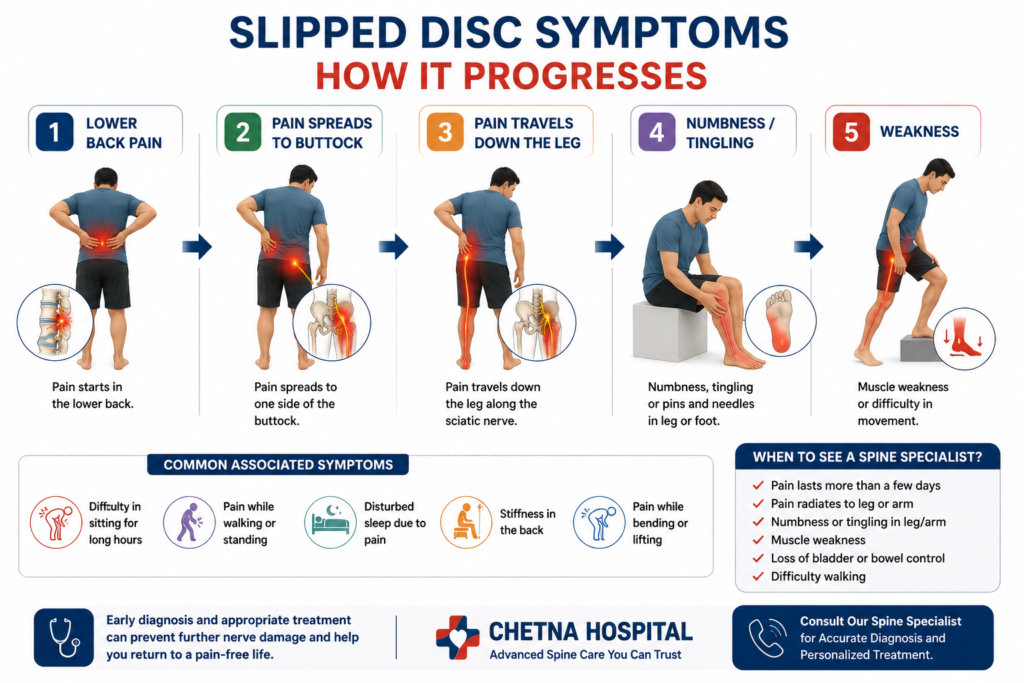
Symptoms depend on the location and severity of the disc problem.
Common symptoms include:
| Symptom | What it may feel like | Possible significance |
|---|---|---|
| Lower back pain | Ache, stiffness or sharp pain | May occur with several spine conditions |
| Leg pain | Pain travelling from back/buttock into leg | May indicate nerve irritation |
| Tingling | Pins-and-needles sensation | Can occur with nerve compression |
| Numbness | Reduced sensation in leg/foot | May indicate nerve involvement |
| Weakness | Difficulty lifting foot or moving leg normally | Needs medical assessment |
| Sciatica | Shooting/electric pain down the leg | Commonly associated with lumbar nerve irritation |
| Difficulty walking | Pain, weakness or balance problems | Should be evaluated |
A simple symptom pattern
Back pain
↓
Pain travels into buttock
↓
Pain travels down leg
↓
Tingling / numbness
↓
Weakness
→ Consider evaluation for possible nerve compression
This does not mean that every case is a slipped disc. A spine specialist needs to determine the actual cause.
Slipped Disc vs Sciatica: What Is the Difference?
Patients frequently use these terms interchangeably, but they are not the same.
| Slipped Disc | Sciatica |
|---|---|
| A structural problem involving a spinal disc | A symptom pattern involving the sciatic nerve |
| May or may not cause symptoms | Usually causes radiating leg pain |
| Can compress a spinal nerve | Usually results from irritation/compression of a nerve root |
| Can be visible on MRI | Diagnosed based on symptoms and examination |
| May require no treatment if asymptomatic | Treatment depends on the underlying cause |
A slipped disc can cause sciatica, but not every slipped disc can cause sciatica.
Similarly, sciatica can have causes other than disc herniation.
What Causes a Slipped Disc?
Several factors can contribute to disc problems.
| Risk Factor | How It Can Affect the Spine |
|---|---|
| Age-related degeneration | Discs gradually lose flexibility and hydration |
| Prolonged sitting | Can contribute to back and neck strain |
| Poor posture | May increase mechanical stress |
| Heavy lifting | Can place sudden stress on discs |
| Repetitive bending/twisting | May contribute to disc injury |
| Previous injury | Trauma can damage spinal structures |
| Physical inactivity | May contribute to reduced muscular support |
| Excess body weight | Can increase mechanical load on the spine |
Modern working habits can also contribute to back problems, particularly in people who spend long hours sitting at desks or driving.
Can a Slipped Disc Heal Without Surgery?
Yes, many patients with slipped disc symptoms do not automatically require surgery.
Treatment depends on the patient’s symptoms, neurological examination, imaging findings and response to conservative management.
Possible non-surgical approaches may include:
- Doctor-prescribed medication
- Activity modification
- Physiotherapy
- Rehabilitation
- Core-strengthening exercises
- Posture correction
- Lifestyle modification
- Selected injection-based treatments
The important point is that treatment should be individualized.
An MRI showing a disc bulge does not automatically mean that an operation is necessary.
Slipped Disc Treatment Options
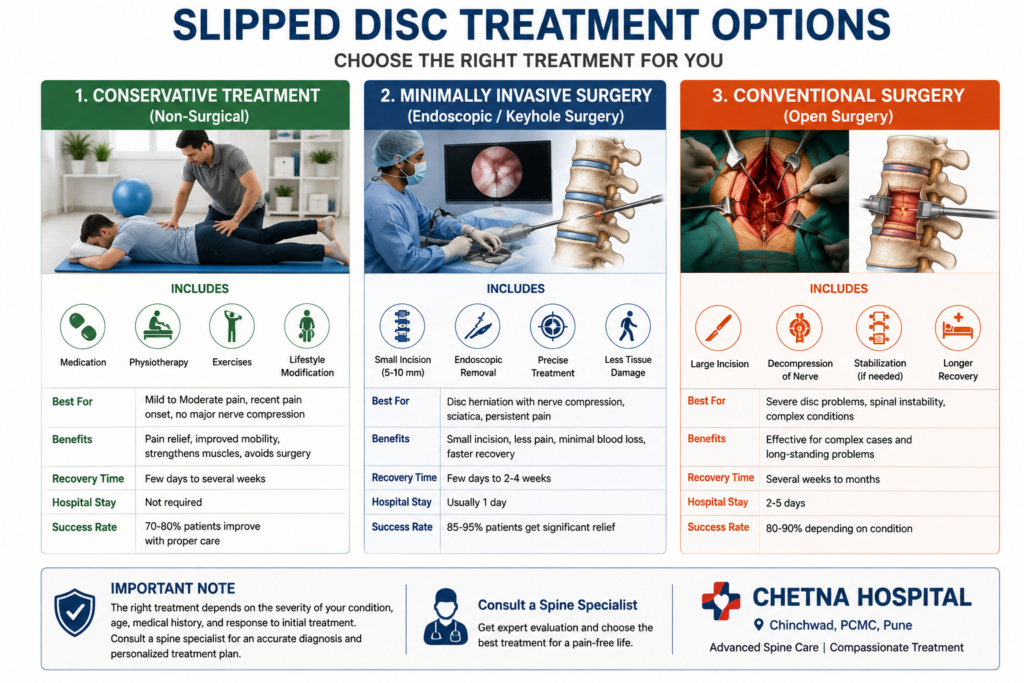
The treatment pathway can broadly be understood as follows:
| Treatment approach | When it may be considered | Main objective |
|---|---|---|
| Activity modification | Mild or early symptoms | Reduce aggravating activities |
| Medicines | Pain/inflammation | Symptom control |
| Physiotherapy | Appropriate stable cases | Improve mobility and strength |
| Rehabilitation | During recovery | Restore function |
| Targeted procedures | Selected persistent symptoms | Reduce nerve-related pain |
| Minimally invasive surgery | Selected structural/nerve compression cases | Relieve compression |
| Endoscopic surgery | Appropriate disc/nerve compression cases | Treat selected conditions through small access |
| Fusion/decompression | Selected complex conditions | Decompress or stabilize the spine |
The correct treatment depends on the individual diagnosis.
When Does a Slipped Disc Need Surgery?
This is one of the most common questions patients ask.
Surgery may be considered when:
- Severe symptoms persist despite appropriate non-surgical treatment
- There is significant nerve compression
- There is progressive neurological weakness
- Pain remains disabling
- The underlying structural problem is unlikely to improve adequately with conservative care
- There are specific urgent neurological symptoms
Surgery is not automatically required simply because:
- An MRI says “disc bulge”
- A report says “disc degeneration”
- You have back pain
- You have occasional stiffness
The clinical examination and symptoms matter.
Slipped Disc Surgery: What Are the Options?
The appropriate procedure depends on the location and nature of the spinal problem.
Microdiscectomy
A microdiscectomy removes the portion of a herniated disc that is compressing a spinal nerve.
It is commonly considered for selected patients with nerve compression and persistent symptoms.
Endoscopic Spine Surgery
Endoscopic spine surgery uses a small camera and specialized instruments to access the affected spinal area through a small surgical opening.
Dr. Nirmal Patil’s Chetna Hospital profile lists spinal endoscopic surgery and minimally invasive spine surgery among his areas of expertise.
Lumbar Decompression
Decompression procedures aim to relieve pressure on spinal nerves.
They may be considered in selected cases of spinal canal or foraminal narrowing.
Spinal Fusion
Fusion procedures may be considered when the spine requires stabilization, such as in selected cases involving instability or significant structural degeneration.
Endoscopic Spine Surgery vs Traditional Spine Surgery
Patients often search for “endoscopic spine surgery in Pune” because they want to understand whether a minimally invasive option is available.
| Feature | Endoscopic / Minimally Invasive Approach | Conventional Surgery |
|---|---|---|
| Surgical access | Smaller access in selected procedures | May require larger exposure |
| Muscle disruption | Generally less in appropriately selected procedures | Can be greater depending on procedure |
| Incision | Usually smaller | May be larger |
| Recovery | Can be quicker for selected procedures | Depends on surgery |
| Suitability | Only appropriate for certain conditions | Used for a broader range of conditions |
| Decision | Based on diagnosis and anatomy | Based on diagnosis and anatomy |
Important: minimally invasive does not mean suitable for every patient.
The surgical technique should be selected according to the patient’s actual spinal condition.
How Is a Slipped Disc Diagnosed?
A diagnosis usually starts with a detailed history and clinical examination.
A spine specialist may assess:
- Pain location
- Duration of symptoms
- Radiation of pain
- Muscle strength
- Reflexes
- Sensation
- Walking ability
- Range of movement
- Neurological signs
If imaging is required, an MRI may help evaluate the discs, nerves and spinal canal.
What an MRI Can Show
| MRI Finding | Possible Meaning |
|---|---|
| Disc bulge | Disc extends beyond its normal boundary |
| Disc herniation | Disc material protrudes further and may compress a nerve |
| Foraminal narrowing | Nerve exit pathway becomes narrower |
| Spinal stenosis | Spinal canal or nerve passage becomes narrowed |
| Degenerative disc changes | Age-related or degenerative changes |
| Nerve compression | A nerve may be affected by surrounding structures |
Important MRI rule
MRI finding + symptoms + clinical examination = meaningful diagnosis
An MRI finding by itself does not always explain the patient’s pain.
When Should You See a Spine Specialist?
Use this quick self-check:
| Situation | What to do |
|---|---|
| Mild back pain after unusual activity | Monitor and consider medical advice if persistent |
| Pain keeps returning | Arrange an evaluation |
| Pain travels into the leg | Consider spine assessment |
| Numbness or tingling | Medical assessment is advisable |
| Weakness in leg/foot | Seek prrgent medical attention |
Back Pain That Travels Into the Leg: Why It Matters
One of the most important distinctions is whether pain remains in the back or travels into the leg.
Local back pain
Lower back → local discomfort
This may have many possible causes.
Nerve-related pain
Lower back → buttock → thigh → leg/foot
This pattern may suggest nerve irritation or compression.
Sciatica treatment in Pune therefore requires identifying the cause of the nerve irritation, rather than treating leg pain as an isolated symptom.
Could Your Back Pain Actually Be Spinal Stenosis?
Not all radiating leg pain is caused by a slipped disc.
Another condition is spinal stenosis, where areas through which the spinal cord or nerves pass become narrowed.
Possible symptoms include:
- Back pain
- Leg pain
- Numbness
- Tingling
- Leg heaviness
- Difficulty walking for longer distances
Dr. Nirmal Patil’s clinical profile lists spinal canal stenosis, cervical myelopathy and lumbar foraminal stenosis among the spinal conditions he treats.
What About Neck Pain and Cervical Disc Problems?
Spinal disc problems can also occur in the neck.
Possible symptoms include:
- Neck pain
- Shoulder pain
- Arm pain
- Tingling in fingers
- Hand numbness
- Arm weakness
Patients searching for cervical spondylosis treatment in Pune may actually have different underlying conditions, which is why diagnosis matters.
Cervical spine problems can sometimes involve nerve or spinal cord compression and should be evaluated when symptoms persist or neurological symptoms develop.
A Patient’s Decision Chart: What Should You Do?
STEP 1 — Identify the symptom
Back pain only?
→ Monitor and seek medical advice if persistent.
Back pain + leg pain?
→ Consider evaluation for possible nerve irritation.
Back pain + numbness/tingling?
→ Spine assessment is advisable.
Back pain + weakness?
→ Seek prompt medical evaluation.
Severe neurological symptoms?
→ Seek urgent medical attention.
Slipped Disc Treatment: How Long Does Recovery Take?
Recovery varies significantly from patient to patient.
| Treatment | Recovery depends on |
|---|---|
| Conservative treatment | Severity, duration and response |
| Physiotherapy | Diagnosis and rehabilitation progress |
| Injection/procedure | Underlying condition |
| Endoscopic procedure | Procedure performed and patient’s health |
| Microdiscectomy | Nerve compression, duration of symptoms and rehabilitation |
| Fusion/decompression | Complexity of surgery and individual recovery |
There is no single recovery timeline that applies to every slipped-disc patient.
A person with a small disc herniation and mild symptoms may recover very differently from someone with severe nerve compression.
Why Early Spine Evaluation Can Be Helpful
Persistent symptoms should not simply be managed with repeated painkillers without understanding the underlying cause.
A proper evaluation can help determine whether the problem is:
- Muscular
- Disc-related
- Nerve-related
- Degenerative
- Stenotic
- Trauma-related
- Structural
Early assessment may also help identify patients who need rehabilitation rather than unnecessary surgery, while allowing patients with significant nerve compression to receive appropriate treatment.
Why Consult Dr. Nirmal Patil at Chetna Hospital?
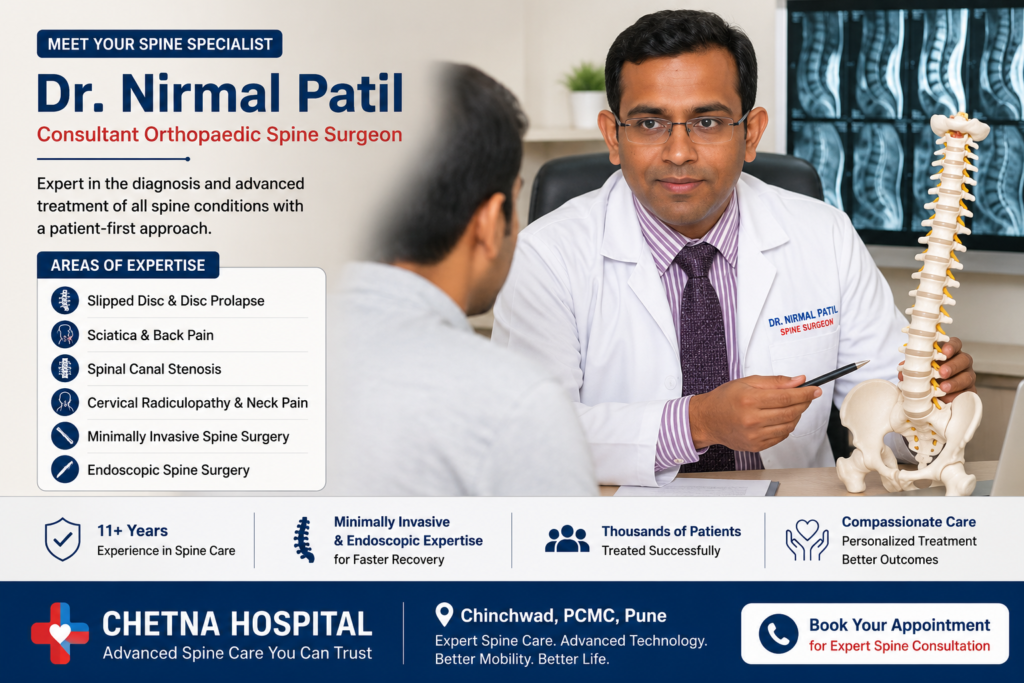
Dr. Nirmal Patil is a Consultant Orthopaedic Spine Surgeon at Chetna Hospital, Pimpri-Chinchwad.
His listed clinical expertise includes:
- Slipped disc
- Disc prolapse
- Disc herniation
- Sciatica
- Back pain
- Neck pain
- Cervical radiculopathy
- Spinal canal stenosis
- Spondylolisthesis
- Scoliosis
- Spine trauma
- Degenerative spine conditions
His listed procedures include minimally invasive spinal surgery, lumbar microdiscectomy, decompression procedures and other spine surgeries.
Chetna Hospital also provides minimally invasive spine treatment options in PCMC, including endoscopic spine procedures for appropriately selected patients.
Slipped Disc Treatment in PCMC: Where Can You Get Evaluated?
If you live in:
- Chinchwad
- Pimpri
- Nigdi
- Akurdi
- Ravet
- Wakad
- Pimple Saudagar
- Thergaon
- Hinjewadi
- Tathawade
- Other parts of PCMC and Pune
and are experiencing persistent back pain, sciatica, numbness, tingling or suspected slipped disc, a specialist spine consultation can help determine the next step.
Chetna Hospital is located in Sambhaji Nagar, Chinchwad, Pimpri-Chinchwad, Maharashtra 411019.
Frequently Asked Questions About Slipped Disc
Find answers to common questions about slipped disc symptoms, treatment, surgery, sciatica and spine consultation.
Is a slipped disc curable?
Many people with a slipped disc improve significantly with appropriate treatment. The right treatment depends on the severity of symptoms, nerve involvement, clinical examination, imaging findings and overall health. Treatment may include medication, physiotherapy, rehabilitation or, in selected cases, spine surgery.
Is slipped disc surgery always necessary?
No. Slipped disc surgery is not automatically necessary for everyone. Many patients can improve with non-surgical treatment. Surgery may be considered when symptoms remain disabling despite appropriate treatment, significant nerve compression is present, progressive weakness develops or there are specific neurological indications for surgery.
Can physiotherapy help with a slipped disc?
Physiotherapy may help appropriately selected patients with slipped disc symptoms. Depending on the diagnosis, a treatment program may focus on improving mobility, strengthening supporting muscles, posture, movement patterns and gradual return to normal activities. Physiotherapy should be guided by the patient’s individual condition.
Is sciatica caused by a slipped disc?
A slipped or herniated disc is one possible cause of sciatica. Sciatica occurs when the sciatic nerve or its contributing nerve roots become irritated or compressed. Other spinal conditions, including spinal stenosis and degenerative changes, can also cause similar nerve-related symptoms.
Which doctor should I see for slipped disc in Pune?
An orthopaedic spine surgeon or appropriately qualified spine specialist can evaluate suspected slipped disc, sciatica, nerve compression and other spinal conditions. The specialist can assess your symptoms and examination findings and determine whether imaging or further treatment is required.
When is slipped disc surgery necessary?
Surgery may be considered when symptoms remain severe or disabling despite appropriate non-surgical treatment, when significant nerve compression is present, when progressive neurological weakness develops, or when the underlying spinal condition has a specific surgical indication. The decision should be made after specialist evaluation rather than from an MRI report alone.
Is endoscopic spine surgery available in PCMC?
Endoscopic and minimally invasive spine surgery may be suitable for selected spinal conditions. Chetna Hospital in Chinchwad, Pimpri-Chinchwad provides specialist evaluation for patients with slipped disc, sciatica and other spine conditions. Whether endoscopic surgery is appropriate depends on the patient’s diagnosis, anatomy, symptoms and clinical findings.
Experiencing Back Pain or Sciatica?
If your back pain is persistent, radiates into your leg, or is associated with numbness, tingling or weakness, consider getting evaluated by a spine specialist.
Consult Dr. Nirmal PatilMedical Disclaimer
This article is intended for general educational purposes and does not replace a medical consultation. Back pain, slipped disc, sciatica and other spinal conditions can have different causes. Diagnosis and treatment should be determined by a qualified healthcare professional after appropriate clinical evaluation.

2 Comments
Spine Surgery in Pune for Back Pain Relief | Dr Nirmal Patil
[…] Slipped or Herniated Disc […]
Back Pain in Your 20s & 30s: 5 Signs to See a Spine Specialist in Pune - Chetna Hospital
[…] A muscle strain usually causes pain and stiffness across the lower back. It is worse with certain movements and better with rest and gentle activity. A slipped disc (disc herniation) can do the same, but it often adds pain that travels down one leg, because the disc presses on a nerve root. This leg pain is called sciatica. You can read more in our guide on slipped disc treatment in Pune. […]