
When a loved one is admitted to the Intensive Care Unit (ICU), families often hear a new term for the first time — Intensivist. Many people are familiar with surgeons, physicians, or cardiologists, but few truly understand the critical role an Intensivist plays in saving lives during medical emergencies.
At Chetna Superspeciality Hospital, Chinchwad, Pune, critically ill patients are managed under the expertise of Dr. Ashpak Bangi, an experienced Intensivist and Critical Care Specialist. This blog explains what an Intensivist does, when ICU care is needed, and why timely critical care can make the difference between life and death.
Who Is an Intensivist?
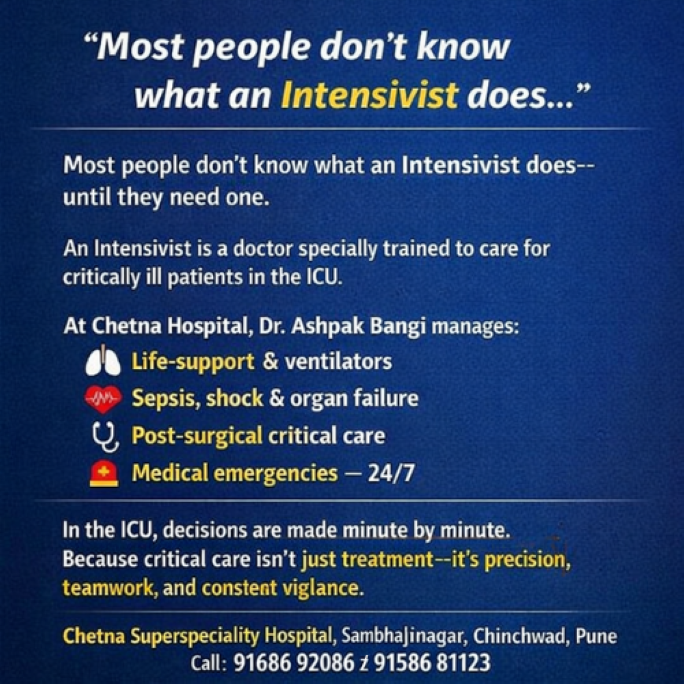
An Intensivist is a doctor who specializes in Critical Care Medicine. These doctors are trained to manage patients with life-threatening conditions who require continuous monitoring, life-support systems, and rapid medical decision-making.
Unlike other specialists who focus on a single organ system, an Intensivist manages the entire body, especially when multiple organs are failing at the same time.
Key Responsibilities of an Intensivist:
- Managing ICU patients
- Operating and monitoring ventilators
- Treating sepsis and septic shock
- Stabilizing low blood pressure and cardiac emergencies
- Managing multi-organ failure
- Post-operative critical care
- Coordinating with surgeons and specialists
- Providing 24/7 emergency ICU care
Why Is an Intensivist So Important in the ICU?
The ICU is not just another hospital ward. Patients admitted to the ICU are often unstable, and their condition can change within minutes. This is where the presence of an Intensivist becomes essential.
At Chetna Superspeciality Hospital, ICU patients are closely monitored under the supervision of Dr. Ashpak Bangi, ensuring timely interventions and evidence-based treatment.
ICU Without an Intensivist vs With an Intensivist
- Faster decision-making
- Continuous monitoring
- Early detection of complications
- Better coordination between departments
- Improved patient outcomes
Studies show that ICUs led by trained Intensivists have lower mortality rates and shorter ICU stays.
Conditions Managed by an Intensivist
1. Severe Breathing Problems
Patients with pneumonia, COVID-related complications, asthma attacks, or respiratory failure often require ventilator support. An Intensivist decides:
- When to start ventilation
- Which mode of ventilation to use
- When and how to safely remove the ventilator
2. Sepsis and Septic Shock
Sepsis is a life-threatening response to infection. It can rapidly lead to organ failure if not treated early. Dr. Ashpak Bangi, as an Intensivist in Chinchwad, Pune, manages:
- Early diagnosis of sepsis
- Blood pressure stabilization
- Infection control
- Organ support
3. Cardiac and Blood Pressure Emergencies
Critically low or high blood pressure, cardiac arrhythmias, and shock require constant monitoring and rapid treatment in the ICU.
4. Multi-Organ Failure
When two or more organs such as the lungs, kidneys, heart, or liver fail simultaneously, ICU care under an Intensivist becomes lifesaving.
5. Post-Surgical Critical Care
High-risk surgeries often require ICU observation. An Intensivist ensures:
- Pain control
- Infection prevention
- Stable recovery
- Organ support if needed
Role of Dr. Ashpak Bangi – Intensivist at Chetna Superspeciality Hospital
Dr. Ashpak Bangi is a dedicated Intensivist in Chinchwad, Pune, associated with Chetna Superspeciality Hospital. He specializes in managing critically ill patients with complex medical conditions.
Clinical Expertise Includes:
- ICU and ventilator management
- Sepsis and shock treatment
- Emergency critical care
- Post-operative ICU care
- Continuous patient monitoring
Dr. Bangi works closely with a multidisciplinary team to provide coordinated and patient-focused critical care services.
When Should a Patient Be Shifted to the ICU?
Early ICU admission can save lives. Patients should be shifted to ICU if they experience:
- Severe breathing difficulty
- Sudden drop in blood pressure
- Altered consciousness
- Severe infections
- Uncontrolled diabetes or kidney failure
- Major trauma or accidents
At Chetna Superspeciality Hospital, Sambhajinagar, Chinchwad, ICU admissions are evaluated promptly to avoid delays in treatment.
ICU Facilities at Chetna Superspeciality Hospital
Chetna Superspeciality Hospital provides advanced ICU care for patients in Pune and nearby areas.
ICU Infrastructure Includes:
- Advanced ventilators
- Continuous cardiac monitoring
- Emergency life-support systems
- Trained ICU nursing staff
- Infection control protocols
- 24/7 availability of Intensivist care
The ICU is designed to handle medical emergencies with precision, safety, and compassion.
Areas Served Near Chetna Superspeciality Hospital
Patients from the following areas frequently seek ICU and critical care services at Chetna Superspeciality Hospital:
- Chinchwad
- Sambhajinagar
- Pimpri
- Akurdi
- Nigdi
- Wakad
- Hinjewadi
- PCMC area
- Pune city and surrounding regions
People searching for an Intensivist near Chinchwad, ICU doctor in Pune, or critical care hospital near Sambhajinagar can access timely care at Chetna Superspeciality Hospital.
Common Myths About ICU and Intensivists
Myth 1: ICU Means No Hope
Reality: ICU care exists to give patients the best possible chance of recovery.
Myth 2: Ventilators Always Mean Death
Reality: Ventilators are life-saving tools when used correctly by trained Intensivists.
Myth 3: Any Doctor Can Manage ICU Patients
Reality: ICU patients require specialized training in critical care medicine.
Why Early Critical Care Matters
Delays in ICU admission or ventilator support can worsen outcomes. An experienced Intensivist like Dr. Ashpak Bangi ensures:
- Early diagnosis
- Timely treatment
- Prevention of complications
- Improved survival rates