Red eyes are a common complaint at eye clinics, and they have many causes. Red eyes are often minor and settle in a few days, but sometimes they point to a more serious eye problem that needs prompt care. Knowing the difference between allergic and infectious causes of red eyes helps you know what to do next.
If you live in Chinchwad, Wakad, Thergaon, Ravet, Punawale, or nearby areas, the eye care (ophthalmology) department at Chetna Hospital, Chinchwad, Pune, can check the cause of red eyes and advise on treatment.
What Causes Red Eyes?
Red eyes occur when the tiny blood vessels in the thin clear layer over the white of the eye (the conjunctiva) become enlarged or irritated. The main causes include:
- Allergies
- Infections (bacterial, viral, or fungal)
- Dry eyes or irritation
- Eye injuries
- Underlying eye diseases
This blog focuses on the two most common causes: allergy-related red eyes and infection-related red eyes.
Red Eyes Due to Allergies
Allergic red eyes occur when the eye reacts to allergens such as pollen, dust, pet dander, or mould. The immune system reacts to these harmless substances, causing inflammation in the conjunctiva (the thin membrane covering the white part of the eye).
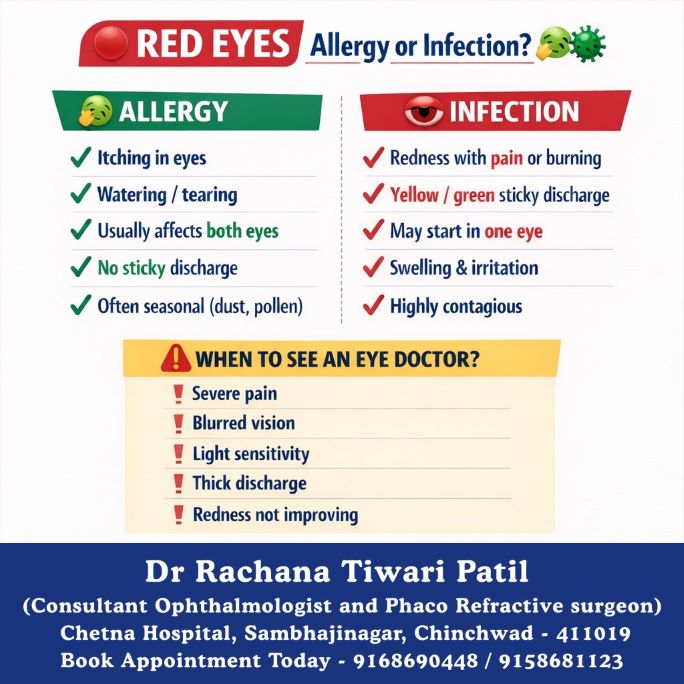
Common Symptoms of Allergic Red Eyes:
- Itching – Often the main symptom
- Watery or teary eyes – Due to irritation
- Both eyes affected – Usually at the same time
- No thick or coloured discharge
- Seasonal or environmental triggers – Such as dust, pollen, or pollution
Allergic red eyes are not contagious. They can keep coming back while you are exposed to the trigger, and rubbing the eyes can make them worse.
Tips to Manage Allergic Red Eyes:
- Avoid exposure to known allergens where you can
- Avoid rubbing your eyes
- Hold a cold, clean cloth over the eyes for a few minutes to ease swelling and irritation
- Ask a pharmacist or eye doctor which eye drops or allergy medicines suit you
- See an ophthalmologist if symptoms persist
Red Eyes Due to Infection
Infection-related red eyes are caused by bacteria, viruses, or, rarely, fungi, and they can affect one or both eyes. The most common infection is conjunctivitis, which often clears up by itself within a couple of weeks. Some infections, especially those affecting the cornea, need prompt medical treatment.
Common Symptoms of Infectious Red Eyes:
- Gritty or burning feeling
- Sticky yellow or green discharge (more likely with bacterial infection)
- Swelling of eyelids
- May start in one eye
- Bacterial and viral conjunctivitis spread easily
Types of Infectious Red Eyes:
- Bacterial Conjunctivitis – Thick, sticky yellow-green discharge, often starts in one eye, spreads easily
- Viral Conjunctivitis – Redness, gritty and watery eyes, often with cold or flu symptoms; spreads easily
- Fungal Eye Infections – Rare, often after an eye injury or in people with a weak immune system
Treatment:
- Bacterial conjunctivitis often gets better on its own; a doctor may prescribe treatment in some cases
- Viral conjunctivitis usually clears on its own; antibiotics do not work for viral or allergic conjunctivitis
- Fungal infections need treatment prescribed by an ophthalmologist
Do not use leftover or borrowed eye drops. Use medicines only as advised by your doctor.
How to Distinguish Between Allergy and Infection
Telling allergic red eyes from infectious red eyes can be tricky. These are typical patterns, not rules:
| Feature | Allergy | Infection |
|---|---|---|
| Itching | Main symptom | Mild or absent |
| Discharge | Watery | Sticky yellow/green (bacterial) or watery (viral) |
| Eye involvement | Both eyes | Often starts in one eye |
| Contagion | Not contagious | Contagious (bacterial/viral) |
| Onset | Seasonal or environmental | Can occur any time |
Risk Factors for Red Eyes
Several factors increase the likelihood of developing red eyes:
- Exposure to pollution, dust, and pollen (common in Chinchwad, Wakad, Thergaon)
- Contact lens misuse
- Poor hygiene or eye rubbing
- Pre-existing conditions such as dry eye syndrome or allergies
- A weakened immune system
When to See an Eye Specialist
Go to an emergency department straight away or call 108 or 112 if a red eye comes with any of these:
- Sudden change or loss of vision, wavy lines or flashing lights
- Pain when looking at light
- Severe eye pain, or a severe headache with nausea
- A very dark red eye, or one pupil larger than the other
- An eye injury, something stuck in the eye, or a chemical in the eye
See an eye doctor the same day if the eye is very painful and red, if you wear contact lenses and have a red eye (take the lenses out), or if a baby under one month old has red, sticky eyes. Book a check-up if there is sticky discharge, or if redness has not cleared within a week.
Prompt treatment can help prevent complications such as corneal ulcers and vision problems.
Preventive Measures for Healthy Eyes
- Keep up good eye hygiene – Wash hands before touching your eyes, and do not share towels or pillows
- Avoid rubbing your eyes
- Clean crusts from the lashes with cooled boiled water on a clean cotton pad, using a separate pad for each eye
- Use eye drops for allergies or dry eyes only as advised by a doctor or pharmacist
- Protect eyes from dust and pollutants using sunglasses
- Follow proper contact lens care, and stop wearing lenses until a red eye has settled
- Schedule regular eye check-ups with a qualified ophthalmologist
Eye Care in Chinchwad, Pune
The eye care (ophthalmology) department at Chetna Hospital, Chinchwad, provides eye care for people in Chinchwad, Wakad, Thergaon, Ravet, Punawale, and nearby areas, including:
- Diagnosis and management of allergic and infectious conjunctivitis
- Cataract and glaucoma care
- Dry eye management
- Contact lens consultation
- Eye care for children and adults
At Chetna Hospital, Chinchwad, Pune, patients receive an eye examination and a treatment plan suited to their needs.
Conclusion
Red eyes are a common symptom with a wide range of causes, from mild allergies to infections. Knowing whether the cause is allergic or infectious helps guide the right care.
If you have persistent redness, discharge, or pain, see the eye care department at Chetna Hospital, Chinchwad, Pune. Prompt care can prevent complications and protect your vision.
Contact Details
Chetna Hospital, Chinchwad, Pune
Eye care (ophthalmology) department
Call 91686 90442 to book a check-up. Main hospital line: 9158681123
General health information, not a diagnosis. Reviewed and updated by Chetna Hospital’s content team with the help of AI writing tools, November 2026.