A meniscus tear is damage to the rubbery cartilage that cushions the knee joint. It can cause pain, swelling, stiffness, clicking and a feeling that the knee is stuck or giving way. Many tears are treated first with rest, ice and physiotherapy, and some heal without surgery. Keyhole surgery, called knee arthroscopy, may be considered if pain carries on despite rehab or the knee keeps locking.
This guide explains the signs, tests and treatment choices for people in PCMC and across Pune.
What is a meniscus tear?
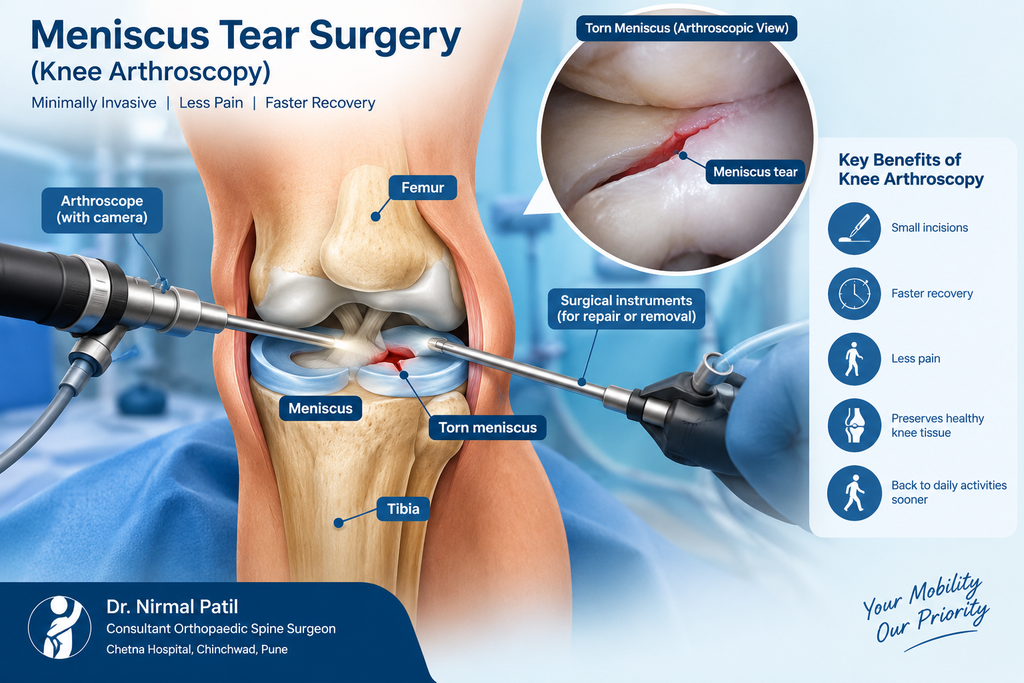
Each knee has two menisci. The medial meniscus sits on the inner side of the knee and the lateral meniscus on the outer side. They lie between the thighbone and the shinbone, where they cushion the joint and act like shock absorbers.
A tear can happen suddenly, often during sport or a hard twist. It can also happen slowly, as the cartilage wears with age or arthritis.
Symptoms of a meniscus tear
You may feel a pop in the knee when the meniscus tears. Swelling or stiffness may take a few hours or days to appear.
- pain or tenderness in the knee
- swelling or stiffness
- trouble bending the knee or straightening it fully
- a feeling that the knee is locked in place when you try to move it
- catching, or a crunching or clicking feeling when the knee moves
- the knee giving way when you stand
These signs can look like a sprain, so have the knee checked if they do not settle.
Why does a meniscus tear make the knee lock?
Some tears block the normal movement of the joint. The knee can then feel stuck, or it may not straighten all the way.
Many tears that do not lock the knee or block its movement become less painful over time. A knee that keeps locking is one of the reasons a doctor may suggest an operation.
Other knee problems can cause similar symptoms. A meniscus tear also often comes with other injuries, such as a torn ACL (a knee ligament), so the knee needs a proper check. Read more about knee pain in younger and older adults.
Causes and risk factors
- twisting the knee hard while the foot stays planted on the ground
- sports with sudden turns, such as football, tennis or basketball
- kneeling, deep squatting or lifting something heavy
- in older adults, a small twist, such as turning as you stand up
- wear and tear with age, arthritis, or being overweight
When to get help
See a doctor if:
- knee pain stops you doing normal activities or affects your sleep
- the pain is getting worse or keeps coming back
- the knee is stiff for more than 30 minutes after you wake up
- the knee locks up or feels like it will give way
- your symptoms have not improved after treating the knee at home
Get medical help the same day if:
- you have very bad knee pain after a fall or injury
- you cannot walk, put weight on the knee, or bend or straighten the leg
- the skin around the knee is swollen and hot
- you have knee pain with a high temperature, or you feel hot, cold or shivery
Call 108 or 112 or go to the emergency department if:
- the knee has moved out of place, changed shape or points at an odd angle
- you have tingling or numbness in the knee, leg or toes
Do not drive yourself. Ask someone to take you or call an ambulance.
How a meniscus tear is diagnosed
The doctor will ask how the injury happened. They will check the knee for swelling and see how far it bends and straightens.
Tenderness along the joint line, where the thighbone and shinbone meet, often points to a tear. In the McMurray test, the doctor bends, straightens and turns your knee. A torn meniscus may then cause pain, a click or a clunk.
- X-ray: cartilage does not show on an X-ray, but an X-ray helps rule out other problems, such as osteoarthritis.
- MRI scan: this shows soft tissues such as cartilage and ligaments. It is the main scan used to look for a torn meniscus.
- Arthroscopy: sometimes the surgeon looks inside the knee with a thin camera, and can treat the tear at the same time.
Treatment options for a meniscus tear
Treatment depends on the type, size and place of the tear, and whether you have arthritis. It often starts without surgery.
Treatment without surgery
- Rest: avoid activities that make the pain worse, especially twisting or turning.
- Ice and raising the leg: these help ease pain and swelling.
- Medicine: a doctor may suggest medicine to ease the pain.
- Physiotherapy: exercises strengthen the muscles around the knee and help it move better.
Tears linked to arthritis often improve as the arthritis is treated, and usually do not need surgery. Read more about osteoarthritis of the knee.
Healing depends on where the tear is. The outer third of the meniscus has a good blood supply. A tear there may heal on its own, or it may be repaired with surgery. The inner two-thirds has little blood supply, so tears there cannot heal by themselves.
Surgery: knee arthroscopy
Surgery may be considered if the knee stays painful despite physiotherapy, or if it keeps locking. It is usually done by arthroscopy, a type of keyhole surgery. The surgeon will usually do one of two things:
- Meniscus repair: the torn edges are stitched together so they can heal. Whether a tear can be repaired depends on its type and the state of the meniscus. Repair is more often possible in children and younger adults.
- Partial meniscectomy: the damaged part is trimmed away when it cannot be repaired.
Removing part of the meniscus leaves the knee with less cushioning, so the risk of arthritis later may be higher.
What happens during knee arthroscopy
- You are given an anaesthetic. It may put you to sleep, or numb the lower half of your body or just the knee.
- The surgeon makes a small cut near the knee and puts in a thin camera with a light.
- The camera sends pictures to a screen, and the surgeon repairs or trims the tear through other small cuts.
- The cuts are closed with stitches or tape.
Most people go home the same day, though some stay one night. Problems are rare but can include a reaction to the anaesthetic, joint pain, numbness, blood clots and infection.
Recovery after surgery
The knee is usually sore and stiff at first. Rehab starts with exercises to get the knee moving, and strength work is added step by step. Physiotherapy is an important part of recovery. Read more about physiotherapy after surgery.
Recovery takes longer after a repair than after trimming, because the stitched tissue needs time to heal. Your surgeon will tell you when to return to work, driving or sport.
Contact the hospital if you get a high temperature, severe or worsening pain or swelling, smelly fluid leaking from a cut, or numbness or tingling around the knee.
What you can do at home
In the first few days after a knee injury:
- Rest the knee and stop sport or exercise for now.
- Hold a wrapped ice pack on the knee for up to 20 minutes every 2 to 3 hours.
- Wear a bandage or knee support, and take it off at night.
- Keep the leg raised on a pillow when you can.
- After a few days, start moving the knee gently.
- Ask a pharmacist or doctor which pain relief medicine suits you.
Avoid heat packs, hot baths, alcohol, massaging the knee and carrying heavy things for the first few days.
Frequently asked questions
Can a meniscus tear heal without surgery?
Some can. Tears in the outer part of the meniscus, which has a good blood supply, may heal on their own. Tears in the inner part cannot heal by themselves. Many tears are treated first with rest, ice and physiotherapy.
Can I still walk with a torn meniscus?
Often, yes. Many people can still walk after the injury. If you cannot put weight on the knee, get medical help the same day.
Does a locked knee always mean a meniscus tear?
No. Other knee problems can cause similar symptoms. A doctor needs to examine the knee, and may order a scan, to find the cause.
Will an X-ray show a meniscus tear?
No. Cartilage does not show on an X-ray, but an X-ray can rule out other problems such as arthritis. An MRI scan is the main test used to see a meniscus tear.
Is it better to repair the meniscus or remove the torn part?
It depends on the tear. A repair keeps the meniscus but takes longer to recover from. Trimming is used when a tear cannot be repaired, and it may raise the risk of arthritis later.
Sources
- NHS: Meniscus tear (knee cartilage damage)
- NHS: Arthroscopy
- OrthoInfo (AAOS): Meniscus tears
- Mayo Clinic: Torn meniscus, symptoms and causes
- Mayo Clinic: Torn meniscus, diagnosis and treatment
- Cleveland Clinic: Torn meniscus
How to reach Chetna Hospital
Spine & Orthopaedics, Chetna Hospital
Chetna Hospital, Plot GP 116, Sambhaji Nagar Road, MIDC G Block, Chinchwad, Pune 411019
At Chetna Hospital in Chinchwad, the Spine & Orthopaedics department sees people with knee pain and suspected meniscus tears. A clinical check, with imaging when needed, helps plan treatment.
How this article was prepared: Chetna Hospital’s content team wrote it with the help of AI writing tools and checked it against the sources listed. It is general health information, not personal medical advice.