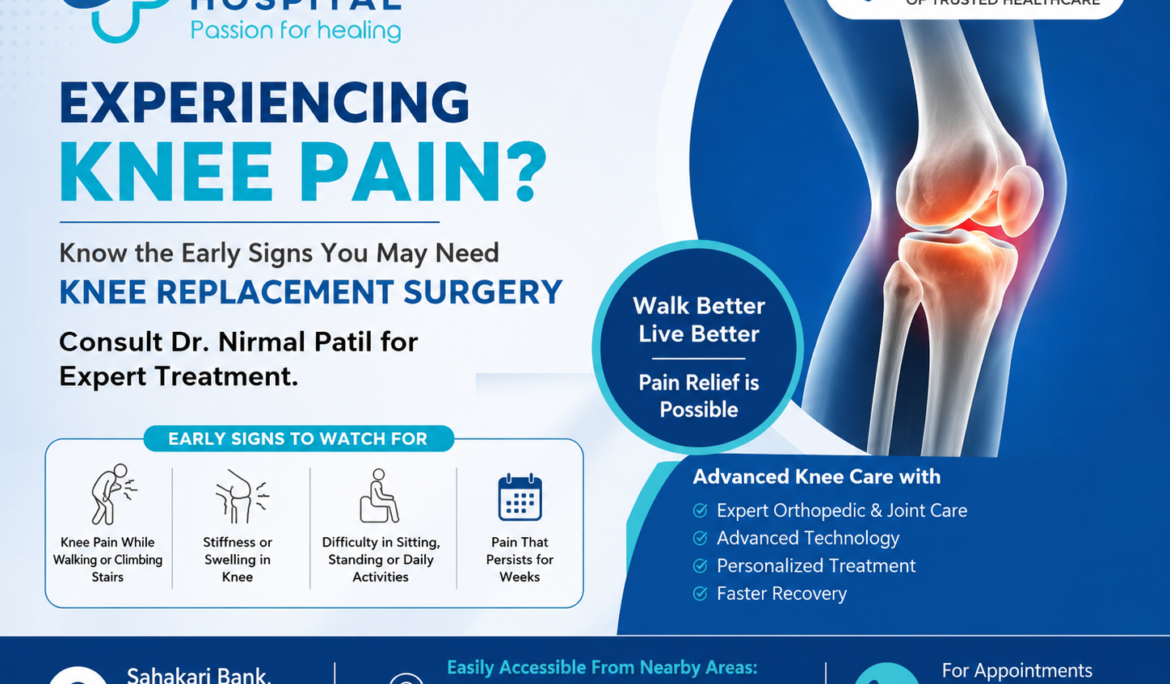
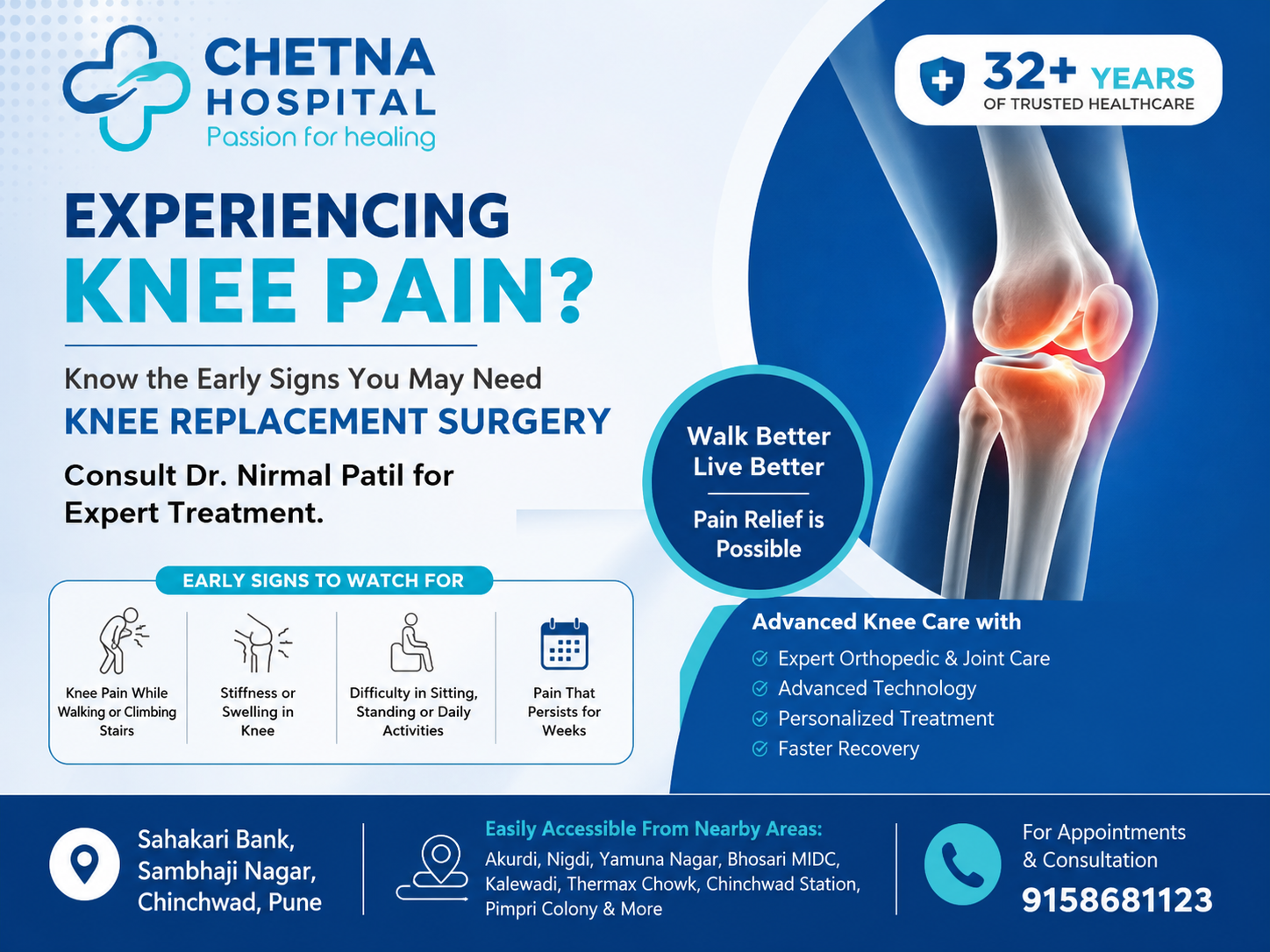
If you are looking for knee replacement surgery in Chinchwad or PCMC, Dr. Nirmal Patil, Consultant Orthopaedic Spine Surgeon at Chetna Orthopedic Clinic, provides orthopaedic evaluation and treatment guidance for knee arthritis, joint problems, fractures, sports injuries, spine conditions and joint replacement-related concerns.
Knee Replacement Surgery in Chinchwad
“Best orthopedic Doctor in PCMC” को अलग blog का focus keyword रखना बेहतर है। इस article में इसे ऐसे बीच में अकेले रखने से topical focus dilute होता है।
Qualifications:
MBBS, MS (ORTHO), MRCS (UK), DNB (ORTHO), MNAMS, SICOT-ORTHO Diploma (Belgium), Advanced Diploma in Spine Surgery (UK)
Professional Memberships:
AO Spine, EuroSpine, ASSI
Medical Registration: 2012/05/1186
Awards & Achievements:
- Pandurangi Award for Best Orthopaedic Resident, 2015
- Selected for the K.S. Masalawala Best Paper Presentation Session at WIROC 2015
- 1st Rank in Maharashtra State and 24th in India in DNB Post Graduate Entrance Examination, 2012
- Gold Medal in Football Tournament, Pimpri-Chinchwad Municipal Corporation, 2002
Last Updated: August 2026
Knee replacement surgery may be considered when severe knee joint damage causes persistent pain, stiffness and difficulty with everyday activities despite appropriate non-surgical treatment. The decision depends on the condition of the knee, symptoms, overall health and response to previous treatment.
If you are looking for knee replacement surgery in Chinchwad or PCMC, Dr. Nirmal Patil, Orthopaedic Surgeon at Chetna Orthopedic Clinic, Chinchwad, provides evaluation and treatment guidance for knee arthritis, joint problems, fractures, sports injuries, spine conditions and joint replacement-related concerns.
Quick answer: Knee replacement is not automatically required for every person with knee pain. An orthopaedic evaluation helps determine whether physiotherapy, medicines, injections, lifestyle changes or knee replacement surgery may be appropriate.
What Is Knee Replacement Surgery?
For more information about total knee replacement, see the American Academy of Orthopaedic Surgeons (AAOS) guide.
“American Academy of Orthopaedic Surgeons (AAOS) guide
It is commonly considered for people with significant knee joint damage, particularly when pain and stiffness affect walking, stairs, sleep or other daily activities and conservative treatment has not provided sufficient relief.
Depending on the pattern and extent of joint damage, a surgeon may consider:
- Total knee replacement: More than one part of the damaged knee joint is replaced.
- Partial knee replacement: Only the affected compartment of the knee is replaced in selected patients.
The appropriate procedure depends on clinical examination, imaging findings, symptoms and overall patient factors.
When Is Knee Replacement Surgery Recommended?
Knee replacement is generally considered when knee pain and functional limitations become significant and other appropriate treatment options have not provided enough relief.
An orthopaedic surgeon may discuss surgery when a patient has:
- Persistent knee pain
- Significant knee stiffness
- Difficulty walking or climbing stairs
- Reduced knee movement
- Pain that interferes with daily activities
- Advanced arthritis or significant joint damage
- Symptoms that continue despite appropriate non-surgical treatment
Age alone does not determine whether someone needs knee replacement. The decision should be based on the condition of the knee, symptoms, health and individual circumstances.
The NHS also explains when knee replacement may be considered, particularly when knee pain significantly affects daily life and other treatments have not provided enough relief.
What Causes Severe Knee Damage?
Several conditions can contribute to knee pain and joint damage.
Osteoarthritis
Osteoarthritis can gradually damage the cartilage in the knee, leading to pain, stiffness and reduced movement.
Rheumatoid Arthritis
Rheumatoid arthritis is an inflammatory joint condition that can affect the knee.
Previous Injuries
Fractures, ligament injuries, cartilage damage and other previous knee injuries may contribute to long-term joint problems.
Sports or Occupational Stress
Repeated impact, twisting or stress on the knee may contribute to injury or worsening symptoms in some individuals.
Risk factors can include increasing age, excess body weight, reduced muscle strength and previous knee injuries.
What Are the Symptoms of Knee Arthritis?
Common symptoms include:
- Knee pain while walking or moving
- Stiffness after sitting for a long time
- Difficulty climbing stairs
- Reduced range of motion
- Swelling around the knee
- Difficulty performing everyday activities
- A feeling of instability
Persistent or worsening symptoms should be evaluated rather than assuming that surgery is automatically required.
When Should You See an Orthopaedic Surgeon?
Consider an orthopaedic consultation if:
- Knee pain continues for several weeks
- Pain is interfering with normal activities
- Stiffness is getting worse
- You have difficulty walking or exercising
- A previous knee injury continues to cause problems
- Your knee repeatedly swells
- You feel instability while standing or walking
Severe pain after a major injury, sudden inability to bear weight, significant swelling or visible deformity requires prompt medical assessment.
How Is Knee Replacement Diagnosed?
Diagnosis usually begins with a detailed medical history and physical examination.
Your orthopaedic doctor may assess:
- Knee movement
- Joint stability
- Pain location
- Walking pattern
- Previous injuries
- Daily activity limitations
Depending on the clinical findings, investigations may include:
- X-rays
- MRI in selected cases
- Blood tests when clinically indicated
Not every patient needs every investigation. The tests depend on symptoms and examination findings.
Knee Pain Treatment: Is Surgery Always Necessary?
No. Knee pain does not automatically mean that knee replacement surgery is required.
Depending on the condition, treatment may include:
- Physiotherapy
- Strengthening exercises
- Weight management
- Activity modification
- Medicines recommended by a doctor
- Injections in selected cases
- Assistive or supportive measures
- Surgery when clinically appropriate
The aim is to choose treatment according to the cause and severity of the knee problem.
What Happens During Knee Replacement Surgery?
During knee replacement surgery, the damaged portions of the knee joint are removed and replaced with artificial components.
In a total knee replacement, the damaged joint surfaces are replaced to create a new joint surface that allows smoother movement.
The exact surgical technique, implant choice and anaesthesia plan depend on the individual patient and the treating surgical team.
Total Knee Replacement
Total knee replacement may be considered when damage affects multiple areas of the knee and symptoms are significant.
Partial Knee Replacement
Partial knee replacement may be considered when arthritis or damage is limited to a specific compartment and the patient meets the appropriate clinical criteria.
A surgeon determines which approach is suitable after examination and imaging.
Knee Replacement Surgery Recovery
Recovery is different for every patient.
After surgery, rehabilitation generally includes:
- Early movement as advised by the treating team
- Physiotherapy
- Gradual improvement in walking and knee movement
- Follow-up appointments
- Gradual return to daily activities
Many patients begin walking with assistance soon after surgery, but the pace of recovery depends on factors such as general health, procedure type and rehabilitation progress.
Full recovery can take several months, so patients should follow their surgeon’s and physiotherapist’s instructions rather than comparing their recovery with another person.
Knee Replacement Recovery Timeline
A general recovery pattern may include:
Early stage: Pain and swelling are managed while movement and walking are gradually introduced.
First few weeks: Physiotherapy and prescribed exercises focus on improving strength, movement and independence.
Around 6 weeks: Many patients may show meaningful progress in mobility and daily activities, although recovery varies considerably between individuals.
Following months: Strength, mobility and confidence can continue improving with rehabilitation.
Your surgeon and physiotherapist should provide individualized recovery guidance.
Risks and Possible Complications
Knee replacement is a major surgical procedure and, like other operations, carries potential risks.
Possible complications include:
- Blood clots
- Wound or joint infection
- Bleeding
- Nerve or blood-vessel injury
- Persistent pain or stiffness
- Knee instability
- Problems involving the artificial joint
- Need for additional surgery in some cases
Most patients do not experience serious complications, but individual risk varies according to overall health and other factors. Discuss your personal risks with your orthopaedic surgeon before surgery.
How Can You Prepare for Knee Replacement Surgery?
Preparation may help support recovery.
Your doctor may advise you to:
- Follow recommended exercises
- Maintain a healthy weight where appropriate
- Stop smoking
- Eat a balanced diet
- Discuss existing medical conditions and medicines
- Arrange help at home after surgery
- Prepare for physiotherapy and follow-up visits
The exact preparation plan should be individualized by your healthcare team.
Knee Replacement Surgery Cost in Chinchwad and PCMC
The cost of knee replacement surgery is not the same for every patient.
It can depend on factors such as:
- Type of knee replacement
- Implant selected
- Hospital and operating-room charges
- Pre-operative investigations
- Surgeon and anaesthesia-related charges
- Medicines and consumables
- Hospital stay
- Physiotherapy and rehabilitation
- Additional medical requirements
For this reason, an exact knee replacement surgery cost should be discussed with the treating hospital or surgeon after clinical evaluation.
Knee Replacement Surgery in Chinchwad, PCMC
Patients searching for knee replacement surgery in Chinchwad, knee replacement surgeon in PCMC or orthopaedic consultation near Chinchwad can consult Dr. Nirmal Patil at Chetna Orthopedic Clinic.
The clinic is located in Sambhajinagar, Chinchwad, Pimpri-Chinchwad, Maharashtra.
Patients from nearby areas including:
- Sambhaji Nagar
- Chinchwad
- Akurdi
- Nigdi
- Yamuna Nagar
- Shahu Nagar
- Bhosari MIDC
- Kalewadi
- Triveni Nagar
- Mohan Nagar
- Pimpri Colony
- Thermax Chowk
- Ravet
- Wakad
- Tathawade
- Punawale
- Pimple Saudagar
may consider an orthopaedic consultation depending on their symptoms and treatment needs.
Local relevance should support the reader rather than simply repeating location keywords. Google’s local search guidance emphasizes accurate business information and relevance, distance and prominence rather than keyword repetition.
Lifestyle Habits That May Support Knee Health
Healthy habits may support overall joint health, although they cannot prevent every knee condition.
Helpful habits can include:
- Maintaining a healthy body weight
- Staying physically active
- Following suitable strengthening exercises
- Avoiding prolonged inactivity
- Maintaining appropriate posture
- Wearing suitable footwear
- Using safe techniques during physical work
- Following physiotherapy advice
- Eating a balanced diet
- Getting adequate sleep
If you have significant knee pain or an injury, seek professional advice before starting strenuous exercise.
Nutrition for Bone and Joint Health
A balanced diet contributes to overall health and supports normal bone and muscle function.
Important nutrients include:
| Nutrient | General role | Food sources |
|---|---|---|
| Calcium | Supports bone strength | Milk, curd, paneer, leafy vegetables |
| Vitamin D | Supports calcium absorption | Sun exposure, fortified foods |
| Protein | Supports muscle and tissue maintenance | Pulses, eggs, dairy, fish |
| Vitamin C | Supports collagen formation | Citrus fruits, vegetables |
| Magnesium | Supports normal bone function | Nuts, seeds, whole grains |
| Vitamin K | Supports normal bone metabolism | Green leafy vegetables |
Nutrition does not replace medical treatment when surgery or other orthopaedic care is required.
Symptoms You Should Not Ignore
Seek medical assessment if you experience:
- Severe knee pain after an injury
- Sudden inability to walk or bear weight
- Major swelling
- Visible deformity
- Persistent worsening pain
- Significant loss of knee movement
After knee replacement surgery, increasing wound redness, swelling, drainage, fever, worsening leg pain or swelling should be discussed promptly with the treating healthcare team because complications such as infection or blood clots can occur.
Knee Replacement: Myths vs Facts
| Myth | Fact |
|---|---|
| Knee replacement is only for very old people. | The decision depends on symptoms, joint damage, health and individual circumstances. |
| Every knee pain needs surgery. | Many knee problems can be managed without replacement surgery. |
| Exercise always damages painful knees. | Appropriate exercise may support strength and mobility, but the right exercise depends on the condition. |
| Everyone recovers at the same speed. | Recovery varies between individuals. |
| Surgery means instant recovery. | Rehabilitation and gradual return to activity are important parts of recovery. |
Frequently Asked Questions About Knee Replacement Surgery
Is knee replacement necessary for every knee pain patient?
No. Knee replacement is considered only when the clinical condition and symptoms make surgery appropriate. Other treatments may be suitable for many patients.
What is the best age for knee replacement surgery?
There is no single age that is best for everyone. The decision depends on joint damage, pain, functional limitations, overall health and individual circumstances.
How do I know if I need knee replacement?
An orthopaedic surgeon can assess your symptoms, physical examination and imaging to determine whether knee replacement or another treatment option is appropriate.
How long does recovery after knee replacement take?
Recovery varies. Many patients begin movement and walking soon after surgery, while strength and function continue improving over the following weeks and months.
What is the difference between total and partial knee replacement?
Total knee replacement replaces more extensive damaged joint surfaces, while partial knee replacement treats a specific affected compartment in selected patients.
How much does knee replacement surgery cost in Chinchwad?
The cost varies according to the procedure, implant, hospital charges, investigations, medicines, hospital stay and rehabilitation. A personalized estimate should be discussed with the treating healthcare provider.
Can knee replacement surgery improve walking?
Knee replacement may reduce pain and improve function for suitable patients with significant knee joint damage. Individual results vary.
Does Dr. Nirmal Patil treat knee pain and joint problems?
Dr. Nirmal Patil provides orthopaedic consultation and treatment related to joint problems, fractures, sports injuries, trauma, spine conditions and joint replacement-related care.
Where can I consult Dr. Nirmal Patil in Chinchwad?
Dr. Nirmal Patil can be consulted at Chetna Orthopedic Clinic, Room No. 3, First Floor, Chetna Hospital, near HP Petrol Pump, Sambhajinagar, Chinchwad, Pimpri-Chinchwad, Maharashtra 411019.
How can I book an appointment?
Patients can contact the clinic at 9158681123 for consultation details.
Why Consult Dr. Nirmal Patil for Orthopaedic Care in Chinchwad?
Dr. Nirmal Patil is an Orthopaedic Surgeon associated with Chetna Orthopedic Clinic in Chinchwad.
His practice includes orthopaedic consultation, joint replacement-related care, spine care, fracture treatment, sports injury treatment and trauma-related orthopaedic care.
Clinic Details
Doctor: Dr. Nirmal Patil
Specialization: Orthopaedic Surgeon
Clinic: Chetna Orthopedic Clinic
Address: Room No. 3, First Floor, Chetna Hospital, near HP Petrol Pump, Sambhajinagar, Chinchwad, Pimpri-Chinchwad, Maharashtra 411019
Phone: 9158681123
OPD: Monday–Saturday: 10 AM–1 PM and 5 PM–9 PM; Sunday by appointment
Conclusion
Knee replacement surgery may be an appropriate treatment for selected patients with significant knee joint damage, persistent symptoms and reduced quality of life when other appropriate treatment options have not provided enough relief.
If knee pain is affecting your walking, stairs, exercise or daily activities, an orthopaedic evaluation can help identify the cause and determine whether non-surgical treatment, joint replacement or another approach is appropriate.
For patients looking for knee replacement surgery in Chinchwad or PCMC, Dr. Nirmal Patil at Chetna Orthopedic Clinic can provide an orthopaedic evaluation and treatment guidance.
Medical information disclaimer: This article is for general educational purposes and does not replace an individual medical consultation, diagnosis or treatment plan. Treatment decisions should be made with a qualified healthcare professional.