If you’ve been wearing glasses or contact lenses for years, the idea of waking up to clear vision is appealing. Two common surgical options for vision correction are LASIK and ICL (Implantable Collamer Lens) surgery. Both are widely performed and both have benefits and risks. But they work very differently, and the right choice depends on the unique condition of your eyes.
In this detailed guide, we break down how LASIK works, how ICL works, the pros and cons of each, eligibility, safety, recovery, and long-term outcomes—so you can have an informed talk with your eye surgeon.
What Is LASIK?
LASIK (Laser-Assisted In Situ Keratomileusis) is a laser-based eye surgery that reshapes the cornea to correct your refractive error. It is one of the most common procedures for people with mild to moderate myopia, hyperopia, or astigmatism.
How LASIK Works
- A thin flap is created on the cornea.
- A laser reshapes the corneal surface beneath the flap.
- The flap is repositioned, allowing the eye to heal naturally.
By reshaping the cornea, light focuses more accurately on the retina, giving you clearer vision.
Who May Suit LASIK?
- People with low to moderate power.
- Those with healthy corneas of enough thickness, and pupils that are not very large.
- Individuals without dry eye disease.
- Adults above 18 with stable power for at least 1 year, who are not pregnant or breastfeeding.
Advantages of LASIK
- Quick procedure (usually 30 minutes or less).
- Fast recovery—vision is generally good within a few days, though full healing can take 2–3 months.
- No stitches or implants required.
- Results usually last, although in a few people vision slowly changes back (regression).
Limitations of LASIK
- Not suitable for thin corneas.
- May worsen or trigger dry eye symptoms.
- Permanent procedure—cannot be reversed.
- Limited power correction (usually not recommended for severe myopia).
- Possible glare, halos or poor night vision, usually for a few days to weeks.
- Under- or over-correction that may need another procedure.
- Flap problems or infection and, rarely, vision loss.
What Is ICL (Implantable Collamer Lens)?
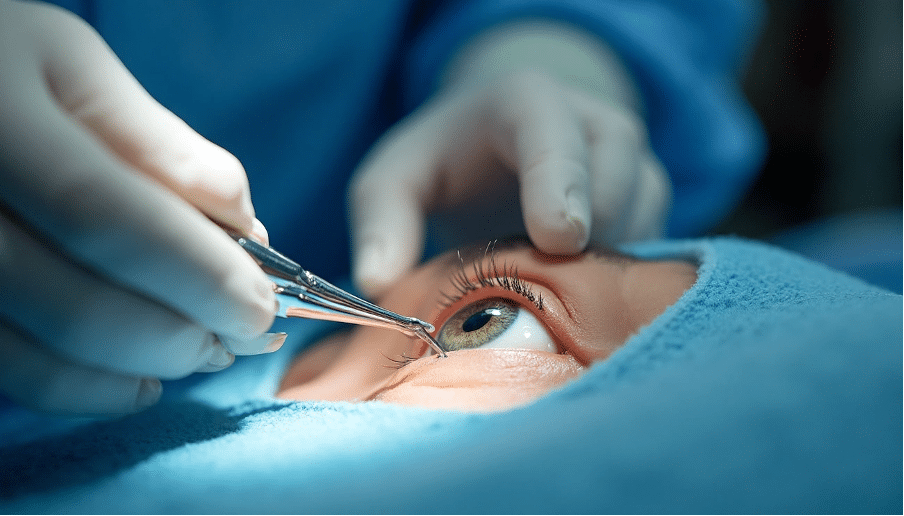
ICL is a vision correction surgery where a soft, flexible, biocompatible lens is implanted inside the eye, behind the iris and in front of the natural lens.
How ICL Works
Unlike LASIK, ICL does not reshape the cornea. Instead:
- A small opening is made in the cornea.
- A soft Collamer lens is folded and inserted inside the eye.
- The lens unfolds and sits comfortably behind the iris.
It works like a contact lens that stays inside the eye, and it can be removed if needed.
Who May Suit ICL?
- People with very high powers (up to about –20D).
- Individuals with a thin or irregular cornea.
- Patients suffering from dry eye disease.
- Adults aged about 21 to 45 with stable power, enough space inside the eye and healthy corneal cells.
Advantages of ICL
- Can correct higher powers than LASIK.
- No corneal cutting or tissue removal.
- Reversible or replaceable.
- Maintains corneal integrity.
- Linked with less dry eye than laser surgery.
Limitations of ICL
- Usually more expensive than LASIK.
- Requires surgery inside the eye.
- Raised eye pressure, which is usually short-term and treatable.
- A small risk of earlier cataract, higher in people over 40.
- Glare or halos, infection or inflammation, lens shifting and loss of corneal cells.
- Rarely, retinal detachment or glaucoma.
ICL vs LASIK: Detailed Comparison
1. Power Correction
- LASIK: Effective for low to moderate myopia.
- ICL: Can treat higher powers, up to about –20D.
In short: ICL can treat higher powers.
2. Corneal Thickness
- LASIK: Needs enough corneal thickness for safe reshaping.
- ICL: Does not reshape the cornea, so it may suit some thin corneas.
In short: ICL may suit thin corneas; LASIK needs enough thickness.
3. Dry Eye Issues
- LASIK: May worsen dryness because it affects corneal nerves.
- ICL: Does not cut corneal nerves, so it is linked with less dry eye.
In short: ICL is linked with less dry eye.
4. Quality of Vision
- LASIK: Good vision for suitable candidates; glare or halos can occur.
- ICL: An option for high powers and thin corneas; glare or halos can occur.
In short: Both can give good vision in suitable eyes.
5. Reversibility
- LASIK: Permanent and irreversible.
- ICL: Fully reversible—lens can be removed or upgraded.
In short: ICL can be reversed; LASIK cannot.
6. Safety
Both are approved procedures, and both have risks.
- LASIK: Works on the cornea, so there is no surgery inside the eye; risks include dry eye and flap problems.
- ICL: Surgery inside the eye; careful screening and follow-up help lower risks such as raised pressure and cataract.
In short: It depends on your eyes.
After either surgery, go to an emergency department straight away, or call 108 or 112, if you have sudden loss of vision, severe eye pain, or a curtain or shadow over your vision.
7. Recovery Time
- LASIK: Vision generally good within a few days; full healing can take 2–3 months.
- ICL: Vision often improves within 24 hours; full improvement may take a week to 10 days.
In short: Both have quick recovery for most people.
8. Long-term Stability
- LASIK: Usually stable, but in a few people vision slowly changes back.
- ICL: Usually stable; the lens may need to be removed or changed, for example if a cataract develops.
In short: Both are usually stable; each has its own long-term issues.
Which One Should You Choose?
Choosing between ICL and LASIK is not about which technique is “better.” Instead, it depends entirely on your eye condition, including:
Your power (myopia level)
Corneal thickness
Corneal shape
Dry eye condition
Pupil size
Overall eye health
LASIK May Suit You If:
- Your cornea is thick enough.
- Your power is moderate.
- You prefer a quick, simple laser procedure.
ICL May Suit You If:
- Your power is very high.
- You have a thin cornea.
- You suffer from dry eyes.
- You want an option that can be reversed.
Why Clinical Evaluation Is Important
Before deciding, you must undergo a detailed eye evaluation, including:
- Corneal topography
- Pachymetry (corneal thickness)
- IOP test
- Pupil size assessment
- Tear film evaluation
- Retina check
- Refractive stability test
These tests help choose the right option for you and lower the risk of problems.
Final Thoughts
Both LASIK and ICL can reduce the need for glasses. The decision depends on your eye’s structural parameters, your lifestyle needs, and the advice of your eye specialist.
For many young patients with high power, thin corneas, or dryness, ICL may be the more suitable option.
For those with moderate power and healthy corneas, LASIK may be a quick and suitable option.
A detailed check-up with an eye surgeon helps you choose the option that suits your eyes. The eye care (ophthalmology) department at Chetna Hospital, Chinchwad, can assess your eyes. Call 91686 90442 to book a check-up.
General health information, not a diagnosis. Reviewed and updated by Chetna Hospital’s content team with the help of AI writing tools, November 2026.