Table of Contents
- What is a Compound Nevus? Symptoms, Causes & Compound Nevus Treatment
- Symptoms of Compound Nevus
- Causes of Compound Nevus
- When to Consult a Specialist
- When Should You Consider Compound Nevus Treatment?
- High-Intent “Call-to-Action” Section
- Why Choose Dr. Aishwarya Patil in PCMC?
- Advanced Techniques for Compound Nevus Treatment
- The Compound Nevus Treatment Process
- Recovery and Aftercare
Compound Nevus Treatment - Preventive Measures
- Cost Considerations
- Final Thoughts
- Frequently Asked Questions About Compound Nevus Treatment
What is a Compound Nevus? Symptoms, Causes & Compound Nevus Treatment
Compound Nevus Treatment – Advanced Options & Expert Care
A compound nevus is a common type of mole (melanocytic nevus) formed by pigment-producing cells located in both the outer layer (epidermis) and the deeper layer (dermis) of the skin. It is usually slightly raised, round or oval, symmetrical, and ranges in color from flesh-toned to dark brown. Although most compound nevi are benign (non-cancerous), professional evaluation is important if there are noticeable changes.
Symptoms of Compound Nevus
Most compound nevi are harmless and do not cause discomfort. Common characteristics include:
- Raised, dome-shaped appearance
- Smooth or slightly rough surface
- Even pigmentation (light brown to dark brown)
- Well-defined, symmetrical borders
- Usually small (less than 6 mm in diameter)
Warning Signs (When to See a Dermatologist)
Seek medical attention if you notice:
- Rapid increase in size
- Irregular or blurred borders
- Multiple colors within the mole
- Itching, bleeding, or crusting
- Sudden change in shape or texture
These changes may require further evaluation to rule out melanoma or other skin conditions.
Causes of Compound Nevus
Compound nevi develop due to a cluster of melanocytes (pigment-producing cells). Contributing factors include:
- Genetics – Family history of moles
- Sun exposure – UV radiation stimulates melanocyte growth
- Hormonal changes – Common during puberty or pregnancy
- Skin type – More common in individuals with lighter skin tones
When to Consult a Specialist
If your mole shows any unusual changes or causes discomfort, consult a qualified dermatologist. Residents in PCMC can seek expert evaluation with Dr. Aishwarya Patil, who offers advanced dermoscopy and modern treatment techniques to accurately diagnose and manage compound nevi.
What Sets a Compound Nevus Apart?
Unlike flat nevi confined solely to the epidermal surface, compound nevi extend deeper into dermal tissue. Consequently, they often possess dimension and depth, making them more palpable and visually distinct.
Moreover, pigment distribution within these moles may appear uneven. Because of this variation, patients sometimes fear malignant transformation. However, although concern is natural, not every irregularity signifies danger. Even so, observation remains essential.
Typically, compound nevi develop during childhood or adolescence. Nevertheless, they may emerge later in adulthood. Furthermore, individuals with fair complexions or prolonged ultraviolet exposure are statistically more predisposed.
When Should You Consider Compound Nevus Treatment?
Importantly, not every compound nevus requires removal. However, certain warning indicators necessitate prompt attention. In this regard, the ABCDE guideline serves as a structured framework:
- Asymmetry: One portion differs significantly from the other.
- Border Irregularity: Edges appear jagged, blurred, or poorly defined.
- Color Variation: Multiple shades or abrupt tonal shifts develop.
- Diameter: Expansion beyond 6mm raises suspicion.
- Evolution: Any alteration in size, shape, color, or sensation.
High-Intent “Call-to-Action” Section
Worried About a Changing Mole? Don’t rely on a Google search for a medical diagnosis. Dr. Aishwarya Patil uses Dermoscopy (polarized light magnification) to see beneath the skin’s surface and provide instant peace of mind.Chetna Multispeciality Hospital
📞 Call 9607753535 / 9158681123 | 💬 Chat on WhatsApp| Book your appointment | 📍 Visit Clinic in Chetna Hospital, Sambhaji Nagar Rd, Chinchwad, Pimpri-Chinchwad, Pune, Maharashtra 411019
Additionally, Watch for These Signs
Beyond the ABCDE criteria, you should also monitor for:
- Unexplained bleeding or oozing
- Persistent itching or tenderness
- Rapid enlargement over a short period
- Satellite spots surrounding the primary lesion
- Surface transformation, such as scaling or crusting
If any of these manifestations arise, then compound nevus treatment becomes both medically advisable and cosmetically beneficial.
Why Choose Dr. Aishwarya Patil in PCMC?
When selecting a dermatologist, expertise and discernment matter profoundly. In this context, Dr. Aishwarya Patil stands as a distinguished authority in Pimpri Chinchwad Municipal Corporation (PCMC).
Not only is she a board-certified dermatologist, but she is also widely recognized as a leading skin specialist in Pimpri Chinchwad. Furthermore, her clinical philosophy merges diagnostic acuity with aesthetic refinement. Consequently, patients receive care that is simultaneously precise and considerate.
In addition, Dr. Patil remains actively engaged in international dermatological forums. Therefore, her treatment protocols reflect contemporary advancements rather than outdated conventions.
A Patient-Centered Philosophy
Equally important, Dr. Patil prioritizes patient comprehension. Before proceeding with any compound nevus treatment, she thoroughly explains the condition, procedural steps, and anticipated outcomes. As a result, patients experience reduced anxiety and enhanced confidence.
Moreover, her clinic environment in PCMC combines technological sophistication with a welcoming design. Thus, patients feel reassured from consultation through recovery.
Advanced Techniques for Compound Nevus Treatment
Depending on lesion characteristics, Dr. Aishwarya Patil selects the most suitable modality. In doing so, she ensures individualized precision rather than generic application.
Fractional CO2 Laser Ablation
First and foremost, fractional CO2 laser technology allows for meticulous targeting of pigmented cells. Because the laser isolates affected tissue while preserving surrounding skin, healing tends to be faster, and scarring is minimal.
For instance, a 28-year-old patient presented with a gradually enlarging facial compound nevus. After careful evaluation, Dr. Patil performed a single-session laser ablation. Subsequently, the lesion was completely removed, downtime was brief, and no visible scarring remained. Within three days, the patient resumed professional activities.
Surgical Excision with Margin Analysis in Compound Nevus Treatment
Alternatively, when a lesion is sizable or clinically suspicious, surgical excision becomes appropriate. In such cases:
- Local anesthesia ensures comfort.
- Calculated margins reduce recurrence risk.
- Immediate pathological review confirms completeness.
- Advanced suturing techniques minimize residual marks.
Therefore, this method provides both therapeutic assurance and aesthetic mindfulness.
Dermoscopy-Guided Assessment
Before selecting a treatment path, Dr. Patil employs dermoscopy. Through magnified visualization, subtle structural patterns become apparent. Consequently, diagnostic accuracy improves significantly.
Radiofrequency Ablation
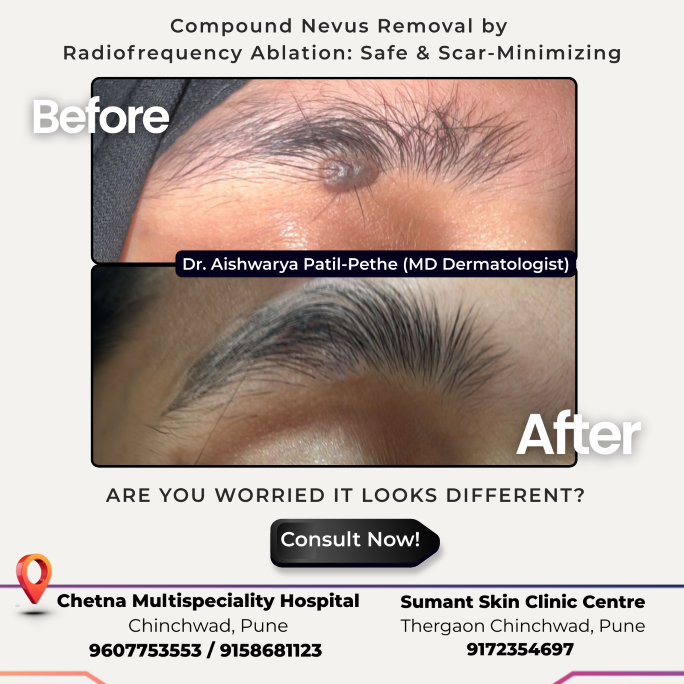
In selected scenarios, radiofrequency ablation offers another refined option. Because this method uses controlled thermal energy, it removes the lesion while sealing blood vessels simultaneously. As a result, bleeding is reduced, and recovery is streamlined.
The Compound Nevus Treatment Process
Initial Consultation in Compound Nevus Treatment
At the outset, your compound nevus treatment journey begins with a comprehensive consultation. During this visit:
- A detailed medical history is recorded.
- A full skin examination is conducted.
- Dermoscopic imaging is performed.
- Photographs are captured for comparison.
- Treatment options are discussed transparently.
Pre-Treatment Preparation in Compound Nevus Treatment
Before the procedure, patients are advised to:
- Avoid sun exposure for at least two weeks.
- Discontinue medications that elevate bleeding risk.
- Stop retinoid application in the treatment zone.
- Arrange transportation if sedation is anticipated.
On Treatment Day
On the scheduled day:
- The area is cleansed and marked precisely.
- Local anesthesia is administered.
- The chosen technique is executed with meticulous attention.
- Post-procedure dressing and instructions are provided.
Follow-Up Schedule
Thereafter, healing is monitored at regular intervals:
- 3–5 days
- 2 weeks
- 6–8 weeks
- Annual dermatological evaluations
Recovery and Aftercare
Compound Nevus Treatment
Immediately After Treatment
During the first 48 hours:
- Keep the area clean and dry.
- Apply prescribed ointments as directed.
- Avoid strenuous activities.
- Elevate the head if facial treatment was performed.
Weeks 1–2
Subsequently:
- Clean gently with mild soap.
- Continue medication use.
- Avoid swimming and sauna exposure.
- Shield the area from sunlight.
Weeks 3–6
As healing advances:
- Gradually resume regular activities.
- Begin gentle scar massage if advised.
- Apply high-SPF sunscreen consistently.
Long-Term Care
Ultimately, maintaining skin vigilance is essential:
- Perform monthly self-examinations.
- Schedule annual check-ups with Dr. Patil.
- Practice disciplined sun protection.
- Report new or changing lesions immediately.
Preventive Measures
Sun Protection
Above all, ultraviolet defense is foundational. Therefore:
- Use broad-spectrum SPF 30+ daily.
- Reapply every two hours outdoors.
- Seek shade during peak UV periods.
- Wear protective garments.
- Avoid tanning beds entirely.
Routine Monitoring
Additionally:
- Examine your skin monthly.
- Photograph existing moles for comparison.
- Seek assistance for hard-to-view areas.
Lifestyle Optimization
Moreover:
- Consume antioxidant-rich foods.
- Maintain adequate hydration.
- Avoid smoking.
- Manage stress effectively.
Cost Considerations
Naturally, compound nevus treatment costs vary. Factors influencing pricing include:
- Lesion size and anatomical location
- Procedural complexity
- Technology utilized
- Pathological analysis requirements
- Follow-up frequency
Importantly, Dr. Patil believes in transparent financial discussions. Furthermore, her clinic assists with insurance verification, claims processing, and flexible payment arrangements.
Final Thoughts
Ultimately, choosing compound nevus treatment is both a medical and aesthetic decision. Therefore, selecting an experienced dermatologist is paramount.
Under the guidance of Dr. Aishwarya Patil, residents of PCMC receive comprehensive, attentive, and technologically advanced care. Not only does she combine clinical expertise with refined technique, but she also ensures that every patient feels informed and supported.
If you have observed changes in a mole — or if uncertainty lingers — then timely evaluation is wise. Early assessment, after all, provides reassurance and optimal outcomes.
To take the next step toward healthier, radiant skin, schedule your consultation with Dr. Aishwarya Patil, the trusted skin specialist in PCMC.
3. FAQ Section
Frequently Asked Questions About Compound Nevus Treatment
Q1: Is compound nevus removal painful? A: Not at all. Dr. Aishwarya Patil performs removal using local anesthesia or advanced CO2 lasers. Most patients describe the sensation as a minor pinch, and the procedure is completed in 15–30 minutes.
Q2: Will mole removal leave a permanent scar? A: When performed by a board-certified dermatologist like Dr. Aishwarya Patil, scarring is minimized. We use Fractional CO2 Laser or Radiofrequency Ablation, which promotes rapid healing with almost invisible marks compared to traditional “shave” methods.
Q3: How much does compound nevus treatment cost in PCMC? A: The cost of mole removal in Pimpri Chinchwad depends on the size, location, and method (Laser vs. Surgical). Prices typically start from a base consultation fee, with procedures tailored to your specific skin type.
Q4: Can a compound nevus turn into cancer (Melanoma)? A: While the risk is low, any mole that changes in color, shape, or starts itching should be examined immediately. Dr. Aishwarya Patil uses the ABCDE criteria to screen for any signs of malignancy.