Breast lump surgeon PCMC at Chetna Hospital
When an Unexpected Lump Interrupts Your Peace
At times, life moves quietly—until something unfamiliar disrupts it. For many women, that disruption arrives in the form of a breast lump. Immediately, the mind begins to race. Soon after, unease follows. Naturally, fear attempts to take control.
However, while anxiety is instinctive, it is not informative. Instead, structured medical clarity provides steadiness. Therefore, the wisest first step is not assumption but evaluation.
Breast lump surgeon PCMC At Chetna Hospital in Pimpri Chinchwad, Dr. Dhananjay Patil, Consultant General Surgeon, approaches every case with disciplined calm. Not only does he rely on evidence-based medicine, but he also prioritizes emotional reassurance. Consequently, patients feel heard as well as treated.
If you are considering breast lump removal in PCMC—or searching for an experienced surgeon near Ravet—the journey must begin with methodical assessment rather than speculation.
Understanding Breast Lumps More Clearly
What Is a Breast Lump, Exactly?
In simple terms, a breast lump is an area of tissue that feels distinct from its surroundings. Sometimes it appears firm; at other times, it may feel soft or elastic. In certain cases, it moves freely beneath the skin; conversely, it may feel anchored. It may cause discomfort or, instead, remain entirely painless.
Importantly, although the discovery can be distressing, nearly 80% of breast lumps are non-cancerous. Nevertheless, every newly discovered lump deserves professional review. Only through systematic examination can its true nature be confirmed.
Types of Breast Lumps
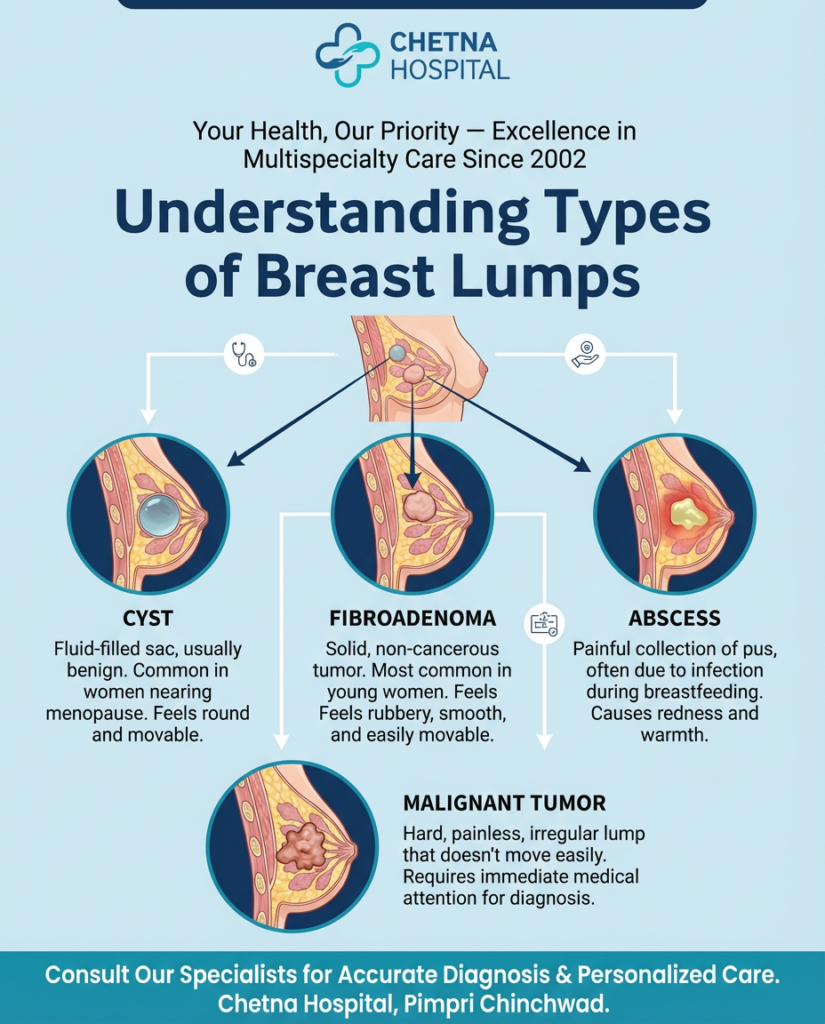
Breast tissue can develop different forms of growth. While many are harmless, others require closer attention.
Common Benign (Non-Cancerous) Lumps
For example:
- Fibroadenomas – Smooth, rubber-like, clearly defined masses
- Cysts – Fluid-filled sacs that may fluctuate with hormones
- Fat necrosis – Firm tissue changes, often after minor trauma
- Lipomas – Soft fatty growths beneath the skin
- Phyllodes tumors – Rare growths that require structured monitoring
Although these are typically benign, confirmation remains essential. Therefore, clinical evaluation ensures reassurance rather than uncertainty.
Breast Lump Surgeon PCMC, Lumps That Require Immediate Attention
On the other hand, certain warning features should prompt swift consultation. Specifically:
- Very hard or jagged lumps
- Masses attached to the skin or the chest wall
- Rapid enlargement within weeks
- Noticeable distortion of breast contour
In such scenarios, early intervention significantly improves clarity and outcomes.
Symptoms That Should Never Be Ignored
If you are contemplating breast lump removal in PCMC, observe accompanying signs. For instance:
- A new lump in the breast or underarm
- Sudden change in size or symmetry
- Skin dimpling or puckering
- Nipple discharge unrelated to breastfeeding
- Inward turning of the nipple
- Persistent pain in one localized area
- Redness or scaling over the breast
While many of these symptoms arise from non-serious causes, evaluation ensures safety. Thus, it is always better to confirm than to assume.
When Should You See a Breast Lump Surgeon in PCMC?
You should seek prompt consultation if you notice:
- Any new lump
- Changes in an existing lump
- Bloody nipple discharge
- Skin resembling an orange peel texture
- Continuous one-sided pain
- Swelling beneath the arm or near the collarbone
Above all, early consultation reduces both medical risk and emotional strain. Moreover, timely detection often simplifies treatment pathways.
Age and Breast Health: Why Timing Matters
Breast health evolves. Accordingly, screening recommendations shift with age.
Below 30 Years
Hormonal fluctuations frequently cause temporary lumps. In most cases, these are harmless. Even so, medical evaluation remains prudent.
Ages 30–39
At this stage, routine examinations become increasingly valuable. Additionally, discussing family history becomes critical. Therefore, regular clinical check-ups are strongly encouraged.
Above 40 Years
Annual mammograms are recommended. Furthermore, any new lump should be examined without delay. In fact, early detection at this stage often leads to excellent outcomes.
Breast lump surgeon PCMC: Precision Guided by Compassion
Dr. Dhananjay Patil, a respected breast lump surgeon in PCMC and Consultant General Surgeon at Chetna Hospital, blends technical mastery with empathetic care. Not only does he possess advanced surgical expertise, but he also ensures that patients understand every step of their journey.
Professional Strengths
- Advanced surgical training
- Extensive experience in breast procedures
- Consistent record of successful outcomes
- Ongoing commitment to medical advancement
- Personalized treatment planning
His Approach to Patient Care
Dr. Patil believes that clarity precedes surgery. Therefore, he emphasizes a complete diagnostic evaluation before intervention. In addition, he maintains transparent communication. Whenever possible, he adopts minimally invasive techniques. Furthermore, he ensures structured post-operative follow-up. Most importantly, he encourages shared decision-making.
As a result, patients feel empowered rather than overwhelmed.
Breast Lump Surgeon PCMC: A Structured Evaluation Process
Before surgery is considered, a systematic pathway is followed.
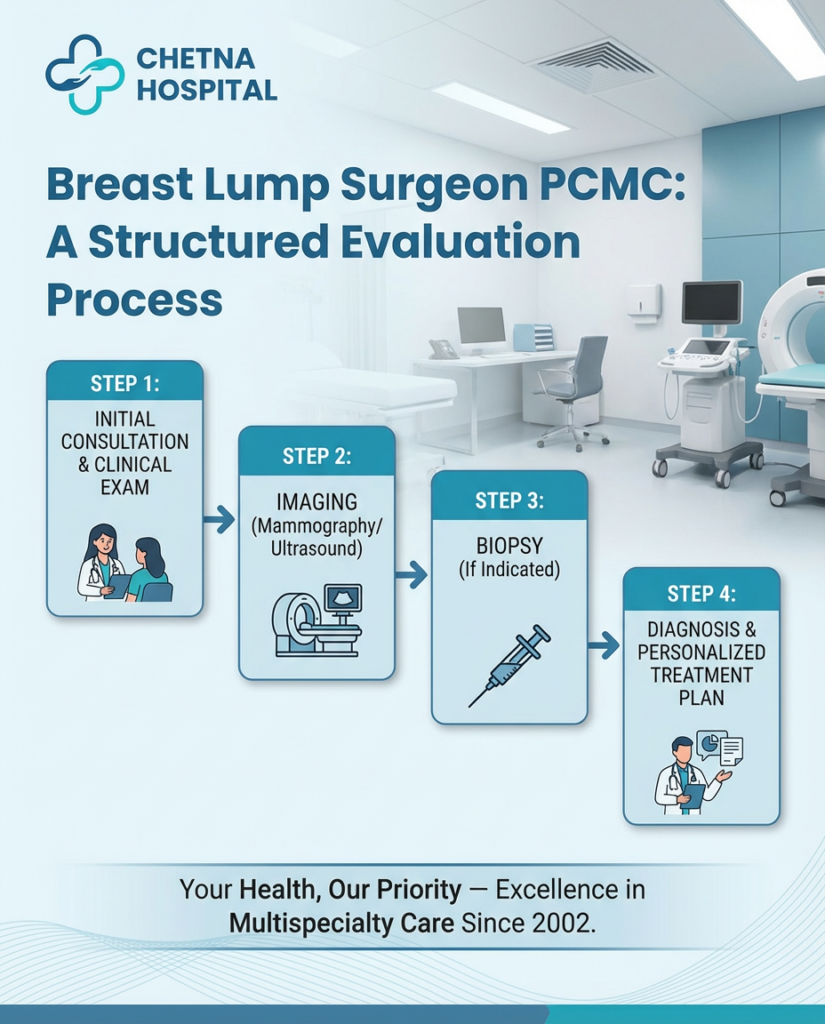
1. Clinical Examination
Initially, this involves:
- Detailed medical history
- Comprehensive physical assessment
- Risk evaluation
- Symptom discussion
Through this process, foundational clarity is established.
2. Imaging Studies
Subsequently, imaging offers deeper insight:
- Mammography – Detailed breast X-ray
- Ultrasound – Differentiates solid from fluid-filled lumps
- MRI – Used in complex cases
- CT scan – Performed when staging is necessary
Together, these tools refine diagnosis.
3. Biopsy (If Required)
If imaging leaves uncertainty, tissue sampling becomes necessary. Options include:
- Fine Needle Aspiration (FNA)
- Core Needle Biopsy
- Vacuum-Assisted Biopsy
- Surgical Biopsy
Only after diagnostic confirmation does surgical planning proceed.
Surgical Options for Breast Lump Removal
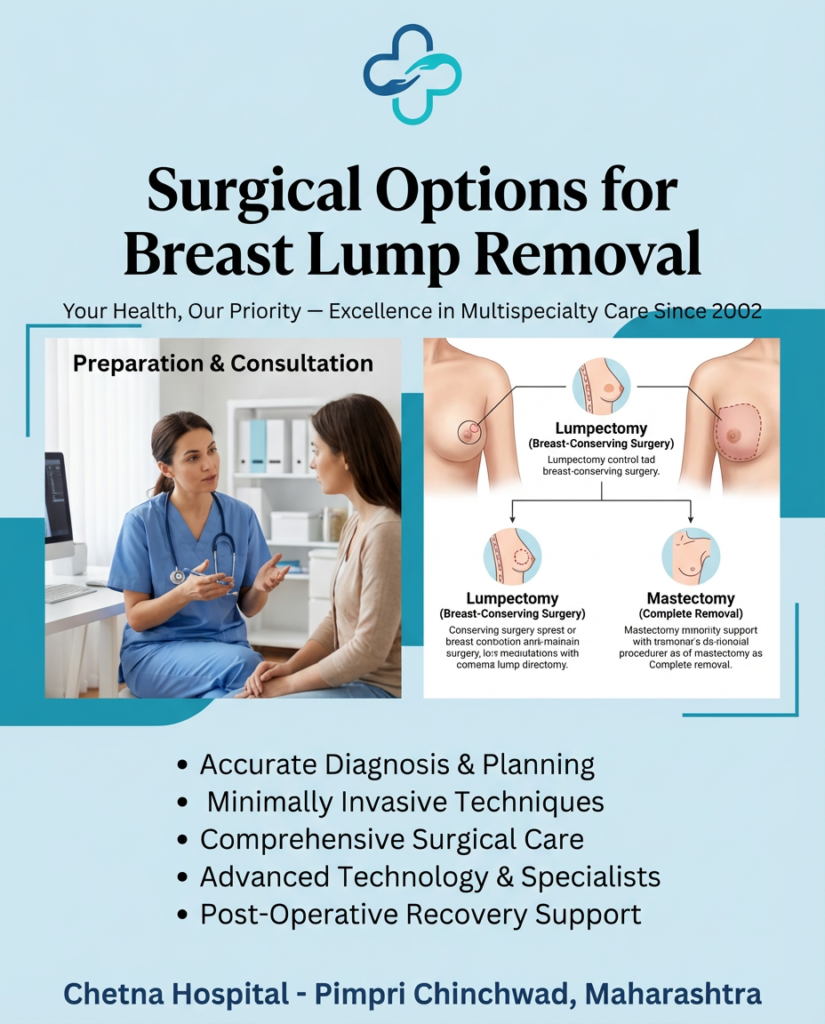
Treatment varies depending on the pathology.
Lumpectomy
In many situations, only the lump and a small margin require removal. Typically, this is a day-care procedure. Consequently, recovery is often swift.
Wide Local Excision
When broader margins are necessary, this approach ensures thorough removal while preserving breast contour.
Mastectomy
In specific cases, complete breast removal is recommended. However, reconstruction options are carefully discussed beforehand. Thus, patients remain informed and prepared.
Advanced Surgical Techniques
To enhance both safety and aesthetics, modern approaches are utilized. These include image-guided surgery and vacuum-assisted removal. Additionally, oncoplastic techniques combine tumor removal with cosmetic refinement. When indicated, a sentinel lymph node biopsy is also performed.
Therefore, treatment prioritizes both medical precision and physical confidence.
Dr. Dhananjay Patil provides specialized surgical care for residents living within a 5km radius of Chetna Hospital, including those in Ravet, Nigdi, Akurdi, and Thergaon, Talawade. Our facility in Chinchwad is equipped with advanced diagnostic tools to ensure patients in the PCMC area receive immediate, world-class attention without the need for long-distance travel.
Why Choose Chetna Hospital?
Chetna Hospital in Pimpri Chinchwad offers advanced imaging, modern operating theatres, strict sterilization standards, and 24/7 emergency care. Moreover, a coordinated team of specialists collaborates closely. As a result, care remains comprehensive and seamless.
Importantly, patients receive guidance at every stage—not merely treatment.
What to Expect During Surgery
Before Surgery
First, detailed consultation and investigations are completed. Then, medication review and fasting instructions are provided. Breast Lump Surgery at Chetna Hospital
On Surgery Day, Breast Cyst Aspiration Doctor,
Next, admission procedures are finalized. After anesthesia assessment, the operation proceeds with precision.
After Surgery
Finally, monitoring ensures stability. Pain control measures are initiated. Clear wound-care instructions follow. Subsequently, follow-up visits are scheduled.
Recovery and Aftercare
First Week
Mild swelling and discomfort are common. Therefore, limited arm movement may occur. Adherence to instructions supports smooth healing.
Weeks 2–4
Gradually, daily routines resume. If required, sutures are removed. Light work can often restart during this period.
After One Month
Most regular activities can be resumed. Nevertheless, follow-up evaluations remain essential.
If heavy bleeding, infection signs, rising pain, unusual discharge, or fever develop, contact the doctor immediately. Early reporting, in turn, prevents complications.
Prevention and Screening: A Proactive Approach
Monthly Self-Examination
Every month, perform a self-exam. Look carefully for lumps, skin changes, or nipple alterations. If anything unusual appears, seek evaluation promptly.
Screening Recommendations
- 20–39 years: Clinical exam every 1–3 years
- 40–49 years: Annual mammogram
- 50+ years: Yearly mammogram
- High-risk individuals: Earlier and customized screening
By following these guidelines, risk is significantly reduced.
Healthy Lifestyle Measures
In addition, maintaining a healthy weight, exercising regularly, limiting alcohol, avoiding smoking, and understanding family history collectively strengthen protection.
Cost and Insurance Transparency
The cost of breast lump removal in PCMC depends on the type of surgery, hospital stay duration, and diagnostic requirements. Fortunately, most insurance plans cover medically necessary procedures.
At Chetna Hospital, billing remains transparent. Furthermore, financial guidance is clearly explained. Consequently, patients avoid unexpected expenses.
Patient Experiences
For instance, a 35-year-old woman detected a lump during self-examination. After evaluation confirmed a benign fibroadenoma, lumpectomy allowed for rapid recovery.
Similarly, a 42-year-old patient with a family history underwent early screening. As a result, detection occurred at a manageable stage.
In a more complex scenario, multidisciplinary collaboration ensured excellent outcomes under Dr. Patil’s supervision.
Patients consistently describe him as calm, clear, and reassuring. Indeed, his balanced approach cultivates trust.
Patient FAQs in PCMC
Most residents seek a General Surgeon with expertise in proctology and oncology, such as Dr. Dhananjay Patil at Chetna Hospital. Patients prioritize surgeons who offer minimally invasive, scarless techniques and have 20+ years of experience in the PCMC region.
Statistically, over 80% of breast lumps are benign (non-cancerous), such as fibroadenomas or cysts. However, surgeons in the Nigdi/Akurdi belt recommend an immediate clinical exam and ultrasound to rule out malignancy, especially for firm, fixed lumps.
Using minimally invasive methods, Dr. Dhananjay Patil ensures a quick turnaround. Most patients are discharged within 4–6 hours. You can typically return to a desk job in Talawade or Hinjewadi within 24 to 48 hours, with full recovery in about a week.
Modern surgical techniques focus on aesthetics. By using “hidden-scar” incisions—either in the natural breast crease or around the nipple—surgeons ensure the mark is nearly invisible once healed. This is a primary concern for patients in the Ravet and Chinchwad areas.
A surgeon may remove a larger area of tissue (Wide Local Excision) if the lump has irregular borders or is a recurring fibroadenoma. This ensures healthy margins and reduces the chance of the lump returning, providing long-term peace of mind.
Schedule a Consultation
If you have discovered a lump—or if breast health concerns persist—consult:
Dr. Dhananjay Patil
Consultant General Surgeon
Chetna Hospital, Pimpri Chinchwad (PCMC), Pune
📅 Book Your Consultation with Dr. Patil
Chetna Hospital, Chinchwad – Open 24/7 for Emergencies
Call Chetna Hospital At
Call: +918390861787
Ultimately, early evaluation restores confidence. Although most breast lumps are benign, only a structured medical assessment can confirm that certainty. Therefore, take the step that replaces fear with clarity—and uncertainty with informed action.