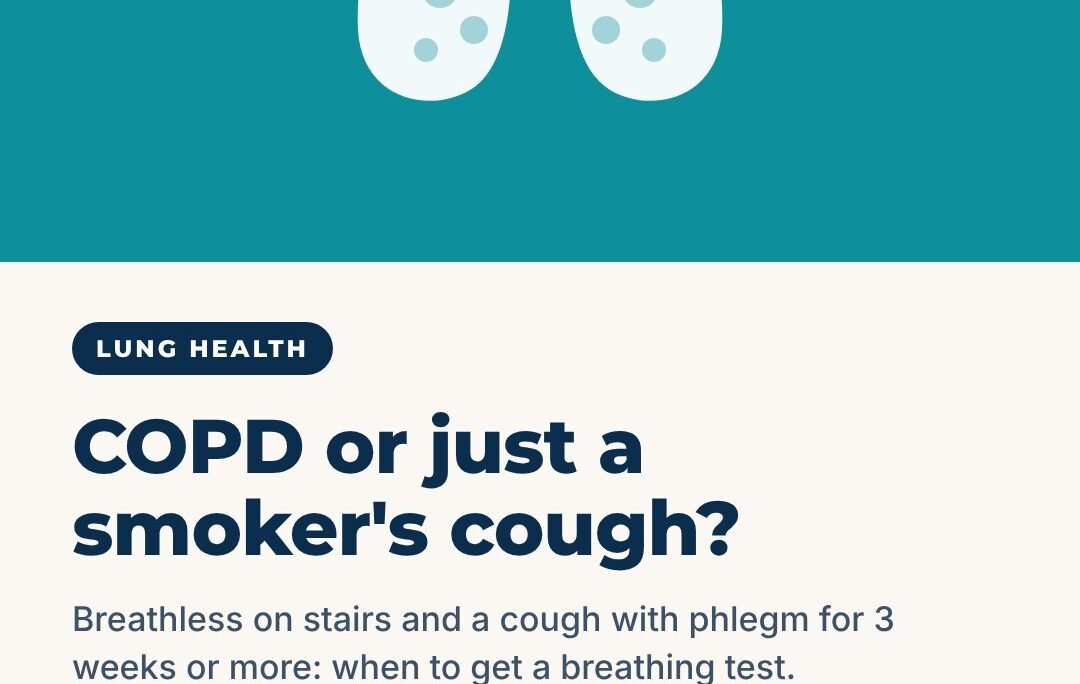
A cough with phlegm that keeps coming back, and getting out of breath doing things you used to do easily, are the main symptoms of COPD (chronic obstructive pulmonary disease), according to the NHS. The NHS advises seeing a doctor if you have been coughing for 3 weeks or more, if you keep getting chest infections, or if you are getting breathless doing things that never used to take much effort. A simple breathing test called spirometry is used to confirm COPD.
Call 91586 80739Book on GoogleWhatsApp
Key takeaways
- COPD causes a long-lasting cough, often with phlegm, breathlessness on exertion and frequent chest infections.
- It is not only a smoker’s disease: dust, fumes, chemicals and smoke from cooking fuels also raise the risk, according to the WHO.
- A cough lasting 3 weeks or more is the NHS threshold for seeing a doctor.
- Spirometry, a breathing test, confirms the diagnosis.
- COPD cannot be cured, but stopping smoking, inhalers, vaccines and pulmonary rehabilitation help symptoms.
- Severe breathlessness, blue or grey lips, or chest pain spreading to the arm or jaw is an emergency.
In this article
- What is COPD?
- What are the symptoms of COPD?
- Is it just a smoker’s cough?
- Who is at risk of COPD?
- Why does COPD get worse in winter?
- How is COPD diagnosed?
- How is COPD treated?
- When is breathlessness an emergency?
- How should you prepare for a lung check-up?
- Frequently asked questions
18 November 2026 is World COPD Day. Many people in Chinchwad, Pimpri, Nigdi and Akurdi live with a morning cough and slowly worsening breathlessness for years and put it down to smoking, age or winter weather. This guide explains, using NHS and WHO information, what COPD symptoms look like, who is at risk and when to get a breathing test.
What is COPD?
The WHO describes COPD as a common lung disease that restricts airflow and causes breathing problems. It is sometimes called emphysema or chronic bronchitis. In COPD, the lungs can be damaged or clogged with phlegm.
The WHO reports that COPD is the third leading cause of death worldwide, causing 3.4 million deaths in 2023, about 6% of all deaths. Nearly 90% of COPD deaths in people under 70 happen in low- and middle-income countries.
What are the symptoms of COPD?
The NHS lists these symptoms:
- shortness of breath during or after activities you used to do easily, such as walking uphill or climbing stairs
- a cough that does not go away and brings up mucus (phlegm)
- frequent chest infections
The WHO adds wheezing and tiredness. Symptoms usually start gradually, from mid-life onwards, and get worse over time. In advanced COPD, a person may be short of breath all the time.
Is it just a smoker’s cough?
A cough that has become “normal” is the easiest symptom to ignore. If you smoke, or used to smoke, and you cough up phlegm most mornings or get out of breath more easily than people your age, it is worth a breathing test rather than assuming it is only a smoker’s cough.
COPD and asthma share symptoms such as cough, wheeze and breathlessness, and the WHO notes that some people have both. A doctor can help tell them apart.
Who is at risk of COPD?
Smoking is a major cause, but not the only one. The WHO lists:
- smoking, and breathing other people’s smoke
- dust, fumes or chemicals at work
- smoke from burning wood, dung, crop waste or coal for cooking or heating
- poor lung growth from early life, such as prematurity or frequent chest infections in childhood
- asthma in childhood
- a rare genetic condition called alpha-1 antitrypsin deficiency
The WHO says tobacco accounts for 30–40% of COPD cases in low- and middle-income countries, where household air pollution is a major risk factor. Outdoor air pollution also matters: the WHO attributes 14% of premature deaths linked to outdoor air pollution in 2019 to COPD.
Why does COPD get worse in winter?
The NHS calls a sudden worsening of symptoms a flare-up. Flare-ups can be triggered by chest infections, breathing in smoke or strong smells, and very cold, hot or windy weather. The WHO notes they usually last a few days and often need extra medicine. Cold mornings, smoky air and seasonal infections can all add up in winter.
How is COPD diagnosed?
A doctor will ask about your symptoms, whether you smoke and the kind of work you do. The NHS lists these tests:
- spirometry, a breathing test that measures how much air you can breathe out
- a chest X-ray
- blood tests
The WHO confirms that spirometry is the test used to confirm COPD.
How is COPD treated?
COPD cannot be cured, but treatment can improve symptoms, according to both the NHS and the WHO. Options include:
- Stopping smoking: the NHS calls this the main thing you can do to improve COPD.
- Inhalers: bronchodilators that widen the airways are the main medicines. Using the correct technique matters.
- Vaccines: the WHO advises yearly flu vaccination and pneumonia vaccination to prevent chest infections.
- Pulmonary rehabilitation: a course of exercise and education, usually 6 to 8 weeks long, according to the NHS.
- Oxygen for some people with severe COPD.
Do not start, stop or change inhalers or tablets without speaking to your doctor.
When is breathlessness an emergency?
The NHS advises emergency help if you have:
- severe difficulty breathing: gasping, choking or not able to get words out
- a chest that feels tight or heavy
- pain that spreads to your arms, back, neck or jaw
- lips or skin turning very pale, blue or grey (on brown skin, check the palms)
- sudden confusion
In India, call 108 for an ambulance or Chetna Hospital’s 24×7 emergency on 91586 80739. Do not drive yourself. The NHS also advises urgent medical advice if you have COPD and are more breathless than usual, are coughing up blood, or have pain or swelling in one leg.
How should you prepare for a lung check-up?
- how long you have had the cough, and whether you bring up phlegm
- which everyday activities now make you breathless
- how many chest infections you have had in the past year
- whether you smoke or used to smoke, and your work or cooking-fuel exposure
- all medicines and inhalers you use, with the inhalers themselves
Bring any earlier chest X-rays or reports.
Consultation near you
Chetna Hospital, Chinchwad: First Floor, Plot GP 116, Sambhaji Nagar Road, near HP Pump, near Rotary Club, G Block, MIDC, Chinchwad, Pune 411019. Call 91586 80739 (24×7 emergency and ambulance). Directions.
Frequently asked questions
What are the first signs of COPD?
According to the NHS, the main symptoms are shortness of breath during activities you used to do easily, a cough that does not go away and brings up phlegm, and frequent chest infections. They usually start gradually.
Can non-smokers get COPD?
Yes. The WHO lists breathing other people’s smoke, dust, fumes or chemicals at work, smoke from cooking fuels, childhood lung problems and a rare genetic condition as other causes.
How long should a cough last before I see a doctor?
The NHS advises seeing a doctor if you have been coughing for 3 weeks or more, or if you keep getting chest infections.
Which test confirms COPD?
Spirometry, a breathing test that measures how much air you can breathe out, is used to confirm COPD. A chest X-ray and blood tests may also be done.
Can COPD be cured?
No. The NHS and the WHO say COPD cannot be cured, but stopping smoking, inhalers, vaccines and pulmonary rehabilitation can improve symptoms.
When is COPD an emergency?
Severe difficulty breathing, a tight or heavy chest, pain spreading to the arms, neck or jaw, blue or grey lips or skin, or sudden confusion need emergency help. In India, call 108 or Chetna Hospital 24×7 on 91586 80739.
Coughing for 3 weeks or more, or breathless on the stairs? Get your lungs checked.
Call 91586 80739Book on GoogleWhatsApp

Your doctor: Dr Ashpak Bangi
Dr Ashpak Bangi, MBBS, MD (Anaesthesia), DNB (Critical Care Medicine), FNB Critical Care Medicine (KEM, Pune), European Diploma in Critical Care Medicine. Consultant physician and intensivist at Chetna Hospital, Chinchwad, with 14 years of experience. OPD Monday to Saturday, 10 am to 1 pm.
Sources
- NHS, Chronic obstructive pulmonary disease (COPD): https://www.nhs.uk/conditions/chronic-obstructive-pulmonary-disease-copd/
- WHO, Chronic obstructive pulmonary disease (COPD) fact sheet, 10 June 2026: https://www.who.int/news-room/fact-sheets/detail/chronic-obstructive-pulmonary-disease-(copd)
This article is general health information and does not replace a medical consultation. In an emergency in India, call 108 for an ambulance, or call Chetna Hospital 24×7 on 91586 80739.
Last updated: 18 November 2026