Appendicitis treatment in Chinchwad, PCMC starts with spotting the pain pattern early. Tummy pain that begins near the navel, settles in the lower right side within hours and keeps getting worse needs a same-day medical check. The general surgery department at Chetna Hospital sees patients with this kind of pain. Gas and indigestion usually bring bloating and wind; appendicitis pain keeps building.
OPD 1, Ground Floor, Chetna Hospital, Sambhaji Nagar Road, next to Pimpri Chinchwad Sahakari Bank, Sambhajinagar, Chinchwad, Pune 411019
Diwali falls on 8 November this year, and with chakli, karanji and ladoo on every plate, it is easy to blame any stomach ache on the food. This article explains the pattern of pain that should not be put down to a heavy meal.
Gas or appendicitis: how to tell them apart
Early appendicitis can feel a lot like indigestion, which is why people often take an antacid and wait. The difference usually shows up over the next few hours.
| What you notice | More like gas or indigestion | Possible appendicitis |
|---|---|---|
| Where and how it hurts | Cramps or a knotted feeling in the tummy, with fullness or bloating | Starts near the navel, then settles in the lower right side |
| Over a few hours | See a doctor if it does not go away or keeps coming back | Becomes constant and keeps getting worse |
| What makes it worse | Often comes on after a heavy or gassy meal | Pressing on the area, coughing or walking |
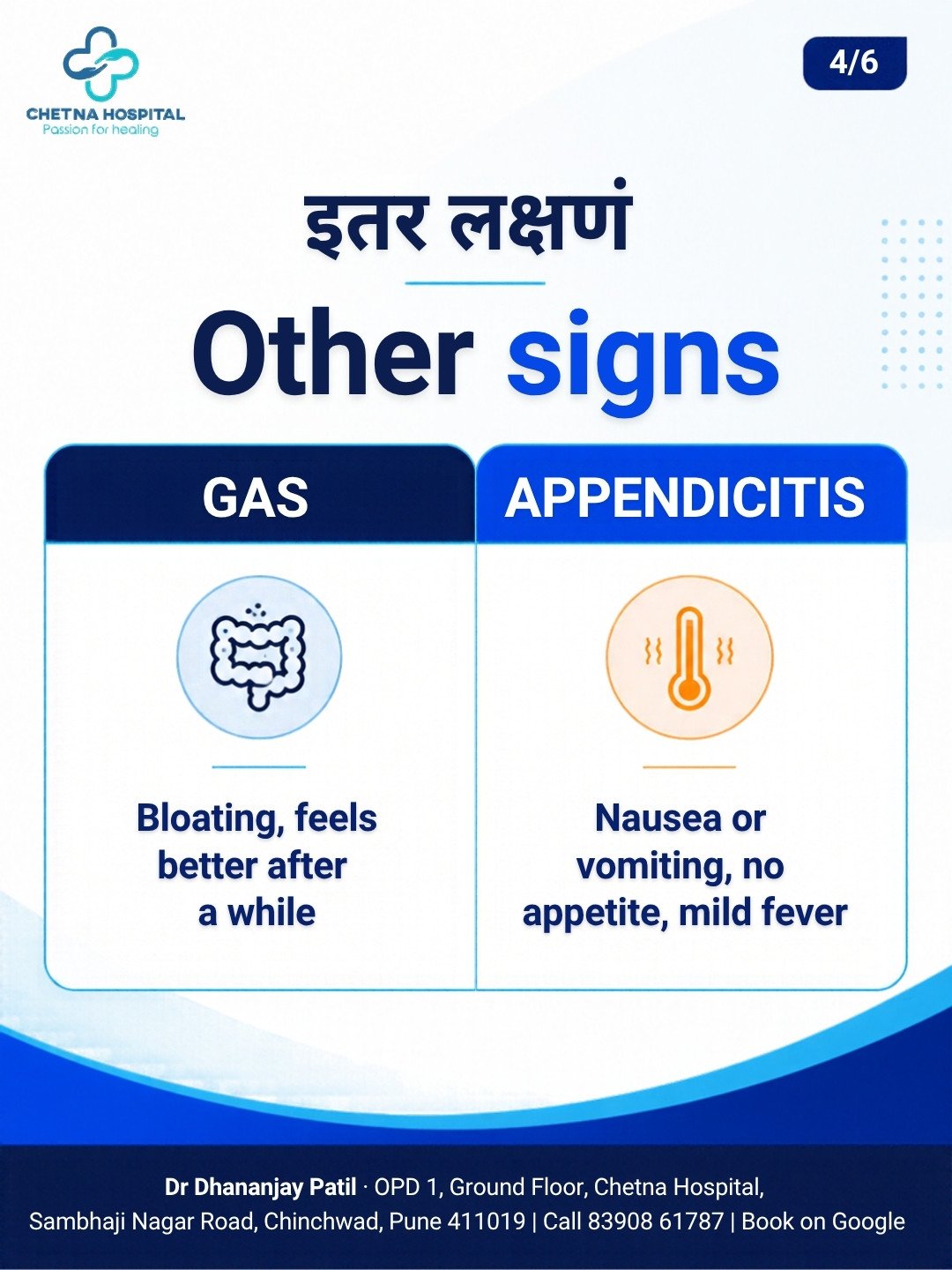
| Other signs | Burping, a lot of wind, heartburn, a swollen-feeling tummy | Nausea or vomiting, loss of appetite, mild fever, sometimes diarrhoea or constipation |
Northern Ireland’s health service, using NHS content, describes the appendicitis pattern: pain that starts in the middle of the tummy, moves to the lower right side within hours, and gets worse when you press on it, cough or walk (NI Direct). The gas and indigestion signs in the table are those listed by the NHS and Mayo Clinic.
One caution: bloating and gas can also happen with appendicitis (Mayo Clinic), and only about half of people with appendicitis have the classic pattern of symptoms (Cleveland Clinic). So the way the pain changes over a few hours matters more than any single sign.
How the pain usually changes
At first: a dull ache near the navel
The pain often begins as a vague ache around the belly button. It may come and go, and it is easy to put down to a heavy meal.
Within hours: it moves to the lower right side
The ache shifts down and to the right, where the appendix sits. Here it tends to become sharper and more constant. Walking, coughing or a jolting ride over a speed breaker often makes it worse (Mayo Clinic).
Alongside it: the body’s other signals
Loss of appetite is common. Nausea, vomiting and a low-grade fever can follow; the fever is usually no higher than 38°C (NI Direct). India’s ICMR treatment workflow for appendicitis notes that the pain comes before the vomiting, and that fever is usually absent in the first 6 hours (ICMR). Irish health service guidance describes the same pain pattern (HSE).
When it becomes an emergency
If the pain suddenly gets much worse and spreads across the whole tummy, the appendix may have burst. Go to an emergency department straight away or call 108. Do not drive yourself; ask someone to take you, and bring any medicines you take (NHS).
What happens when you come in with this pain
- History and examination. The surgeon asks where the pain started, how it has moved and what makes it worse, and gently examines the tummy. The diagnosis of appendicitis is mainly made on this examination (ICMR).
- Tests. Blood and urine tests, and usually an ultrasound or sometimes a CT scan, help confirm the diagnosis and rule out other causes such as a kidney stone, a urine infection or, in women, a gynaecological problem. Women may also be offered a pregnancy test (NHS Wales). No single test always confirms appendicitis, so doctors may watch how the symptoms change over a few hours.
- Treatment plan. Appendicitis usually needs surgery to remove the appendix. In many cases this can be done as keyhole (laparoscopic) surgery; open surgery with a larger cut is sometimes needed. Antibiotics may be used instead of surgery in some cases, for example when the infection has not spread and surgery carries a high risk. If a lump (appendix mass) has formed, antibiotics are usually given first, with surgery a few weeks later if symptoms continue (NHS).
Recovery after appendix surgery
- After keyhole surgery, many people can go home the next day. Open surgery or a burst appendix can mean a few days in hospital (NHS).
- Most people recover in a couple of weeks. Strenuous activity may need to be avoided for up to six weeks after surgery (NI Direct).
- Do not drive until you can do an emergency stop safely, and finish any course of antibiotics you are given.
- Get advice quickly if the wound becomes more sore or red, if there is bleeding or pus from it, or if you have a high temperature (NHS).
Your surgeon will tell you what applies to you before you go home.
Who needs extra care
- Children: appendicitis is most common in children over 10 and young adults, but it can be hard to spot in young children, who may not have the usual pattern of pain (MedlinePlus, NHS).
- Pregnant women: the appendix sits higher in pregnancy, so the pain may seem to come from the upper tummy or the right side rather than the usual place (Mayo Clinic, ICMR). Any tummy pain in pregnancy needs an urgent medical check (NHS).
- Older people: symptoms can be milder or unusual, and sudden confusion can be a sign (NHS). Signs on examination may be less clear at older ages (ICMR).
The slide from our post
Share it with anyone at home who reaches for an antacid at the first tummy ache.
Other causes of tummy and groin pain
Pain in the lower right side is not always the appendix. Bad, ongoing pain that can go down to the groin, with pain when passing urine, is more typical of a kidney stone (NHS); see when a kidney stone needs a procedure. A swelling or lump in the groin can be a hernia (NHS), covered in our page on hernia treatment in Chinchwad. Constipation is another common cause of tummy pain (NHS); read about piles and fissure care during fasting and festivals, and about anal fistula treatment in Chinchwad. The department also provides laparoscopic surgery in Chinchwad; see our general surgery services.
Where can you get appendicitis care in Chinchwad, PCMC?
The general surgery department sees patients at OPD 1, Ground Floor, Chetna Hospital, Sambhaji Nagar Road, next to Pimpri Chinchwad Sahakari Bank, Sambhajinagar, Chinchwad, Pune 411019 (Chetna Hospital). Patients come from Chinchwad, Pimpri, Akurdi, Nigdi, Ravet, Wakad, Hinjewadi, Pimple Saudagar, Thergaon, Tathawade, Punawale, Moshi and Bhosari. For sudden, severe tummy pain, go to the nearest emergency department or call 108 instead of waiting for an OPD slot.
Frequently asked questions
How do I know if my stomach pain is appendicitis or gas?
Gas and indigestion usually come with bloating, a lot of wind, or a full feeling after a meal. Appendicitis pain usually starts near the navel, moves to the lower right side within hours, becomes constant and hurts more when you walk, cough or press on it. If the pain keeps getting worse or does not go away, see a doctor the same day.
Can appendicitis go away with medicine at home?
Do not try to treat suspected appendicitis at home or wait for it to settle on its own. Appendicitis usually needs surgery to remove the appendix. Antibiotics alone are used only in some cases, and a surgeon decides the treatment after examining you and checking test results.
When is stomach pain an emergency?
Go to an emergency department or call 108 if severe tummy pain starts suddenly, or if the pain suddenly becomes much worse and spreads across the whole tummy. A sudden spread of pain can be a sign that the appendix has burst. Do not drive yourself; ask someone to take you or call 108.
Is lower right side pain always appendicitis?
No. Constipation, a urine infection, a kidney stone and, in women, gynaecological problems such as period pain or an ovarian cyst can cause similar pain. A surgeon can tell them apart with an examination and tests. The general surgery department at Chetna Hospital also sees patients with hernia.
Where can I get appendicitis treatment in Chinchwad, PCMC?
The general surgery department sees patients at OPD 1, Ground Floor, Chetna Hospital, Sambhaji Nagar Road, Chinchwad, Pune 411019. Call or WhatsApp 83908 61787. For sudden, severe tummy pain, go to the nearest emergency department or call 108.
OPD 1, Ground Floor, Chetna Hospital, Sambhaji Nagar Road, next to Pimpri Chinchwad Sahakari Bank, Sambhajinagar, Chinchwad, Pune 411019
Sources
- NHS. Appendicitis.
- NHS. Stomach ache.
- NHS. Inguinal hernia repair.
- NHS Wales. Appendicitis.
- NI Direct (adapted from NHS content). Appendicitis.
- HSE (Health Service Executive, Ireland). Appendicitis: symptoms.
- Indian Council of Medical Research. Standard Treatment Workflow: Acute appendicitis.
- MedlinePlus (US National Library of Medicine). Appendicitis.
- Mayo Clinic. Appendicitis: symptoms and causes.
- Mayo Clinic. Gas and gas pains.
- Cleveland Clinic. Appendicitis.
How this article was prepared: Chetna Hospital’s content team wrote it with the help of AI writing tools and checked it against the sources listed. It is general health information, not personal medical advice.