









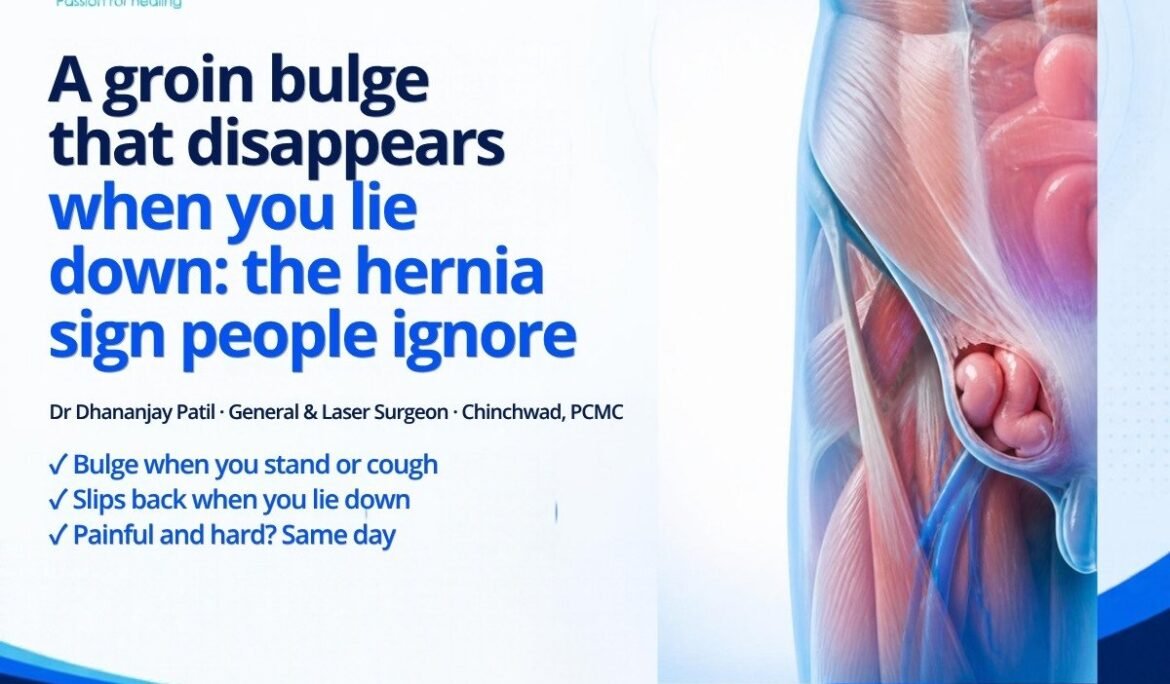
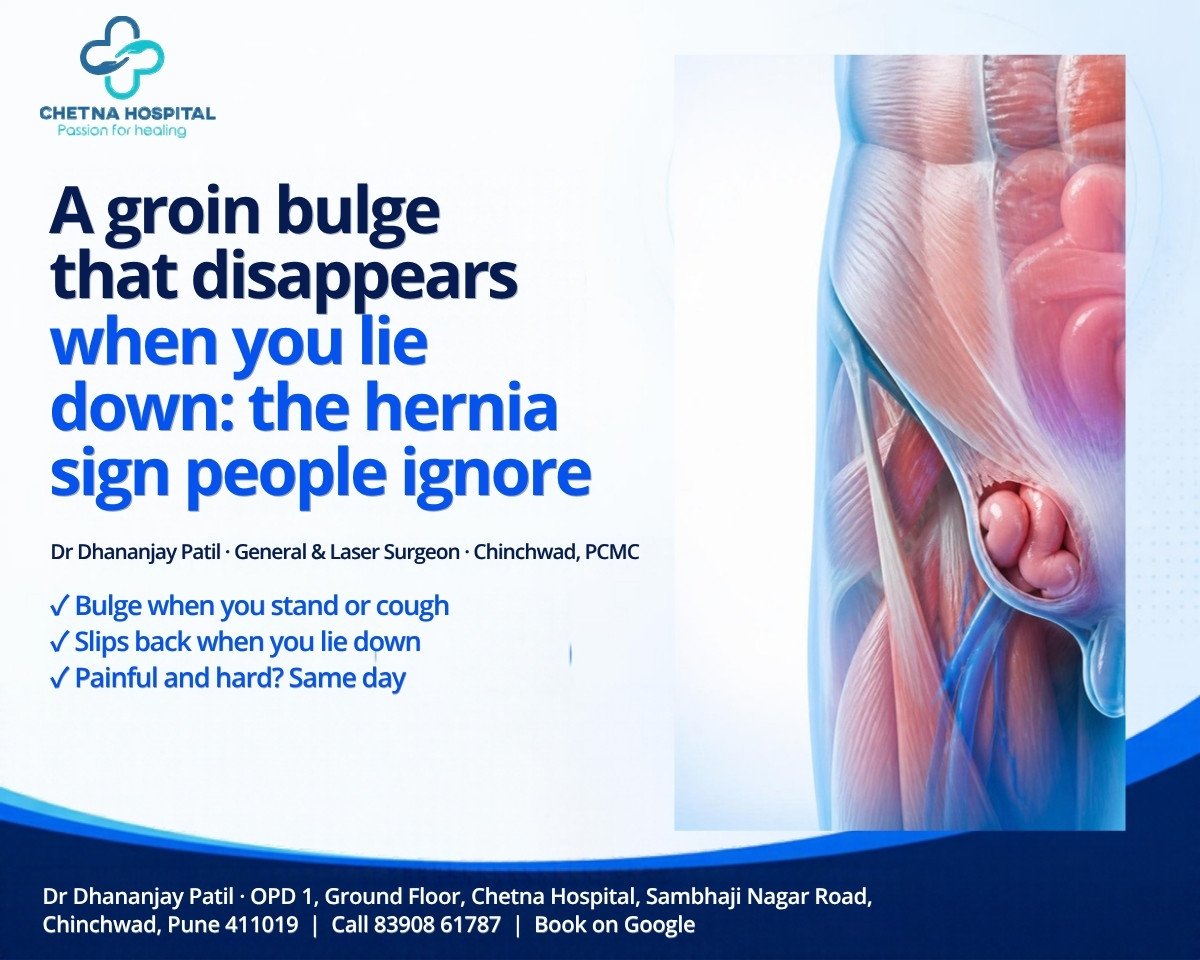
A soft bulge in the groin that appears when you stand, cough or lift, and slips back when you lie down, is the classic sign of an inguinal hernia. Dr Dhananjay Patil, general and laser surgeon in Chinchwad, PCMC, advises getting it examined soon, and coming the same day if the bulge turns hard, painful or will not go back in.
Dr Dhananjay Patil – Hernia, Piles & General Surgeon in Chinchwad, PCMC
OPD 1, Ground Floor, Chetna Hospital, Sambhaji Nagar Road, next to Pimpri Chinchwad Sahakari Bank, Sambhajinagar, Chinchwad, Pune 411019
“It goes away when I lie down, so I thought it was nothing.” I hear some version of this sentence in my Chinchwad OPD almost every week. The patient has usually noticed the lump months earlier. What brings them in is not the lump itself but a day of heavy work, when it became bigger, heavier or harder to push back.
In this guide, Dr Dhananjay Patil, Consultant General Surgeon at Chetna Hospital, explains why that “disappearing” bulge matters, why it often shows up during festival cleaning, and which signs mean you should not wait.
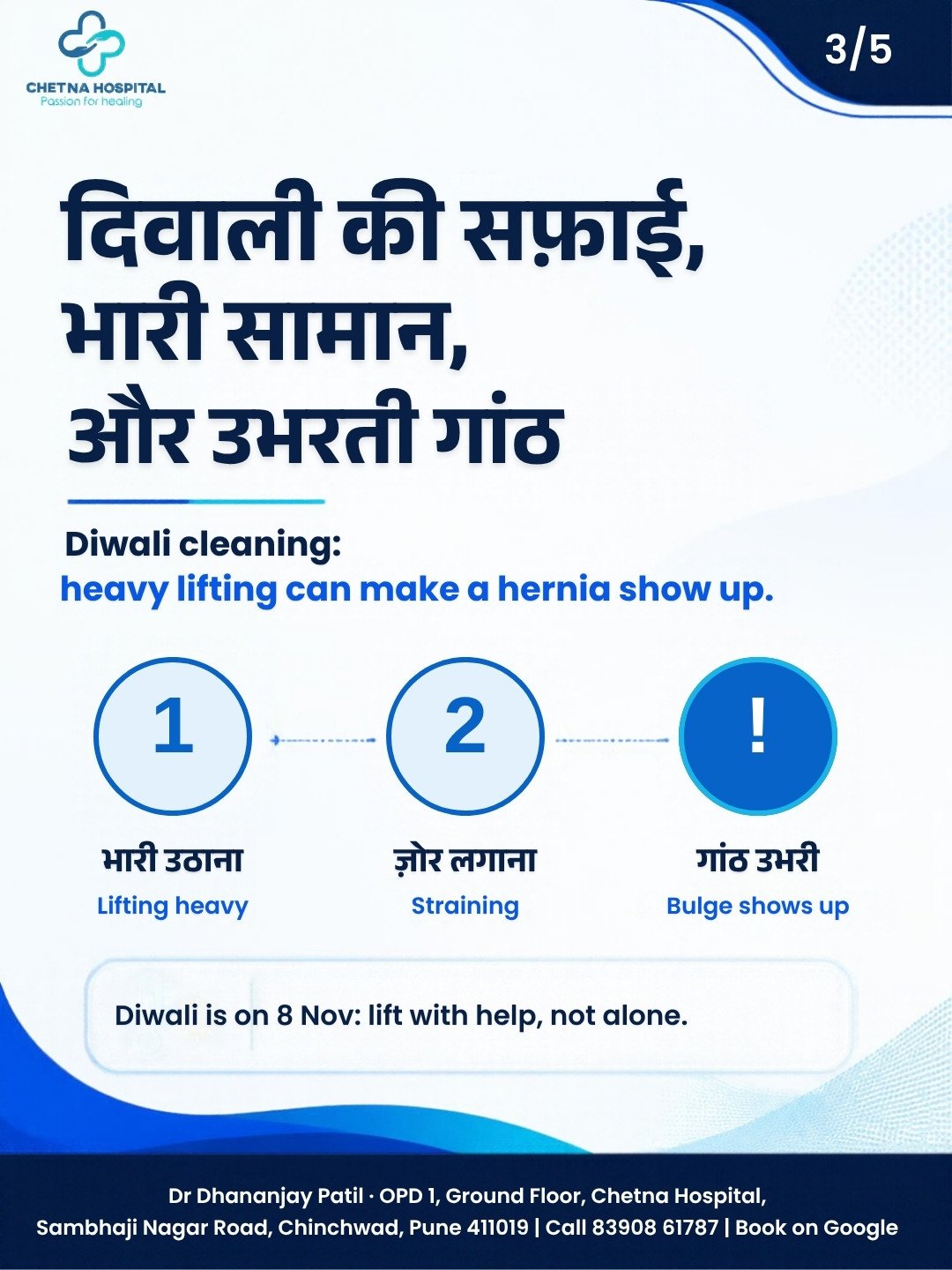
Why this is in the news now: Diwali falls on Sunday, 8 November 2026, and families across PCMC are starting the yearly deep clean: moving cupboards, lifting beds and clearing lofts. That kind of straining is exactly when a hidden hernia makes itself known.
What is that bulge?
Your abdominal wall is a sheet of muscle that holds the intestines in place. In the groin there is a natural passage through this wall, and it can become weak. When pressure inside the tummy rises, a little fat or a loop of intestine can push through the weak spot. That push is the bulge you see or feel.
The US National Institute of Diabetes and Digestive and Kidney Diseases (NIDDK) describes inguinal hernia as common, especially in men, and notes that symptoms often get worse with straining, lifting, coughing or standing for long, and ease with rest or lying down.
The sign I see people ignore
The bulge that comes and goes is reassuring to patients, and that is the problem. Because it “goes back”, they assume it is harmless or that it will heal by itself. It will not. The weak spot in the muscle stays, and over time it usually gets wider.
Look for these together:
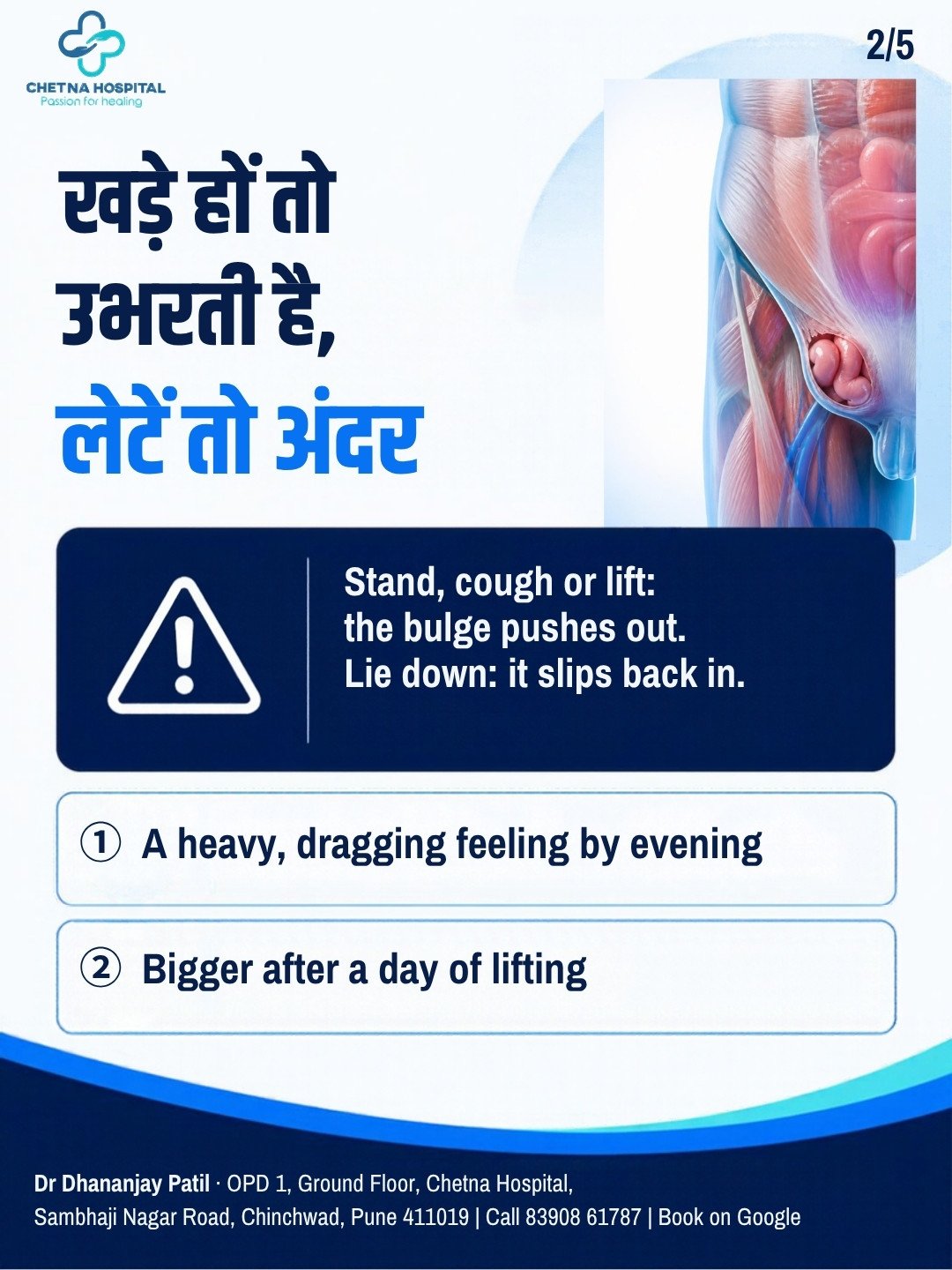
- A soft swelling in the groin, or in the scrotum in men, that is bigger when you stand or cough.
- It shrinks or disappears when you lie flat.
- A dragging, heavy or burning feeling by evening, especially after a long day on your feet.
- It seems bigger after lifting or straining on the toilet.
Hernias can also appear at the navel (umbilical hernia) or along an old surgery scar (incisional hernia). The same rule applies: if it pushes out on effort and goes back at rest, get it checked.
Why Diwali cleaning brings it out
Lifting a heavy cupboard, pushing a bed, carrying water buckets up the stairs or holding your breath to move a sofa all raise the pressure inside the abdomen. If a weak spot is already there, that pressure is what pushes tissue through. Long-standing constipation and a chronic cough do the same thing day after day, which is why I also ask about these. If straining on the toilet is part of your routine, our guide on constipation, piles and fissure is worth reading too.
A pattern I see before every festival season
The story is often similar. A man in his forties or fifties, sometimes a retired father helping with the house, has had a small groin swelling for a year. It never hurt much, so he never mentioned it. Then comes a weekend of shifting furniture and painting. By Monday the bulge is larger, aches by evening and takes longer to go back in. Most of these patients can be examined, scanned if needed and planned for repair calmly. The ones who worry me are those who wait at home while the bulge turns tight and painful.
Is it a hernia, or something else?
Not every groin lump is a hernia. Swollen lymph nodes, a fluid collection around the testis or a fatty lump can look similar. A hernia usually changes with coughing and position; many other lumps do not. In the clinic I examine you standing and lying down and ask you to cough. Sometimes an ultrasound helps confirm it. Please do not try to diagnose or push a painful lump back yourself.
When a hernia becomes an emergency
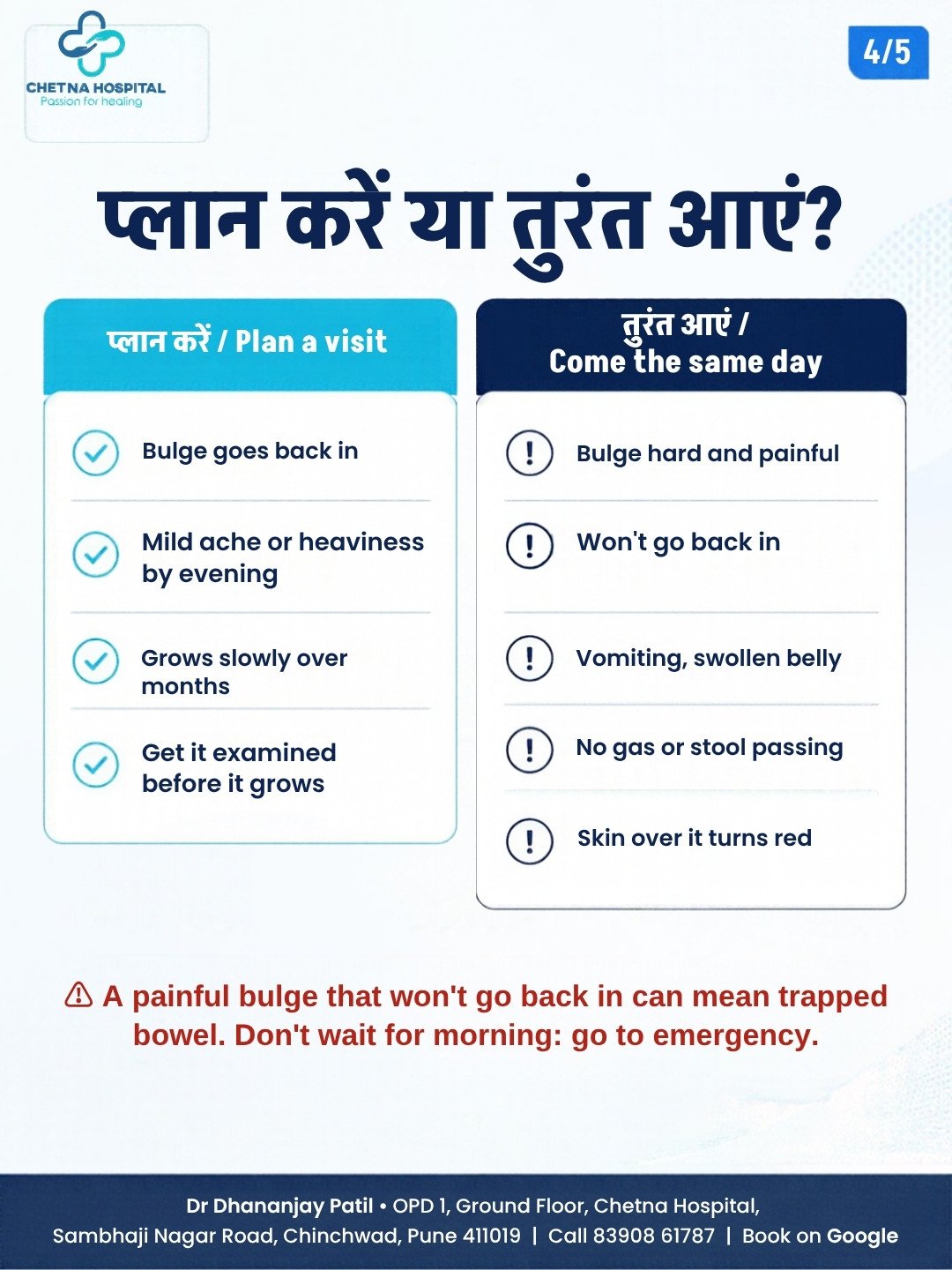
A hernia can get stuck (incarcerated). If the trapped tissue loses its blood supply, it is called strangulated, and that is life-threatening. The NIDDK lists these warning signs. Go to hospital the same day if you notice:
- The bulge suddenly gets bigger, hard or very tender.
- It no longer goes back in when you lie down.
- The skin over it turns red, or you have fever.
- Tummy pain with bloating, nausea or vomiting, or you cannot pass gas or stool.
Do not wait for the morning OPD if this happens at night. Go to the nearest emergency department.
What happens at your visit, and what treatment looks like
The only way to close the weak spot is surgery. The NHS notes that a hernia that causes no symptoms may not need treatment straight away, while repair is usually recommended when it causes pain or to prevent a blocked or strangulated bowel. The NIDDK adds that men with few symptoms can sometimes wait under follow-up, but many go on to need surgery later.
Repair can be done through one cut in the groin (open repair) or through small keyhole cuts (laparoscopic surgery) (for example open mesh repair, laparoscopic TEP or TAPP, umbilical and incisional repair), usually with a mesh to strengthen the wall. Which one suits you depends on the size and type of hernia, whether it is on one or both sides, and your general health.
A hernia belt (truss) may ease the dragging feeling for some people, but it does not repair the gap. Read more about our general surgery services and the full guide to hernia symptoms, causes and surgery.
Lifting safely during the Diwali clean-up
- Don’t lift heavy furniture alone. Two people, or slide it on a cloth.
- Bend your knees, keep the load close and breathe out as you lift. Don’t hold your breath.
- Split loads. Two half buckets instead of one full bucket on the stairs.
- Treat constipation and a long cough, because daily straining matters as much as one heavy lift.
- Already have a bulge? Skip the heavy lifting this year and get it examined first.
The five slides, in one strip
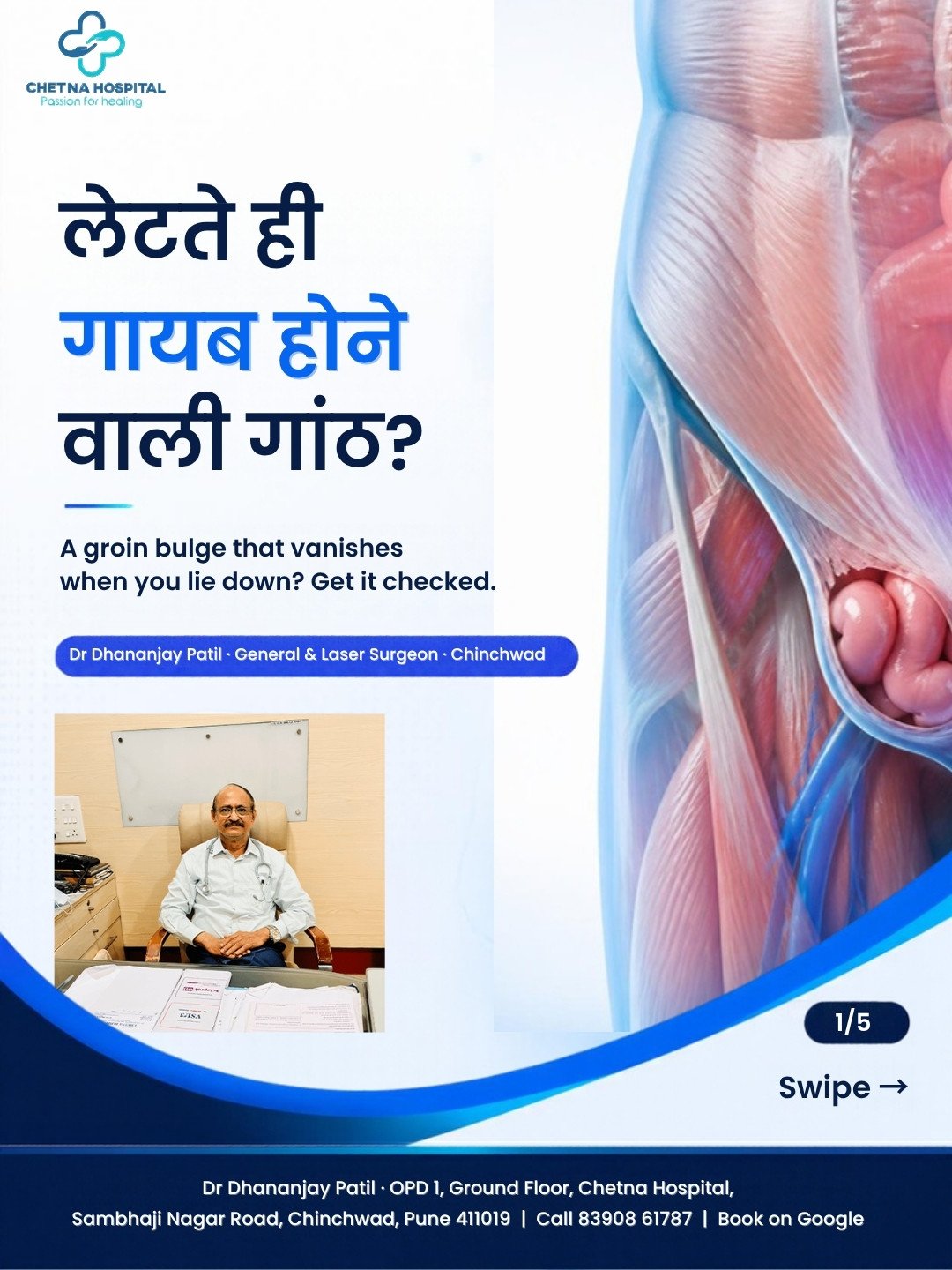
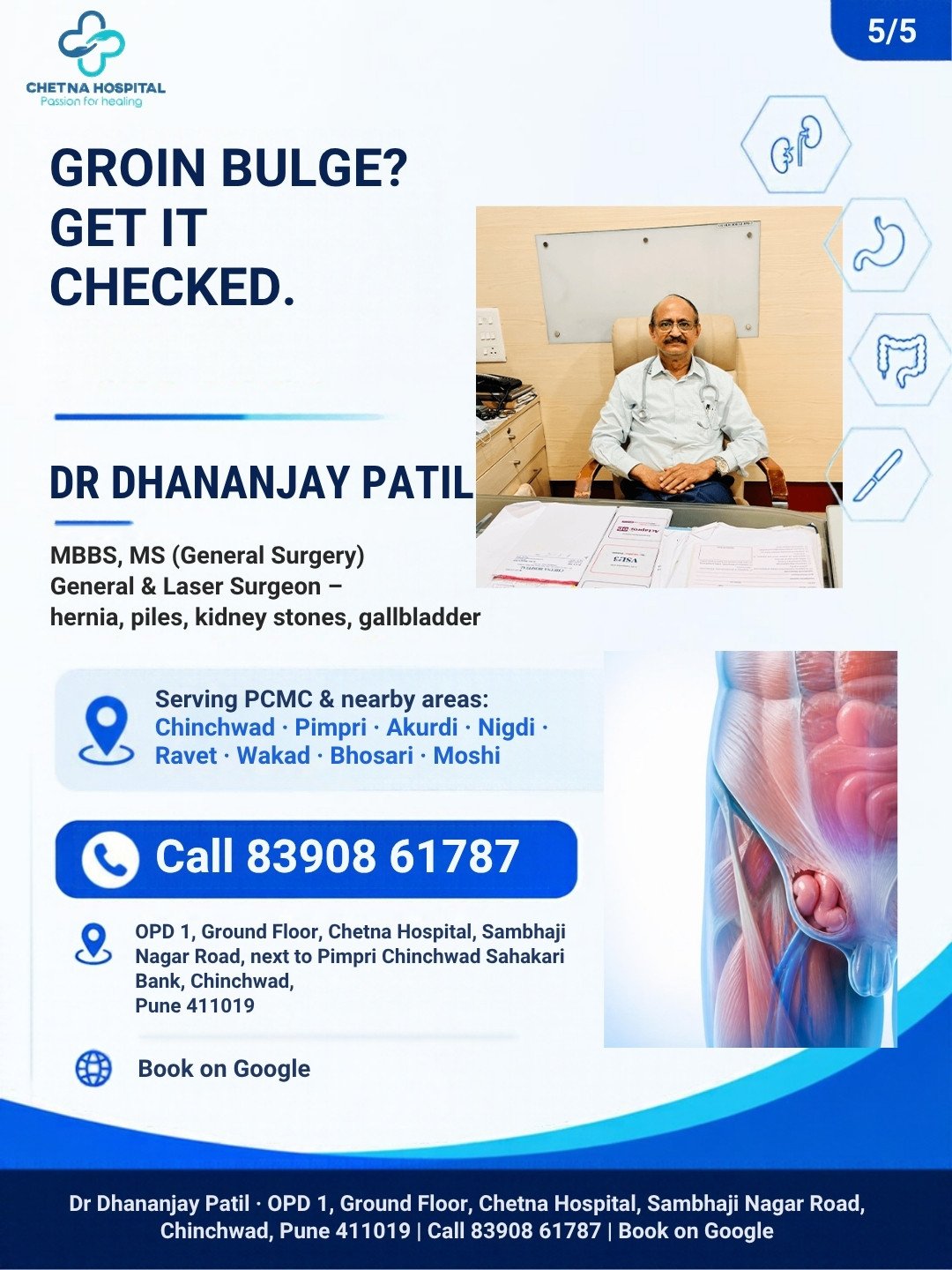
These slides are from our Instagram post. Save them and share them with whoever is doing the heavy lifting at home.
What patients say
Excerpts from Google reviews on Dr Dhananjay Patil’s profile:
⭐⭐⭐⭐⭐
“Dr. Dhananjay treated my hernia successfully. He explained the surgery, recovery process, and follow-up care in detail, which gave me confidence.”
– Arjun, Google review, June 2026
⭐⭐⭐⭐⭐
“I am from Nigdi and was suffering from reducible umbilical hernia with pain and swelling near the navel… He explained my condition clearly and guided me properly for the treatment.”
– Adil, Google review, May 2026
Read all reviews on Google → Individual experiences vary.
Consultation near you: hernia check-up in Chinchwad, PCMC
Dr Dhananjay Patil sees patients at OPD 1, Ground Floor, Chetna Hospital, Sambhaji Nagar Road, next to Pimpri Chinchwad Sahakari Bank, Sambhajinagar, Chinchwad, Pune 411019. Patients come from Chinchwad, Pimpri, Akurdi, Nigdi, Ravet, Wakad, Hinjewadi, Pimple Saudagar, Thergaon, Tathawade, Punawale, Moshi and Bhosari. If your pain is higher in the abdomen rather than in the groin, read when abdominal pain needs a surgical evaluation.
Frequently asked questions
Can a hernia go away on its own?
No. The bulge may slip back when you lie down, but the weak spot in the muscle stays and often widens with time. A small hernia without symptoms can sometimes be watched under a surgeon’s follow-up, but only surgery closes the gap.
Why does my groin lump disappear when I lie down?
Lying flat lowers the pressure inside the abdomen, so the fat or bowel that pushed through the weak spot slides back. Standing, coughing or lifting raises the pressure and pushes it out again. This in-and-out pattern is typical of an inguinal hernia.
Can heavy lifting during Diwali cleaning cause a hernia?
Heavy lifting and straining raise abdominal pressure. They can push tissue through an existing weak spot and make a hidden hernia appear or grow. Lift with help, bend your knees, breathe out as you lift, and avoid heavy lifting if you already have a bulge.
When is a hernia an emergency?
Go to hospital the same day if the bulge becomes hard, painful or red, no longer goes back in, or comes with vomiting, a bloated tummy or inability to pass gas or stool. These can be signs of a stuck or strangulated hernia.
Where can I get a hernia check-up in Chinchwad, PCMC?
Dr Dhananjay Patil, Consultant General Surgeon (MBBS, MS General Surgery), sees patients with hernia at OPD 1, Ground Floor, Chetna Hospital, Sambhaji Nagar Road, Chinchwad, Pune 411019. Call or WhatsApp 83908 61787 to book.
A bulge that comes and goes? Get it examined before the heavy lifting.
OPD 1, Ground Floor, Chetna Hospital, Sambhaji Nagar Road, next to Pimpri Chinchwad Sahakari Bank, Chinchwad, Pune 411019
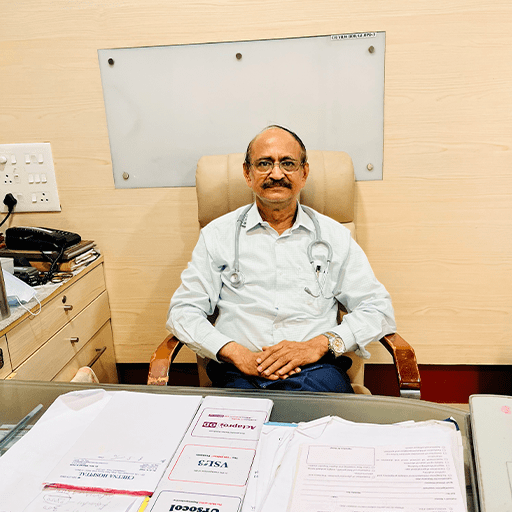
About the author: Dr Dhananjay Patil
Consultant General Surgeon
MBBS, MS (General Surgery)
Hernia, piles, fissure, fistula, gallbladder, kidney stones and general surgery at Chetna Hospital, Chinchwad. View full profile
Medically reviewed by Dr Dhananjay Patil. Last updated 15 October 2026.
Sources
- National Institute of Diabetes and Digestive and Kidney Diseases (NIDDK). Inguinal hernia.
- NHS. Inguinal hernia repair.
- IndiaBonds. When is Diwali 2026.
- Hindutone. How to celebrate Diwali at home in 2026: a day-by-day plan from cleaning to Bhai Dooj.
This article is general health information and does not replace a consultation. A painful, hard or stuck bulge needs prompt medical care.