
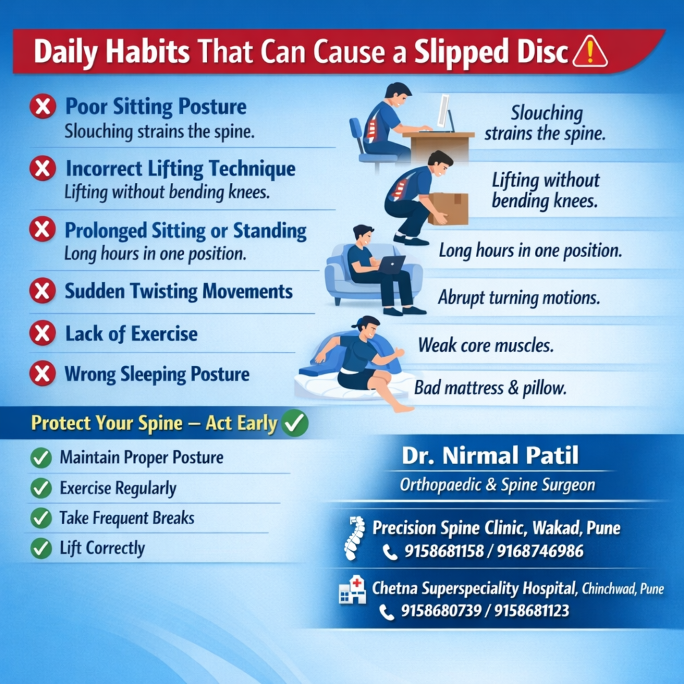
Your spine is the backbone of your body—literally. It supports your posture, helps you move, and protects your spinal cord, which is crucial for overall body function. However, in today’s sedentary lifestyle, your daily habits may silently damage your spine, leading to conditions such as slipped disc or herniated disc. Understanding these habits and taking early preventive steps is key to maintaining a healthy back.
At Precision Spine Clinic, Wakad, and Chetna Superspeciality Hospital, Chinchwad, Dr. Nirmal Patil, a leading orthopaedic and spine surgeon, has treated hundreds of patients suffering from slipped discs. His expertise in spine care and orthopaedic treatments ensures early diagnosis and personalized care.
What is a Slipped Disc?
A slipped disc, medically known as a herniated disc, occurs when the soft gel-like material inside a spinal disc pushes out through a tear in the disc’s outer layer. This can press on nearby nerves, causing back pain, leg pain, numbness, or tingling sensations.
Slipped discs can happen suddenly due to trauma, but often, they develop gradually due to repetitive stress, poor posture, and unhealthy daily habits.
Common Daily Habits That Can Cause a Slipped Disc
Even without heavy lifting or accidents, certain everyday habits can put your spine at risk. Recognizing and correcting these habits can prevent severe spine conditions.
1. Poor Sitting Posture
Spending hours slouched over a computer or phone puts undue pressure on your spinal discs. Poor posture leads to misalignment of the spine, increasing the risk of disc degeneration.
Tip: Sit upright with your back supported, shoulders relaxed, and feet flat on the floor. Use a chair with lumbar support.
2. Long Hours of Sitting
Many office workers spend 6–8 hours a day seated. Continuous sitting without breaks increases disc pressure and weakens core muscles, which are essential for spine support.
Tip: Take short walking breaks every hour. Stretch your back and legs to improve circulation and relieve pressure on spinal discs.
3. Incorrect Lifting Techniques
Bending from the waist to lift heavy objects is a common mistake. This action strains the lower back and can lead to a slipped disc.
Tip: Always bend your knees and keep your back straight when lifting. Hold objects close to your body and avoid twisting.
4. Lack of Physical Activity
A sedentary lifestyle weakens the muscles that support the spine, making discs more susceptible to injury. Core and back strengthening exercises are crucial.
Tip: Include daily exercises such as yoga, swimming, or core strengthening workouts to maintain spine health.
5. Excess Body Weight
Carrying extra weight puts constant pressure on spinal discs, especially in the lumbar region. Over time, this increases the risk of disc herniation.
Tip: Maintain a healthy weight through a balanced diet and regular exercise. Consult a spine specialist for guidance if experiencing back pain.
6. Sleeping on a Bad Mattress
A poor mattress can fail to support the natural curvature of the spine, leading to back strain. Sleeping positions also play a crucial role in spinal health.
Tip: Use a firm mattress that supports the spine and maintain a sleeping posture that keeps your back aligned. Avoid sleeping on your stomach.
Warning Signs of a Slipped Disc
Early detection is crucial to avoid surgery or chronic pain. Watch out for these warning signs:
- Back pain radiating to the legs
- Numbness or tingling in the limbs
- Difficulty bending, standing, or walking
If you notice any of these symptoms, consult a spine specialist immediately. At Precision Spine Clinic, Wakad, and Chetna Superspeciality Hospital, Chinchwad, Dr. Nirmal Patil uses advanced diagnostic tools like MRI, X-ray, and CT scans for accurate evaluation.
How Dr. Nirmal Patil Treats Slipped Disc
Dr. Nirmal Patil focuses on minimally invasive spine treatments and personalized care plans. Treatment may include:
- Physiotherapy and Rehabilitation – Targeted exercises to strengthen back and core muscles.
- Pain Management – Medications or injections to reduce inflammation and discomfort.
- Surgical Intervention – For severe cases, procedures like microdiscectomy or spinal fusion are performed with precision.
Patients from Wakad, Chinchwad, Thergaon, and surrounding Pune areas have benefited from his expertise in spine surgery, orthopaedic care, and rehabilitation.
Preventing a Slipped Disc: Daily Spine Care Tips
Preventing a slipped disc is often easier than treating one. Here are essential tips:
- Maintain proper posture while sitting, standing, and walking.
- Take regular breaks during long hours of sitting.
- Strengthen back and core muscles through exercise.
- Use ergonomic chairs and supportive mattresses.
- Avoid lifting heavy objects incorrectly.
- Maintain a healthy body weight.
- Stay active to promote flexibility and spinal health.
Following these habits can significantly reduce the risk of developing a slipped disc and improve overall spine health.
Areas Served
Dr. Nirmal Patil and his team provide spine and orthopaedic care in multiple areas across Pune, including:
- Wakad – Precision Spine Clinic
- Chinchwad – Chetna Superspeciality Hospital
- Thergaon, Pimpri, Ravet – Nearby neighbourhoods
- Hinjewadi and Baner – Spine consultation and orthopaedic services
Patients from all over Pune trust Dr. Patil for advanced spine care, orthopaedic treatments, and rehabilitation programs.
Contact Information
For consultation or spine evaluation, contact:
🦴 Precision Spine Clinic
📍 Wakad, Pune
📞 9158681158 / 9168746986
🏥 Chetna Superspeciality Hospital
📍 Chinchwad, Pune
📞 9158680739 / 9158681123
Conclusion
A slipped disc can significantly affect your quality of life, but preventive care, early diagnosis, and professional treatment can make a huge difference. Avoid poor habits, maintain a healthy lifestyle, and consult a spine specialist like Dr. Nirmal Patil if you experience persistent back pain or discomfort.
Remember: Your daily habits may be silently harming your spine. Take action today for a healthy back tomorrow.