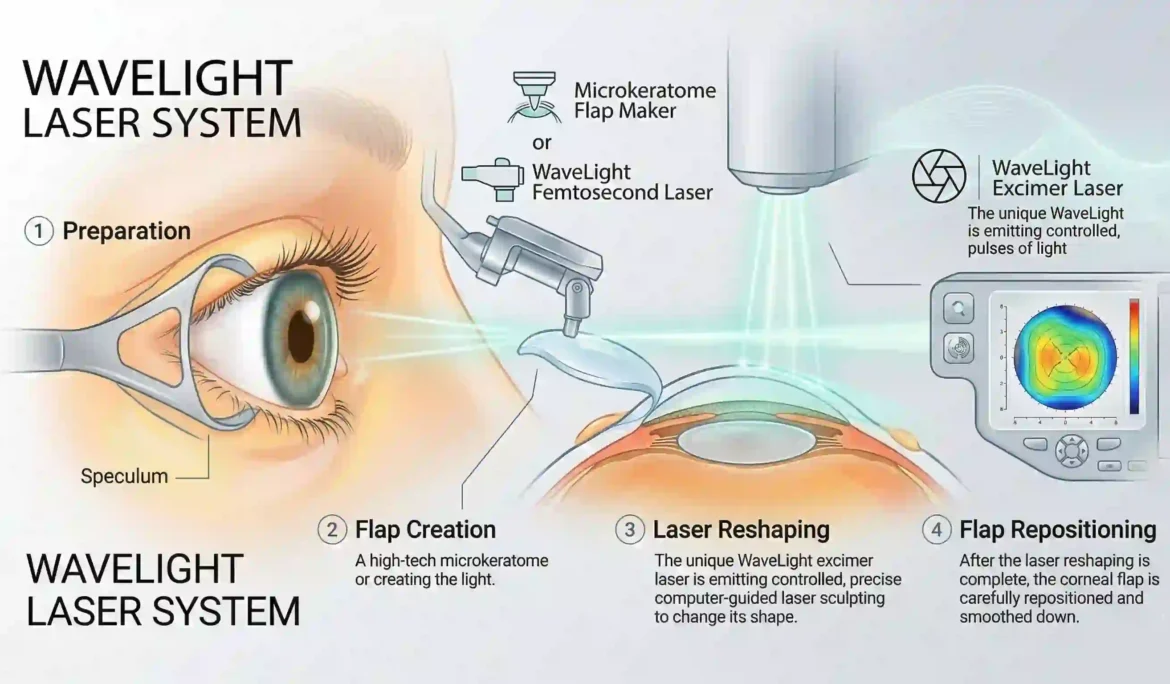
Introduction to WaveLight Eye Surgery in Pune
What is WaveLight Plus? WaveLight Plus is a ray-tracing guided LASIK treatment. Before surgery, a device called Sightmap measures the shape of the front of your eye, the length of your eye and how light passes through it. Software uses these measurements to build a 3D model of your eye, sometimes called a “digital twin”, and plans the laser treatment from it. It is used for short-sightedness (myopia), with or without astigmatism.
At Chetna Hospital, Sambhaji Nagar, Chinchwad, Pune, the eye care (ophthalmology) department can assess your eyes and explain whether laser vision correction may suit you. You can call the eye department on 91686 90442 (main hospital line 9158681123) or visit chetnahospital.co.in.
What Is WaveLight Eye Surgery?
WaveLight is a family of excimer laser systems used for LASIK and similar procedures. The laser reshapes the cornea (the clear front of the eye) using a detailed map of your eye.
Because the treatment is planned for your own eye, the aim is clear vision with fewer side effects such as glare. Results still vary from person to person.
Possible Benefits:
- A treatment plan based on measurements of your own eye
- Less need for glasses or contact lenses for many people
- Quick return to most daily activities
- Treats short-sightedness and astigmatism
Laser Eye Surgery at the Eye Care Department in Chinchwad
When you are thinking about WaveLight eye surgery, a careful eye assessment matters as much as the laser. The eye care (ophthalmology) department at Chetna Hospital checks each eye in detail before deciding whether LASIK or another option is right for you.
How WaveLight Plus Technology Works
The excimer laser: An excimer laser removes tiny amounts of corneal tissue to change its shape. Modern lasers track your eye movements during treatment.
Ray-tracing vs. other LASIK: Standard LASIK is planned mainly from your glasses prescription and measurements of the cornea. Ray-tracing also uses the length of your eye and how light passes through the whole eye.
The digital eye model: A 3D software model of your eye is made before surgery to plan the treatment.
First, detailed scans of your eye are taken. Then a laser reshapes the cornea based on this data. As a result, light focuses better on the retina, which improves vision.
Recovery Time After WaveLight Eye Surgery
Recovery is usually quick, but following your eye doctor’s aftercare advice is important.
Typical Recovery Timeline
- First few hours: Eyes may feel scratchy or burn. Go home and rest.
- First few days: You may be asked to wear a protective eye shield, including while you sleep. Do not rub your eyes. Use the drops your eye doctor prescribes.
- First week: Many people return to most daily activities. Ask your eye doctor when you can swim, use eye make-up or play contact sports.
- Up to about a month or longer: Dry eyes and vision that changes during the day usually settle within about a month, but this can take longer for some people.
Many people can return to desk work within a few days. Your eye doctor will tell you when it is right for you.
Risks of WaveLight Plus
Like any surgery, LASIK has risks. Most side effects are temporary, but some can last.
- Dry eyes
- Glare, halos or starbursts around lights, and reduced night vision
- Blurred or hazy vision
- Vision that is under- or over-corrected, which may need glasses or more laser treatment
- Rarely, eye infection, vision that is worse than before even with glasses or, very rarely, blindness
A careful check before surgery helps find people for whom LASIK is not suitable, which lowers the chance of problems.
Other Laser Vision Options
Different procedures suit different people. A proper eye assessment is needed to choose.
Common options include:
- Wavefront-guided or wavefront-optimised LASIK
- SMILE (small incision lenticule extraction)
- PRK (surface laser treatment)
Your eye doctor will suggest an option based on your prescription, corneal thickness and eye health.
How Laser Eye Procedures Differ
| Feature | WaveLight Plus (Ray-Tracing LASIK) | SMILE | PRK |
| How it works | A thin flap is made, then the laser reshapes the cornea, planned from a 3D eye model | A small piece of tissue is removed through a small cut, with no flap | The surface layer is removed, then the laser reshapes the cornea |
| Main uses | Short-sightedness with or without astigmatism | Short-sightedness with or without astigmatism | Short-sightedness, long-sightedness and astigmatism; can suit thinner corneas |
| Recovery | Vision usually improves within a day or two | Vision usually improves within a few days | Slower; discomfort for a few days and vision improves over weeks |
LASIK Results After 10 Years
For most people, the vision correction from LASIK lasts. But LASIK does not stop natural changes in the eye with age.
For example:
- Distance vision often stays clear for years
- Reading glasses are usually needed from around age 40
- Small changes in prescription can happen
According to the American Academy of Ophthalmology, about 9 in 10 people have vision between 20/20 and 20/40 without glasses or contacts after LASIK, and LASIK does not prevent future changes in vision.
Why LASIK After 40 Has Limitations
From around age 40, the lens inside the eye becomes less flexible, and close-up vision gets harder. This is called presbyopia. LASIK cannot correct presbyopia.
As a result:
- Reading vision declines with age
- Most people need reading glasses, even after LASIK
- Monovision (one eye set for distance and the other for near) may be an option; trying it with contact lenses first is often suggested
Some people over 40 may still be suitable after a proper assessment.
Choosing a Laser Eye Surgery Option
The right option depends on your corneal thickness, prescription, eye health and lifestyle. A personal consultation is needed.
LASIK is not right for everyone. It is usually not advised if you have an unstable prescription, very high prescriptions, severe dry eye, thin or scarred corneas, keratoconus, late-stage glaucoma, a cataract affecting vision, or poorly controlled diabetes.
Newer Developments in Eye Surgery
Laser platforms and eye-mapping tools keep developing, with more detailed scans used to plan each treatment. Ask your eye doctor which options are available and whether they suit you.
Can Eyesight Worsen After LASIK?
Vision can change over time after LASIK. This is often due to ageing rather than the procedure itself.
Common reasons include:
- Natural ageing, including presbyopia and cataract
- Hormonal changes, for example in pregnancy
- Health conditions such as diabetes
If vision changes, more laser treatment (an enhancement) may be possible for some people, or glasses may be needed.
How Long Do WaveLight Plus Results Last?
The change made to the cornea is lasting. However, age-related changes in the eye can still affect vision later in life.
What to Expect After Surgery
Most people see well enough after LASIK to do most daily tasks without glasses or contact lenses. Some people still need glasses for some tasks, such as driving at night or reading. Ask your eye doctor what result is realistic for your eyes.
Laser Eye Surgery for Astigmatism
Yes, laser surgery can treat astigmatism.
It is often used for:
- Mild astigmatism
- Moderate astigmatism
- Some higher amounts, depending on the eye. Very high astigmatism or an irregular cornea (such as keratoconus) may need a different treatment.
Easy to Reach from Chinchwad and Nearby Areas
Chetna Hospital is at consulting 1, Chetna Hospital, Plot No. GP 116, Sambhaji Nagar Rd, near Rotary Club, G Block, MIDC, Chinchwad, Pimpri-Chinchwad, Pune, Maharashtra 411019. It is easy to reach from nearby areas such as Nigdi, Akurdi, Thergaon, Wakad, Bhosari and Pimple Saudagar. If you are looking into WaveLight eye surgery in PCMC, being close to home makes follow-up visits easier.
FAQs
The eye care (ophthalmology) department at Chetna Hospital, Sambhaji Nagar, Chinchwad, can check whether laser vision correction may suit you. Call 91686 90442 or visit chetnahospital.co.in.
General criteria include being at least 18 (ideally over 21) with a glasses prescription that has been stable for about a year, healthy corneas that are thick enough, and good general eye health. LASIK is usually not advised with severe dry eye, keratoconus, late-stage glaucoma, a cataract affecting vision or poorly controlled diabetes. Detailed eye scans are done to confirm whether you are suitable.
Standard LASIK is planned mainly from your glasses prescription and corneal measurements. WaveLight Plus uses the Sightmap device to also measure the length of your eye and how light passes through it, and plans treatment from a 3D model of your eye. Ask your eye doctor whether it is likely to make a difference for your eyes.
Side effects are like those of other LASIK. Common ones include dry eyes, glare, halos, blurred vision and vision that changes during the day. These usually settle within about a month but can take longer or, for some people, last. Rare risks include infection and loss of vision.
For PCMC Patients:
Chetna Hospital is in Sambhaji Nagar, Chinchwad, close to Akurdi, Nigdi, Ravet and Wakad, near Sambhaji Nagar Road, for people looking for an eye specialist near them in Pimpri-Chinchwad.
Conclusion
Laser eye surgery can reduce or remove the need for glasses for many people, but it is not right for everyone and it has risks. Technologies like WaveLight Plus plan treatment in more detail. A careful eye assessment is the most important first step.
When to get help straight away: go to an emergency department straight away, or call 108 or 112, if you have sudden loss of vision, a dark curtain or shadow over your vision, new flashes or floaters, a chemical in the eye, an eye injury, or severe eye pain with redness, headache or feeling sick.
To book an eye check-up, call the eye care (ophthalmology) department at Chetna Hospital on 91686 90442. Main hospital line: 9158681123. Chetna Hospital, Sambhaji Nagar, Chinchwad, Pune.
Patient-Focused Care for WaveLight Laser Eye Surgery
At Chetna Hospital, consultations for WaveLight laser eye surgery are not rushed. The eye care team explains the procedure, the risks and what recovery involves, so you can make an informed choice.
If this article helped you, share it with others who are thinking about laser eye surgery.
General health information, not a diagnosis. Reviewed and updated by Chetna Hospital’s content team with the help of AI writing tools, November 2026.