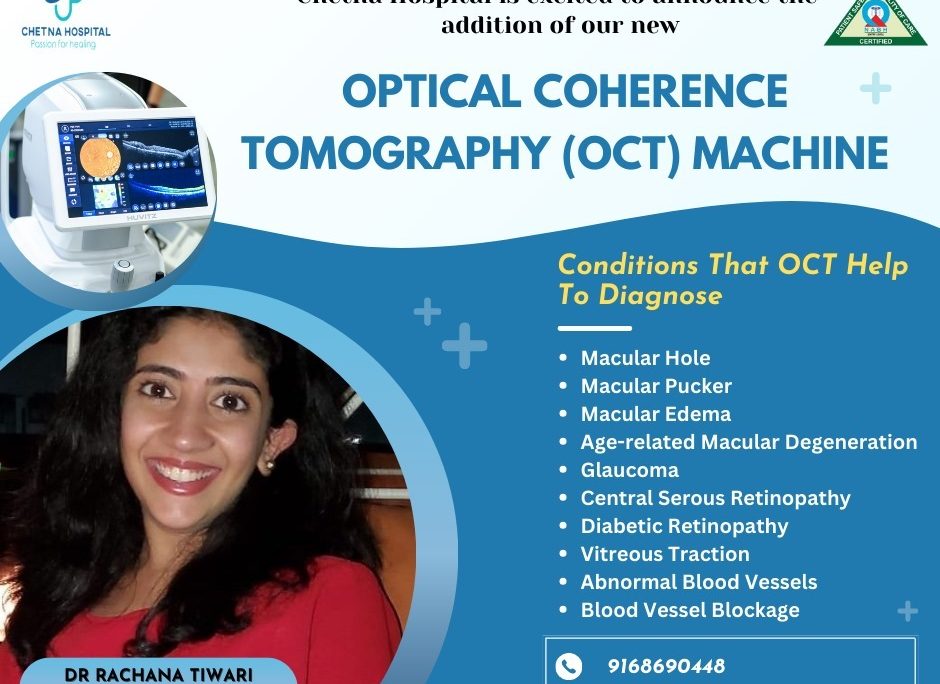
The eye care (ophthalmology) department at Chetna Hospital now has an Optical Coherence Tomography (OCT) machine, made by Huvitz. OCT helps eye doctors diagnose and monitor many eye conditions, often before symptoms appear.
What is Optical Coherence Tomography (OCT)?
Optical Coherence Tomography (OCT) is a non-invasive imaging test that uses light waves to take cross-sectional pictures of your retina, the light-sensitive tissue lining the back of the eye. It gives detailed images that help eye doctors see each of the retina’s layers. By measuring these layers’ thickness, OCT aids in the early detection, diagnosis, and monitoring of eye diseases.
Conditions That OCT Helps to Diagnose
OCT helps diagnose and monitor a wide range of eye conditions, including:
- Macular Hole: A small break in the macula, the central part of the retina responsible for sharp, detailed vision.
- Macular Pucker: A condition where the macula’s surface becomes wrinkled, causing distorted and blurred vision.
- Macular Edema: Swelling or thickening of the macula due to fluid accumulation.
- Age-related Macular Degeneration (AMD): A common eye condition among people over 50, causing damage to the macula and loss of central vision.
- Glaucoma: A group of eye conditions that damage the optic nerve, often associated with increased pressure in the eye.
- Central Serous Retinopathy:A condition where fluid builds up under the retina, causing visual impairment.
- Diabetic Retinopathy: Damage to the blood vessels in the retina caused by complications of diabetes, which can cause vision problems and potentially blindness.
- Vitreous Traction:A condition where the vitreous gel inside the eye pulls on the retina, which can lead to retinal detachment.
- Abnormal Blood Vessels: Detection of abnormal growth of blood vessels in the retina, often related to diseases like AMD and diabetic retinopathy.
- Blood Vessel Blockage: Identification of blockages in the blood vessels of the retina, which can lead to vision loss.
What to Expect During the Scan
The scan does not touch the eye and usually takes about 5 to 10 minutes. You may or may not need drops to widen (dilate) your pupils. If you do, your eyes may be sensitive to light for several hours afterwards.
Benefits of OCT for Patients
- Early Detection and Treatment: OCT enables early detection of eye conditions before significant symptoms appear, allowing for timely treatment.
- Non-Invasive Procedure: The test is quick, comfortable and non-invasive, making it suitable for regular monitoring and follow-up.
- Comprehensive Monitoring: Regular OCT scans help in closely monitoring the progression of eye diseases and the effectiveness of treatments.
- Detailed Imaging: The high-resolution images provided by the OCT machine help eye doctors assess the eye in detail.
Visit Us for Your Eye Health Needs
Chetna Hospital provides eye care with the help of tests such as OCT. If you are having vision problems or have been diagnosed with an eye condition, you can arrange an eye examination with the eye care (ophthalmology) department at Chetna Hospital.
For more information or to book an appointment, please call the eye department on 91686 90442 or the main hospital line on 9158681123, or visit our website at www.chetnahospital.co.in.
Regular eye check-ups help find problems early.
General health information, not a diagnosis. Reviewed and updated by Chetna Hospital’s content team with the help of AI writing tools, November 2026.