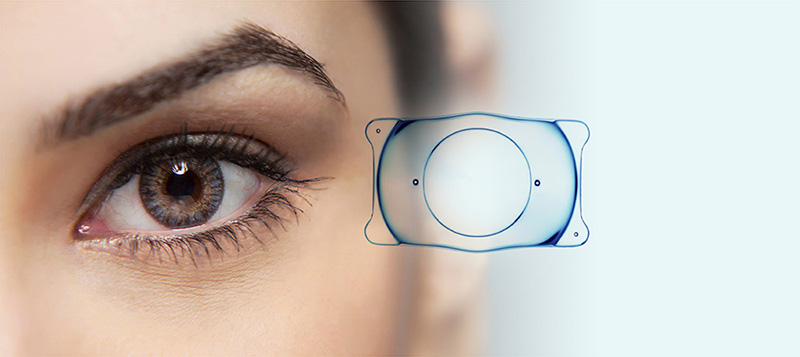
High myopia, or severe short-sightedness, is common. People who have high power glasses or contact lenses know the daily struggles — blurry vision without correction, thick lenses, frequent eye strain, and depending on glasses all day.
LASIK has helped many people reduce their need for glasses, but it isn’t suitable for everyone. People with thin corneas, high refractive errors, or dry eyes often find themselves disqualified.
That’s where ICL (Implantable Collamer Lens) Surgery can be another option, including for some people who cannot have LASIK.
What is ICL Surgery?
ICL stands for Implantable Collamer Lens — a soft, flexible, and biocompatible lens made of Collamer, a material designed to sit safely inside the eye.
During ICL surgery, this lens is gently placed inside the eye, between the iris (the colored part of your eye) and the natural lens. Unlike LASIK or PRK, ICL does not involve cutting or reshaping the cornea.
It works a bit like a contact lens that stays inside your eye, so it corrects vision all day. It can be removed later if needed.
Who Needs ICL Surgery?
ICL may suit people with:
- Moderate to high myopia (up to about -20.00D, depending on the lens)
- Thin or irregular corneas, unsuitable for LASIK
- Stable eye power for at least one year
- Healthy eyes with no glaucoma, cataract, uveitis, retinal disease or infection
- Age between 21 and 45, with enough space inside the eye and healthy corneal cells
This makes ICL surgery an option to discuss for people who have been told they are not suitable for LASIK. Pregnancy, breastfeeding, uncontrolled diabetes and some other conditions may mean waiting or choosing another option.
How ICL Helps in High Myopia
1. Corrects Very High Power Levels
ICL can correct higher degrees of myopia than LASIK.
Laser procedures have an upper limit that depends on corneal thickness, while ICL can treat up to about -20.00D. This makes it an option for some people with very high power.
2. An Option for Thin or Irregular Corneas
Many people are rejected for LASIK due to insufficient corneal thickness.
Since ICL doesn’t remove any corneal tissue, it may suit some patients with thin or irregular corneas.
The cornea keeps its natural structure.
3. Reversible and Replaceable
One advantage of ICL is that it is reversible.
If needed, the lens can be removed or replaced later in life — unlike LASIK, which permanently reshapes your cornea.
This gives flexibility if your eyes change, for example if you need cataract surgery later.
4. Quick Recovery
ICL surgery uses a small opening and usually takes under 30 minutes.
Vision often improves within 24 hours, and full improvement may take a week to 10 days. Most people return to most activities in a few days.
There’s no corneal flap, and dry eye is less common than after laser surgery.
5. Less Dry Eye
ICL does not cut the corneal nerves, so it is linked with less dry eye than LASIK, which may cause dryness due to corneal nerve disruption.
6. Maintains Corneal Integrity
Since there is no cutting or reshaping of the cornea, ICL maintains the natural biomechanics of your eye.
This may matter for people who want to avoid corneal thinning. Your eye surgeon will advise about contact sports and eye protection.
7. Quality of Vision
Many people have good quality vision after ICL.
Some notice glare or halos, especially at night.
How is ICL Surgery Performed?
- Pre-Surgery Assessment:
A detailed eye evaluation is performed — including corneal thickness, anterior chamber depth, and retina health — to ensure suitability. - Lens Customization:
The ICL power and size are chosen to match your eye’s measurements. - Surgery Day:
- Numbing drops are applied to ensure comfort.
- A tiny opening (about 3 mm) is made to insert the ICL lens.
- The lens unfolds and positions itself naturally behind the iris.
- The opening usually seals on its own, so stitches are often not needed.
- Post-Surgery Care:
You can usually return home the same day. Vision often improves by the next day. Use the eye drops your doctor prescribes and attend every follow-up visit.
Safety and Long-Term Benefits
ICL lenses are approved by the US FDA and have been used for many years. Like any eye surgery, ICL has risks: raised eye pressure, infection or inflammation, glare or halos, lens shifting, earlier cataract, loss of corneal cells and, rarely, retinal detachment or glaucoma. Some people need another procedure.
Possible long-term benefits include:
- Lasting vision correction for many people
- Reversible nature of the procedure
- Less risk of dry eye than laser surgery
- Comfortable, natural visual experience
After surgery, go to an emergency department straight away, or call 108 or 112, if you have sudden loss of vision, severe eye pain, pain with redness and nausea, or a curtain or shadow over your vision.
ICL Surgery at Chetna Hospital
The eye care (ophthalmology) department at Chetna Hospital, Chinchwad, provides ICL surgery, other vision correction options and cataract care.
Before surgery, your eyes are measured and checked in detail to see whether ICL suits you.
Life After ICL Surgery
Many people find daily life easier after ICL surgery, with less need for glasses or contact lenses.
Ask your eye surgeon when it is safe to swim, go to the gym or travel after surgery.
Reading glasses may still be needed after about age 40.
The lens needs no daily cleaning or care, but regular eye check-ups are still needed.
The Future of Vision Correction
ICL surgery is one option for treating high myopia.
It corrects vision without reshaping the cornea and keeps your natural lens, and it is reversible.
If you’ve been told LASIK isn’t suitable for you, or if you’re tired of glasses and contact lenses, ask an eye surgeon whether ICL surgery suits you.
Call 91686 90442 to book a check-up with the eye care (ophthalmology) department at Chetna Hospital, Chinchwad.
General health information, not a diagnosis. Reviewed and updated by Chetna Hospital’s content team with the help of AI writing tools, November 2026.