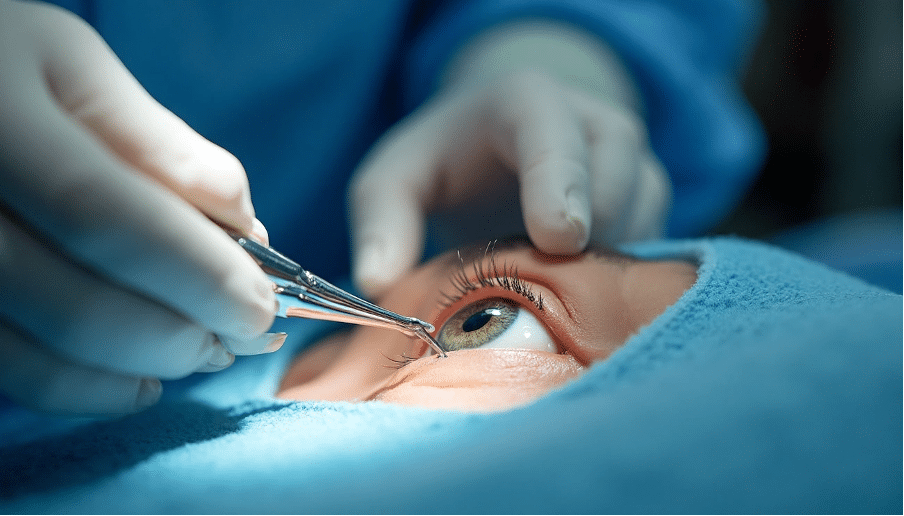
In today’s world, more people are looking for ways to get rid of glasses and contact lenses for good. While LASIK has long been a popular choice, not everyone is eligible for it—especially those with high power or thin corneas. For some of these people, ICL (Implantable Collamer Lens) surgery is another option. It corrects vision without reshaping the cornea.
Let’s understand who is eligible for ICL surgery and what its risks are.
What Is ICL Surgery?
ICL stands for Implantable Collamer Lens. It’s a type of lens implant that is placed inside the eye to correct refractive errors like myopia (nearsightedness) and astigmatism.
Unlike LASIK, which involves reshaping the cornea with a laser, ICL surgery involves inserting a thin, flexible lens between your iris (the colored part of the eye) and your natural lens. This lens works with your eye’s natural focusing system to give you clearer vision.
ICL is also reversible. The lens can be removed or replaced in the future if needed.
Who Is Eligible for ICL Surgery?
Not everyone is a suitable candidate for ICL surgery. Your ophthalmologist will conduct a detailed eye evaluation to determine if this procedure is right for you.
Below are the key eligibility criteria:
1. Age Group
ICL surgery is usually considered for people between 21 and 45 years old.
By this age the eye power has usually settled. In younger people the prescription may still be changing, which can affect results.
2. Stable Eye Power
Your eye prescription should remain stable for at least one year before surgery.
If your power is changing every few months, your doctor may recommend waiting until it stabilizes for long-term accuracy.
3. Degree of Myopia
ICL is mainly used for moderate to high myopia, up to about -20.00D depending on the lens.
It is often considered for people whose eye power is too high for LASIK to correct safely.
4. Corneal Thickness
If your cornea is thin or irregular, LASIK may not be an option.
Since ICL surgery does not reshape or thin the cornea, it may be an option for such patients.
5. Astigmatism
A toric ICL can also correct astigmatism, including higher amounts in some people.
6. Adequate Anterior Chamber Depth
Before surgery, your doctor will check the anterior chamber depth—the space between the cornea and the iris.
There must be enough room to place the ICL. The doctor will also count the cells on the inner layer of the cornea (endothelial cells), which need to be healthy.
7. Good Eye Health
You must have healthy eyes, free from conditions like:
- Glaucoma (high eye pressure)
- Cataract (lens opacity)
- Keratoconus that is still getting worse (corneal thinning)
- Uveitis (eye inflammation)
- Retinal diseases or detachment
Any existing eye disease should be treated before considering ICL surgery.
8. General Health
Patients should not have uncontrolled diabetes, autoimmune disorders, or severe allergies, as these may interfere with healing and recovery.
9. Pregnancy or Breastfeeding
Hormonal changes during pregnancy or breastfeeding can temporarily alter vision.
So it is advised to wait until after pregnancy and breastfeeding, when your prescription is stable again.
10. Realistic Expectations
ICL surgery can give lasting vision improvement for many people. However, patients should understand that:
- Regular follow-ups are necessary.
- Light sensitivity, glare or mild discomfort may occur at first.
- Reading glasses may still be needed after age 40 due to natural aging (presbyopia).
How Safe Is ICL Surgery?
ICL surgery has been used for many years. Like any eye surgery, it has risks as well as benefits.
Points to know about ICL safety:
1. No Corneal Tissue Removal
Unlike LASIK, ICL doesn’t reshape or thin your cornea.
This means your natural corneal structure remains untouched, maintaining its strength and stability.
2. Reversible Procedure
The ICL lens can be removed or replaced if needed.
This gives flexibility if your prescription changes or if you need cataract surgery later.
3. Short Procedure
The surgery usually takes under 30 minutes, done with numbing eye drops.
Vision often improves within 24 hours, and full improvement may take a week to 10 days.
4. Quality of Vision
Many people have good quality vision after ICL. Some notice glare or halos, especially at night.
5. Less Risk of Dry Eyes
LASIK can cause temporary dryness due to nerve disruption in the cornea.
ICL does not cut the corneal nerves, so it is linked with less dry eye than laser surgery.
Possible Risks
As with any eye procedure, ICL surgery has risks such as:
- Raised eye pressure (IOP), usually short-term and treatable
- Infection or inflammation
- Lens shifting, which may need another procedure
- Glare or halos, especially at night
- Earlier cataract, a small risk that is higher in people over 40
- Loss of cells on the inner layer of the cornea
- Glaucoma or retinal detachment, which are rare
Careful checks before surgery, using drops as prescribed and attending every follow-up help lower these risks.
Aftercare and Follow-Up
After surgery, you will need to:
- Use the eye drops your doctor prescribes, for as long as advised
- Avoid touching or rubbing your eyes
- Wear sunglasses outdoors
- Attend all follow-up visits for IOP and lens position checks
Most patients return to most normal activities within a few days, and vision settles over a week to 10 days.
After surgery, go to an emergency department straight away, or call 108 or 112, if you have sudden loss of vision, severe eye pain, pain with redness and nausea, or a curtain or shadow over your vision. Contact the hospital the same day for discharge from the eye, fever or redness that is getting worse.
Benefits of ICL Surgery
- Less need for glasses or contacts
- Reversible procedure
- Quick recovery for most people
- Can suit some people with high myopia or thin corneas
ICL at Chetna Hospital
The eye care (ophthalmology) department at Chetna Hospital, Chinchwad, provides ICL surgery, cataract surgery (phacoemulsification) and laser treatments.
Before any surgery, your eyes are checked in detail to see whether ICL suits you.
In Conclusion
If you’ve been told you’re not suitable for LASIK or you have a high eye power, ICL surgery may be an option for you.
Talk to an eye surgeon about its benefits and risks for your eyes.
Call 91686 90442 to book a check-up at Chetna Hospital, Chinchwad, and find out if ICL surgery suits your eyes.
General health information, not a diagnosis. Reviewed and updated by Chetna Hospital’s content team with the help of AI writing tools, November 2026.