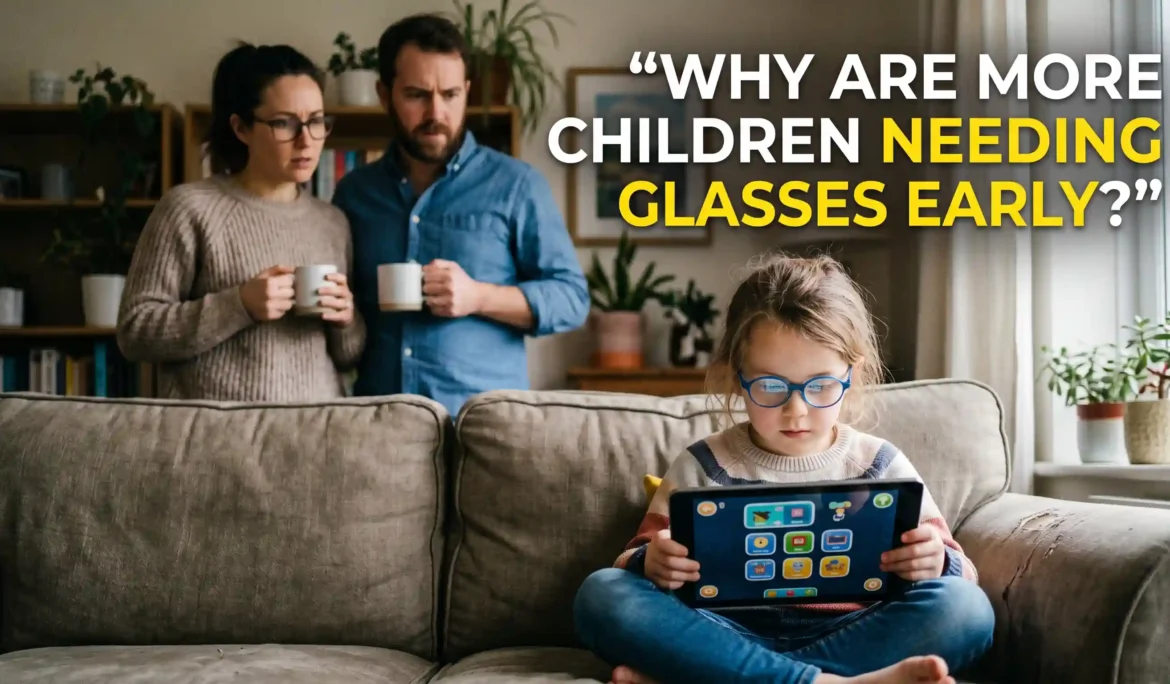
Why Are Children Developing Eye Power at Earlier Ages?
Many parents in Chinchwad and Pimpri-Chinchwad are noticing something surprising — children are needing glasses at much younger ages than before. Earlier, eye power problems were mostly seen in teenagers or adults. Today, even preschool children are being diagnosed with vision issues like myopia or astigmatism.
Childhood myopia is becoming more common worldwide, including in India. More screen time, online learning, less outdoor play and long hours of close-up work are thought to play a part, along with family history. Eye clinics in Chinchwad, Nigdi, Akurdi and Pimpri are seeing more children with glasses.
The good news is that early diagnosis and the right glasses help children see clearly, and healthy habits may help slow myopia getting worse.
What Is Eye Power in Children?
“Eye power” usually refers to a refractive error. In simple words, this means the eyes cannot focus light properly. As a result, children may experience blurred or unclear vision.
Moreover, eye power problems can affect daily activities such as reading, writing, watching television, and seeing the classroom board clearly. Therefore, early detection is very important for healthy visual development.
In addition, many children may not realize they have blurry vision. Consequently, parents should watch carefully for early warning signs and schedule regular eye checkups.
Myopia (Minus Power)
Myopia, or near-sightedness, means children can see nearby objects clearly but struggle to see distant objects.
Examples include:
- Difficulty reading the classroom blackboard
- Sitting very close to the TV
- Squinting to see road signs
This is the most common eye power problem in school-age children. It usually starts between about 6 and 14 years and can keep increasing until the early twenties.
Hyperopia
Hyperopia (long-sightedness, plus power) means the eyes have to work harder to focus, especially on nearby objects. Some children develop headaches or eye strain while reading, and high hyperopia can cause a squint or lazy eye.
Astigmatism
Astigmatism occurs when the cornea has an irregular shape. Vision may appear blurry or distorted at all distances.
Children with astigmatism may complain about:
- Eye strain
- Headaches
- Double vision
- Difficulty concentrating
Why Are Children Developing Glasses Earlier?
Today, several lifestyle changes are contributing to the early rise of eye power in children.
The most common reasons include:
- More screen exposure
- Less outdoor play
- Increased academic pressure
- Early mobile phone use
- Continuous close-up work
Moreover, many children now spend long hours using smartphones, tablets, and laptops every day. As a result, their eyes remain focused on nearby objects for extended periods.
Parents in Thergaon, Ravet and Wakad often report that children spend several hours a day on screens for online classes, gaming or entertainment. Long periods of close focus may add to the risk of myopia.
In addition, reduced outdoor activity has become another major concern. Earlier, children spent more time playing outside. However, many children today prefer indoor screen-based activities instead.
That is why eye doctors encourage balanced screen habits, regular eye breaks and daily outdoor play.
The World Health Organization (WHO) notes that myopia is becoming more common worldwide. External reference: https://www.who.int
Why Is Childhood Myopia Increasing So Fast?
Childhood myopia is increasing rapidly around the world. Similarly, eye clinics in Chinchwad, Pimpri, Nigdi, and Akurdi are seeing more young children with glasses every year.
Mobile Phone Usage
Today, children spend several hours using smartphones. They watch videos, attend classes, and play games on screens daily.
Because of this, their eyes stay focused at a close distance for long periods.
Online Classes
During and after the pandemic, online learning became very common. Consequently, screen exposure increased sharply among school children.
Long screen time may lead to:
- Eye strain
- Headaches
- Dry eyes
- Blurred vision
Reduced Outdoor Activity
At the same time, outdoor play has decreased significantly. Many children now spend more time indoors.
Studies show that children who spend more time outdoors are less likely to become short-sighted. Many eye doctors suggest about 1 to 2 hours outdoors every day.
Continuous Near Work
Reading, writing, and using digital devices all involve near work. When children do these activities continuously without breaks, eye strain can increase.
Signs Parents Should Watch For
Many children do not complain about poor vision. Therefore, parents must watch carefully for warning signs.
Common Symptoms of Eye Power
Look for these symptoms:
- Squinting while watching TV
- Sitting too close to screens
- Frequent headaches
- Eye rubbing
- Excess blinking
- Watery eyes
- Difficulty seeing the blackboard
- Reduced focus in school
In addition, some children may avoid reading or lose interest in studies because they cannot see clearly.
School Performance Can Be Affected
Poor vision may reduce classroom concentration. As a result, children may struggle academically.
Teachers are often the first to notice vision problems. Therefore, parents should take school feedback seriously.
Can Mobile Phones Damage Children’s Eyes?
Mobile phones do not directly damage the eyes. However, long screen use can cause eye strain and dry eyes, and long hours of close work may add to myopia.
Reduced Blinking
Normally, we blink many times every minute. However, blinking reduces during screen use.
As a result, children may experience:
- Dry eyes
- Burning sensation
- Watering
- Eye discomfort
Eye Strain
Long periods of close focus tire the focusing muscles inside the eye. Children may then complain of headaches and blurry vision.
Sleep Problems
Using screens late at night may also affect sleep quality. Moreover, poor sleep can increase eye fatigue.
Why Outdoor Play Is Important for Eye Development
Outdoor time is linked with a lower chance of developing myopia in children.
Natural Light Helps the Eyes
Researchers are not yet sure why outdoor time helps. Brighter daylight and looking at distant objects may both play a part.
Outdoor Activities Reduce Near Work
When children play outdoors, they naturally spend less time looking at screens.
Healthy outdoor activities include:
- Cycling
- Cricket
- Running
- Walking
- Football
Many eye doctors suggest at least 1 to 2 hours of outdoor activity every day.
At What Age Should Children Have Eye Checkups?
Children should have their eyes checked at birth, in infancy and in early childhood. Vision and eye alignment should be checked between 3 and 5 years, and again before starting school.
After that, regular vision checks are recommended. Your eye doctor will advise how often, which may be every year for children who wear glasses or whose power is changing.
Regular testing helps detect:
- Myopia
- Lazy eye
- Squint
- Astigmatism
Most importantly, finding problems early means glasses or treatment can start on time. Lazy eye treatment works better when started in early childhood.
How Parents Can Reduce Eye Power Progression
Myopia cannot always be prevented, but healthy habits may help slow it. Ask your eye doctor about options to slow myopia if your child’s power is increasing quickly.
Follow the 20-20-20 Rule
Every 20 minutes, children should:
- Look 20 feet away
- For at least 20 seconds
This simple habit gives the eyes a break from close focus.
Reduce Screen Time
Parents should limit unnecessary mobile and tablet use. Instead, encourage outdoor games and hobbies.
Ensure Proper Lighting
Children should study in bright, comfortable lighting. Poor lighting may increase eye strain.
Encourage Healthy Sleep
Good sleep supports overall health and reduces tiredness. Children should avoid screens before bedtime.
Regular Eye Checkups Matter
Routine eye exams help detect problems early. In addition, wearing prescribed glasses correctly is very important.
When Should Parents Take Their Child to an Eye Doctor Soon?
Some signs need a prompt eye check.
See an eye doctor within days if your child has:
- A rapid increase in eye power
- Eyes that turn in or out (squint)
- Frequent headaches
- A white reflection in the pupil, for example in a flash photo
- Blurry vision that is new
- Falling school performance linked to poor vision
If your child has a sudden loss of vision, an eye injury or a chemical in the eye, go to an emergency department straight away or call 108 or 112. Children with a family history of high myopia should have regular monitoring.
Pediatric Eye Care in Chinchwad & Pimpri-Chinchwad
Parents looking for child eye checkups and myopia treatment in:
- Chinchwad
- Pimpri
- Nigdi
- Akurdi
- Ravet
- Wakad
- Thergaon
- Pimple Saudagar
- Talwade
- Bhosari
can contact the eye care (ophthalmology) department at Chetna Hospital, Pimpri-Chinchwad, Pune.
The department provides eye care for children of all ages. Parents also get guidance about screen habits, eye health and early warning signs of vision problems.
The clinic focuses on:
- Personalized pediatric eye care
- Early diagnosis of eye problems
- Parent education and awareness
- Child-friendly consultations
Regular eye checks can find vision problems early, so children can get the glasses or treatment they need for learning and daily life.
FAQ Section
Why is my child’s eye power increasing rapidly?
Family history, long hours of close work and screen time, and less outdoor time can all add to increasing eye power.
Can screen time increase the minus number?
Long hours of close-up work, including screens, may add to myopia getting worse.
At what age do children start needing glasses?
Some children may need glasses as early as preschool age.
Can outdoor play reduce eye power?
Outdoor activity may help slow the progression of myopia.
Is childhood myopia permanent?
Myopia usually does not go away. Glasses or contact lenses correct the blur, and an eye doctor can advise on ways to help slow it.
When should a child see an eye specialist?
Children should see an eye specialist if they squint, complain of headaches, or struggle to see distant objects. A white reflection in the pupil or a new squint needs a prompt check.
Book a Child Eye Checkup in Chinchwad
If your child is:
- Squinting frequently
- Complaining of headaches
- Sitting too close to screens
- Showing a rapid increase in glasses power
then it may be time for a full eye examination. Early detection helps your child get the right glasses or treatment, which supports learning and comfort.
Book a detailed eye check if you notice these signs.
Contact the eye care (ophthalmology) department at Chetna Hospital, Pimpri-Chinchwad, Pune for children’s eye care. Call 91686 90442 to book a check-up.
General health information, not a diagnosis. Reviewed and updated by Chetna Hospital’s content team with the help of AI writing tools, November 2026.