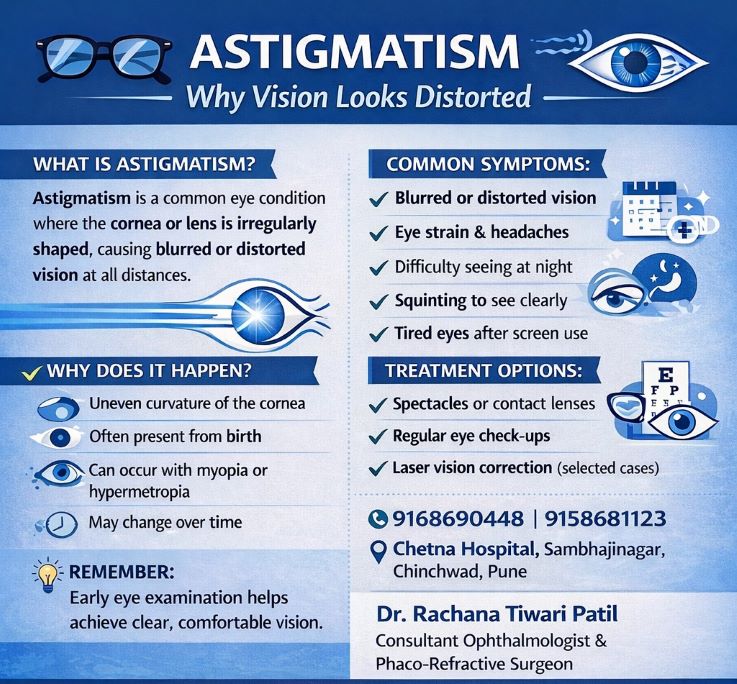
Blurred or distorted vision is a common complaint at eye clinics in Pune. One common cause is astigmatism, a refractive error that affects people of all ages. Astigmatism happens when the cornea or lens has an uneven curve, which can make vision blurred or distorted at all distances. It often occurs together with short-sightedness (myopia) or long-sightedness (hypermetropia).
For people in Chinchwad, Wakad, Thergaon, Ravet, Punawale, and nearby areas, the eye care (ophthalmology) department at Chetna Hospital, Chinchwad, Pune, can check for astigmatism and advise on how to correct it.
What is Astigmatism?
Astigmatism is a common refractive error caused by an uneven shape of the cornea or, less commonly, the lens inside the eye. In a typical eye, the cornea and lens are evenly curved, so light focuses on the retina at the back of the eye. In astigmatism, the uneven curve bends light unevenly, resulting in blurred or distorted vision.
Astigmatism can affect both children and adults. Some people are born with it, and many develop it in childhood or young adulthood. Mild astigmatism may cause no noticeable problems, while higher amounts can interfere with daily activities such as reading, driving, or working on digital screens.
Symptoms of Astigmatism
Common signs include:
- Blurred or distorted vision at all distances
- Eye strain or fatigue, especially after long reading or screen use
- Headaches
- Difficulty seeing at night, including glare or halos around lights
- Squinting to see more clearly
- Tired eyes after focusing for long periods
These symptoms can have other causes too. The only way to know if you have astigmatism is an eye examination.
Causes of Astigmatism
Astigmatism occurs when the cornea or lens has an uneven shape. Instead of being evenly round like a basketball, it may be shaped more like a rugby ball. This stops light from focusing correctly on the retina, causing blurred or distorted images. The exact cause is not known.
Things linked to astigmatism include:
- Genetics: Astigmatism often runs in families
- Eye injuries, eye disease or surgery: Anything that changes the shape of the cornea
- Other refractive errors: Astigmatism often occurs together with myopia (short-sightedness) or hypermetropia (long-sightedness)
- Changes over time: Astigmatism can get worse, improve or stay the same as the eye grows and ages
Reading in dim light or sitting close to the TV does not cause astigmatism or make it worse.
Diagnosing Astigmatism
Diagnosis needs a comprehensive eye examination. At Chetna Hospital, Chinchwad, the eye care department checks the amount and type of astigmatism.
Tests may include:
- Visual acuity test: Measures clarity of vision at different distances
- Corneal topography: Maps the surface curvature of the cornea
- Refraction test: Finds the lens power needed for correction
- Eye health evaluation: Detects co-existing conditions like cataracts or glaucoma
Finding astigmatism early helps ease eye strain and headaches, and in children it helps protect normal vision development.
Types of Astigmatism
Astigmatism is classified based on its location and pattern:
- Corneal Astigmatism: Caused by an unevenly shaped cornea
- Lenticular Astigmatism: Caused by an unevenly shaped lens
- Regular Astigmatism: The two main curves of the eye are at right angles to each other
- Irregular Astigmatism: The curves are uneven and not at right angles, often due to eye injury, scarring, eye disease or surgery
Knowing the type of astigmatism helps the eye doctor suggest the right correction options.
Treatment Options for Astigmatism
Treatment depends on how much astigmatism you have and your needs. Mild astigmatism may not need any treatment.
1. Eyeglasses
Glasses are the most common option. They use cylindrical lenses to make up for the uneven curve, giving clearer, more comfortable vision.
2. Contact Lenses
Soft toric contact lenses are designed for astigmatism. Rigid gas permeable (RGP) lenses may suit higher or irregular astigmatism. Contact lenses can suit active lifestyles but need careful hygiene.
3. Laser Vision Correction
For selected adults, laser procedures like LASIK or PRK can reshape the cornea to reduce or correct astigmatism. Not everyone is suitable, so a thorough eye evaluation is needed first, and the risks should be discussed with your eye doctor.
4. Regular Eye Check-Ups
Even if you already use corrective lenses, regular eye examinations help track changes in vision and keep your eyes healthy.
Astigmatism in Children
Astigmatism often appears in childhood, and children may not realise their vision is blurry. It can affect reading and schoolwork. Signs in children may include:
- Squinting while reading
- Sitting very close to screens or books
- Complaining of headaches
- Frequent eye rubbing
Untreated astigmatism in children can lead to amblyopia (lazy eye), so regular eye checks for children are important for healthy visual development.
Living with Astigmatism
Astigmatism is common and manageable. These habits can help reduce discomfort in daily life:
- Use good lighting while reading for comfort
- Take regular breaks from screens
- Wear your prescribed glasses or lenses as advised
- Have eye check-ups as often as your eye doctor advises
When to See an Ophthalmologist
Book an eye check-up if you have:
- Persistent blurred or distorted vision
- Eye strain or frequent headaches
- Night vision problems
- Glasses that no longer seem right
- Vision problems affecting work, studies, or daily life
Astigmatism changes slowly. If vision suddenly becomes distorted or blurred, or you lose vision, go to an emergency department straight away or call 108 or 112.
The eye care department at Chetna Hospital, Chinchwad, Pune, sees people from Chinchwad, Wakad, Thergaon, Ravet, Punawale, Pimpri, and nearby areas.
Conclusion
Astigmatism is a common, correctable eye condition that affects how clear and comfortable your vision is. Noticing the symptoms and getting an eye examination helps you see more clearly and comfortably.
If you have blurred or distorted vision, headaches, or eye strain, visit the eye care (ophthalmology) department at Chetna Hospital, Sambhajinagar, Chinchwad, Pune.
Contact: Call 91686 90442 to book a check-up. Main hospital line: 9158681123
General health information, not a diagnosis. Reviewed and updated by Chetna Hospital’s content team with the help of AI writing tools, November 2026.