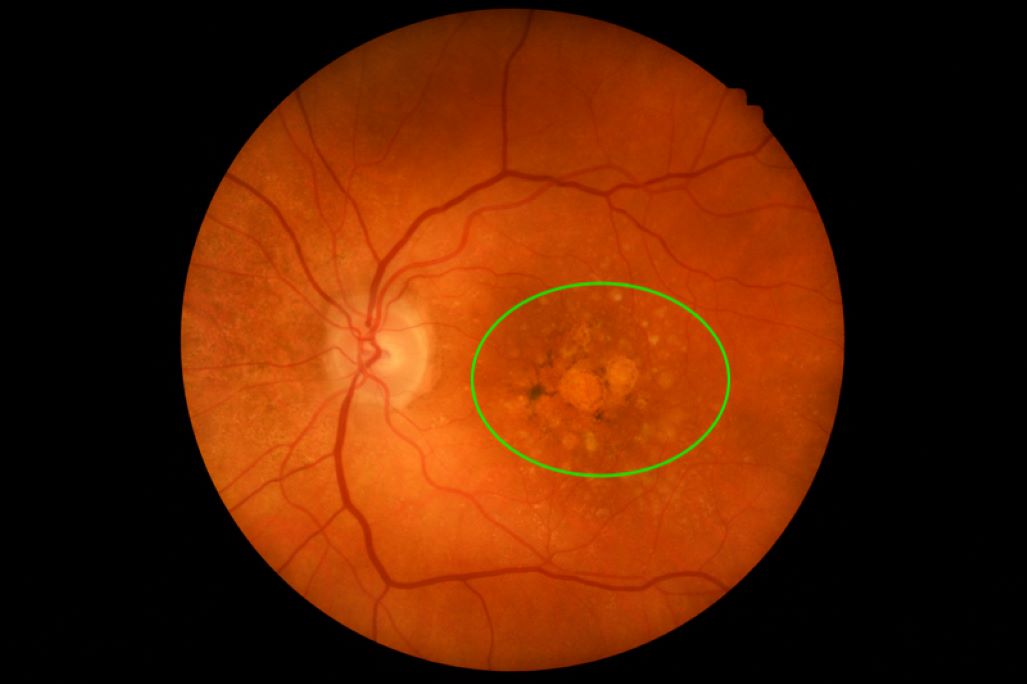
What Is the Macula?
The macula is a small but vital area in the center of the retina, located at the back of the eye. It is responsible for central vision and allows us to see fine details. In AMD, this part of the retina gradually deteriorates, making it difficult to perform daily activities that require clear vision.
Types of AMD
There are two main types of Age-Related Macular Degeneration:
Dry AMD (Atrophic):
This is the more common form: most people with AMD have dry AMD. It happens when the macula slowly thins with age. Vision loss is gradual and often hard to notice at first. Dry AMD can sometimes turn into wet AMD.
Wet AMD (Neovascular):
This less common but more severe form is caused by the growth of abnormal blood vessels under the retina. These vessels may leak blood or fluid, which can damage the macula quickly and cause faster vision loss.
Signs and Symptoms
AMD may not show symptoms in the early stages, especially in dry AMD. However, as the condition progresses, you may notice:
Blurred or fuzzy central vision
A dark or empty area in the center of your vision
Straight lines appearing wavy or distorted (metamorphopsia)
Difficulty reading or recognizing faces
Symptoms usually affect both eyes but may not progress at the same rate in each. AMD is not painful and does not change how the eyes look.
Sudden changes need urgent care: if your central vision gets worse suddenly, straight lines suddenly look wavy, or a dark patch appears, get your eyes checked the same day. Go to the nearest emergency department straight away, or call 108 or 112, if you suddenly lose vision or see a dark curtain or shadow across your vision.
Who Is at Risk?
Certain factors can increase your risk of developing AMD:
Older age (usually over 50)
Family history of AMD
Smoking
High blood pressure
Being overweight
A diet low in green leafy vegetables
How Is AMD Diagnosed?
An eye doctor can detect AMD during a comprehensive eye exam. Tests commonly used include:
Dilated Eye Exam – to examine the retina and macula
Optical Coherence Tomography (OCT) – to get cross-sectional images of the retina
Fluorescein Angiography – to identify abnormal blood vessels in wet AMD
Amsler Grid Test – to detect visual distortions
Can AMD Be Treated?
Treatment cannot reverse AMD, but it can help some people keep their vision for longer:
Dry AMD: There is no medical treatment yet. Regular check-ups, not smoking, a healthy diet and low-vision aids can help. For some people, an eye doctor may suggest specific eye vitamin supplements. Take these only on an eye doctor’s advice, and smokers should not take some of them.
Wet AMD: Injections of medicine into the eye can stop the abnormal blood vessels from growing. Light treatment (photodynamic therapy) or laser is used in some cases. Starting treatment early gives the most chance of keeping vision.
Protecting Your Vision
Early detection is the key to preserving vision. If you’re over 50 or have risk factors, schedule regular eye check-ups. Not smoking, keeping blood pressure in check, staying a healthy weight and eating plenty of green leafy vegetables may help lower your risk. Call 91686 90442 to book an eye check-up at Chetna Hospital.
General health information, not a diagnosis. Reviewed and updated by Chetna Hospital’s content team with the help of AI writing tools, November 2026.