








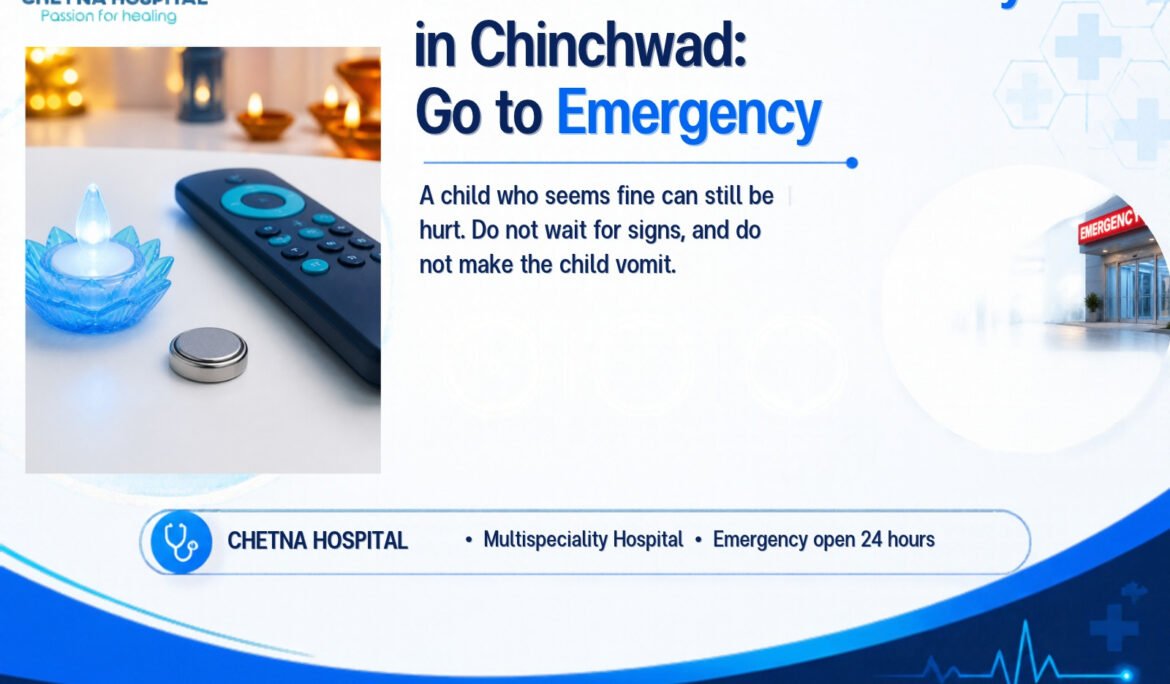
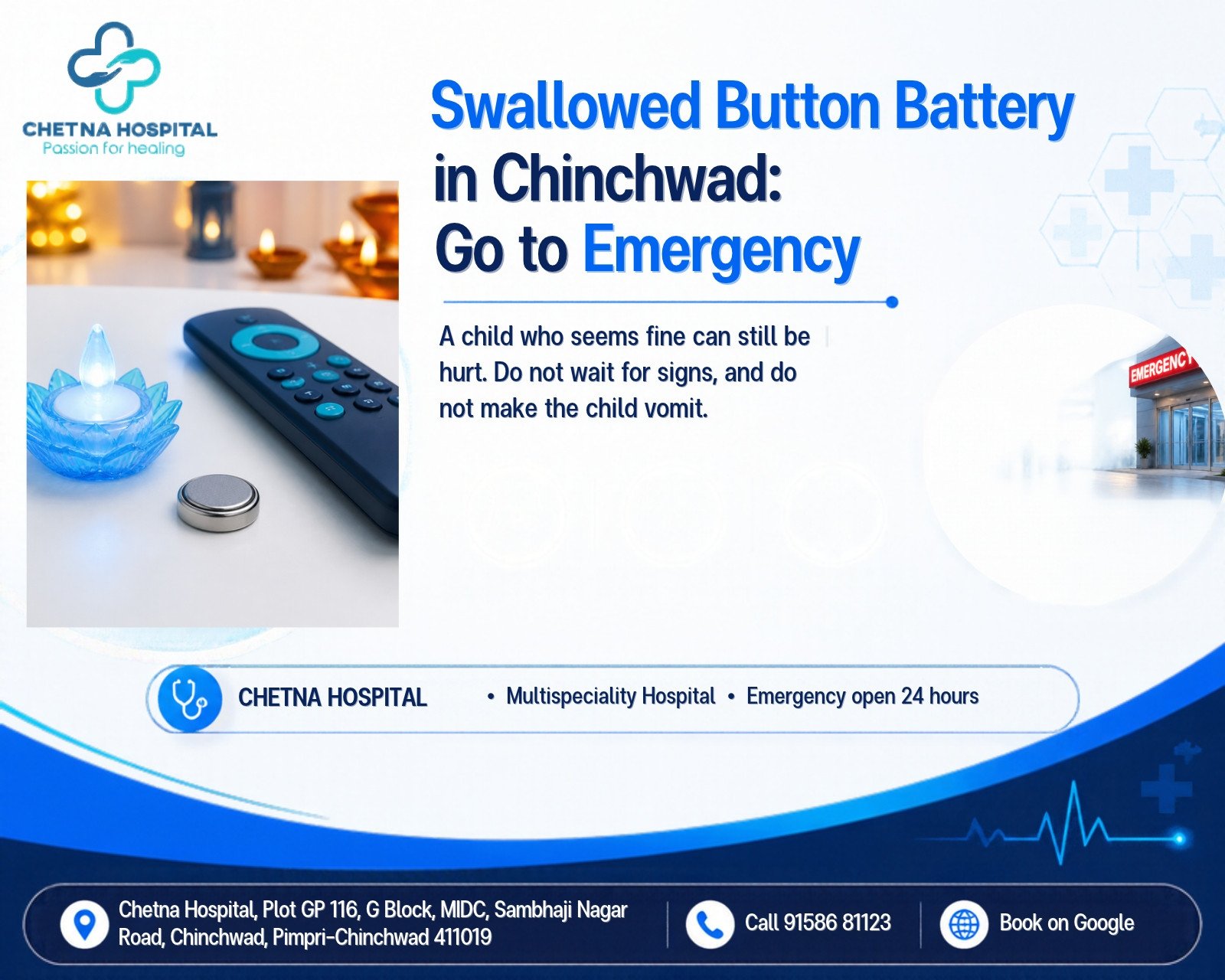
A swallowed button battery is an emergency even when your child seems completely fine. The coin-shaped cell can start to burn the food pipe from the inside before any sign shows. So the emergency team at Chetna Hospital, Chinchwad, PCMC, asks parents not to wait: go to the nearest emergency department at once.
Chetna Hospital – Multispeciality Hospital in Chinchwad, PCMC
Chetna Hospital, Plot GP 116, G Block, MIDC, Sambhaji Nagar Road, Chinchwad, Pimpri-Chinchwad 411019
Key takeaways
- A swallowed button battery needs emergency care now, not tomorrow.
- A child can look normal at first, which is why parents wait.
- Do not make the child vomit, and do not give food or drink.
- An X-ray shows where the battery is, so the team can act fast.
- Tape battery covers shut on Diwali lights, remotes and toys.
In this article
- Why it is an emergency
- Signs parents miss
- The first few minutes
- What happens at the hospital
- Where batteries hide this Diwali
- Slides to save and share
- Warning signs
- Help near you
- Questions parents ask
Last updated 4 November 2026
“He swallowed it, but look, he’s playing.” It is natural to feel relieved when a child seems well. However, a child who looks well is the case that worries doctors most, because the harm starts quietly.
Why this is in the news now: Diwali falls on 8 November this year, and homes are filling up with LED diyas, light strings, remotes and new toys, many of which run on button cells.
Why is a swallowed button battery an emergency?
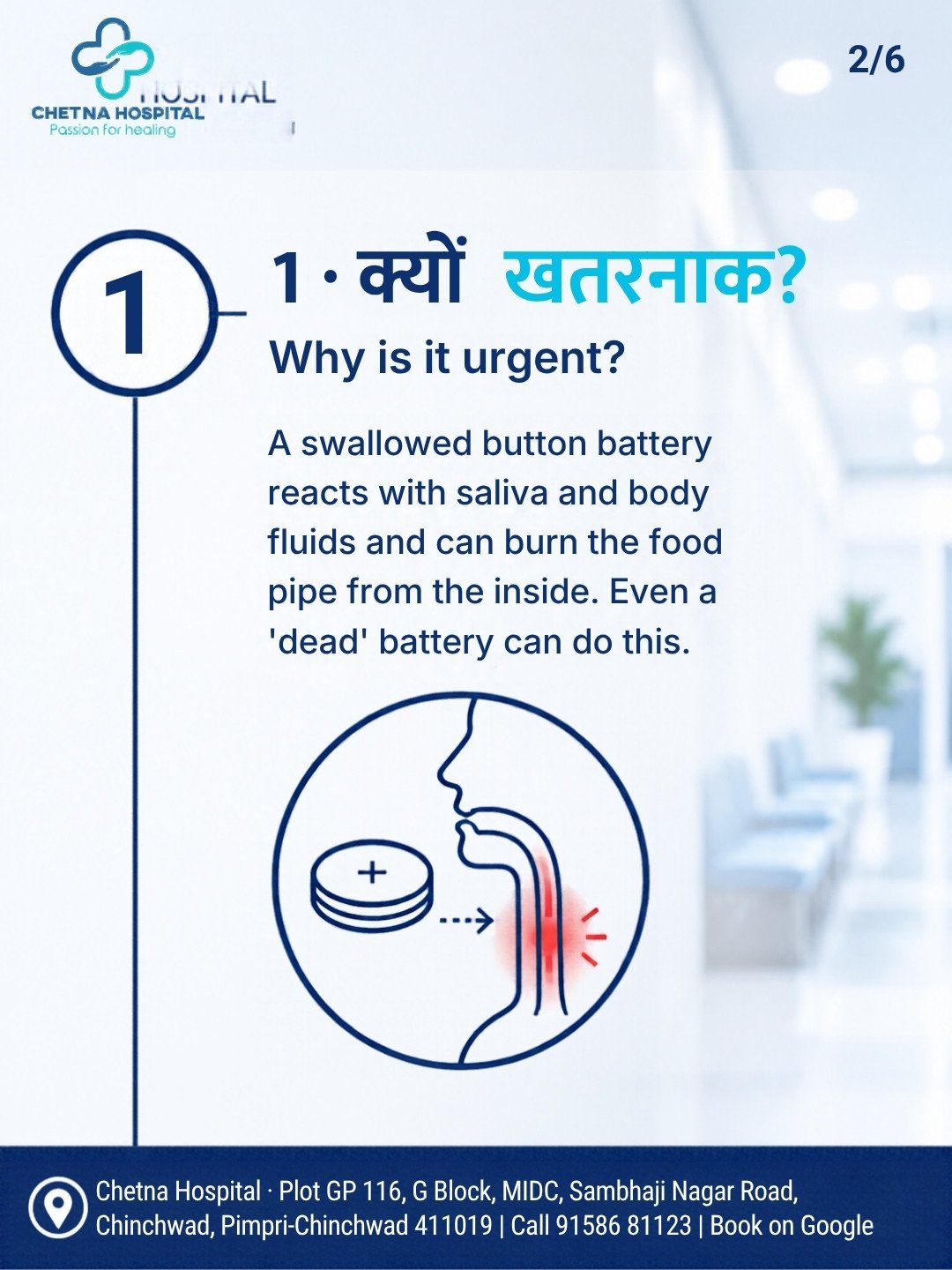
A swallowed button battery can get stuck in a child’s food pipe. There, it reacts with spit and body fluids. As a result, it releases an alkali, similar to caustic soda, that burns the tissue around it. Great Ormond Street Hospital, part of the NHS, also warns that a “dead” battery can still do this, so a used cell is just as risky as a new one.
The burn also keeps going for as long as the battery stays in place. That is why time matters more here than with a coin.
What signs do parents miss?
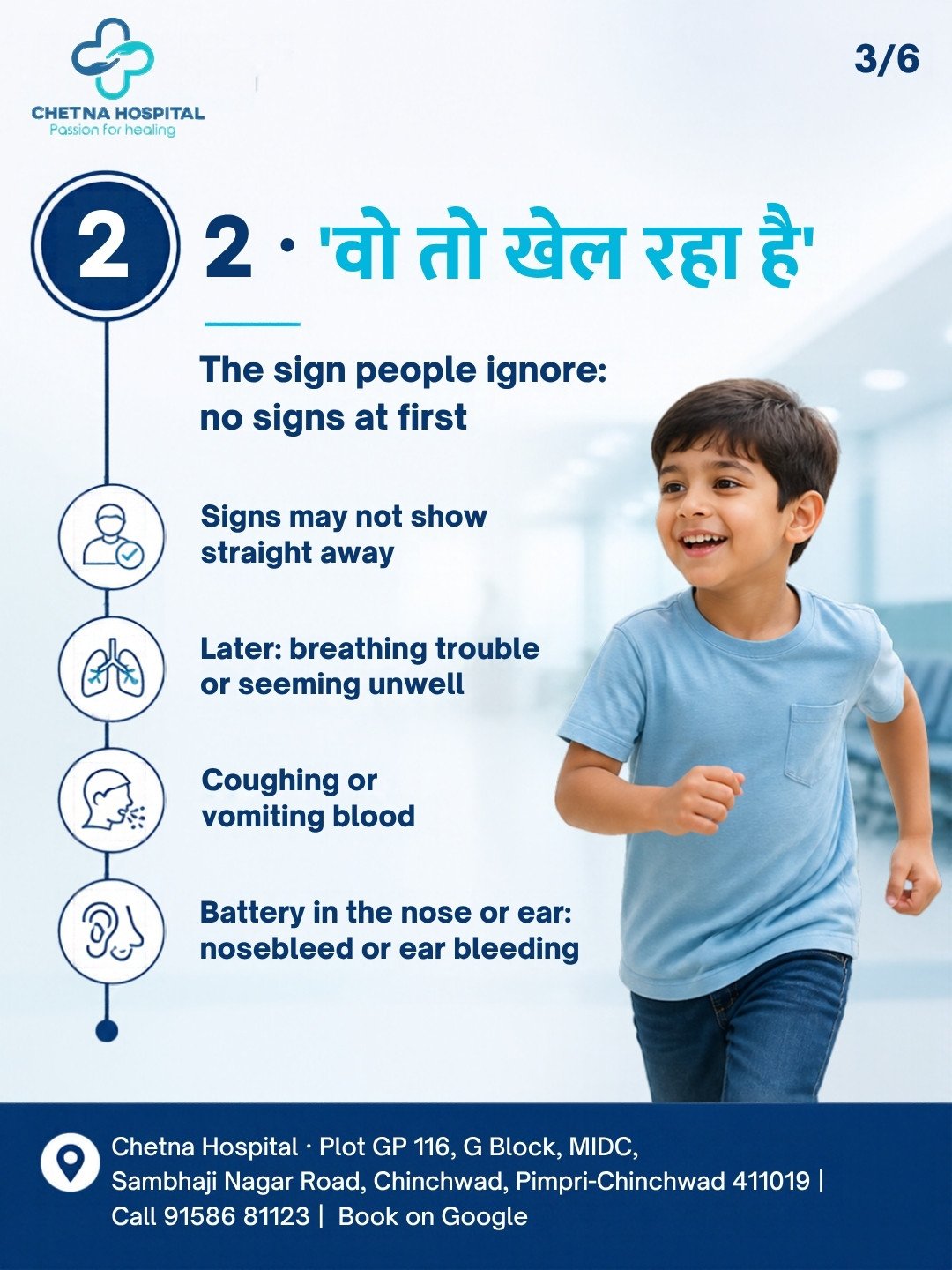
The sign people miss most is no sign at all, because the first hours can look normal. A child may eat, talk and play as usual. For example, a toddler may simply cough once and carry on. Later, warning signs can appear:
- Vomiting, or coughing or vomiting blood.
- Drooling, or pain or difficulty when swallowing.
- Throat or chest pain, or refusing food.
- Noisy or difficult breathing, or seeming generally unwell.
- With a battery pushed into the nose or ear: a nosebleed or bleeding from the ear.
So if you did not see the swallow but a battery is missing from a toy or remote, treat it as swallowed and get your child checked.
What should you do in the first few minutes?
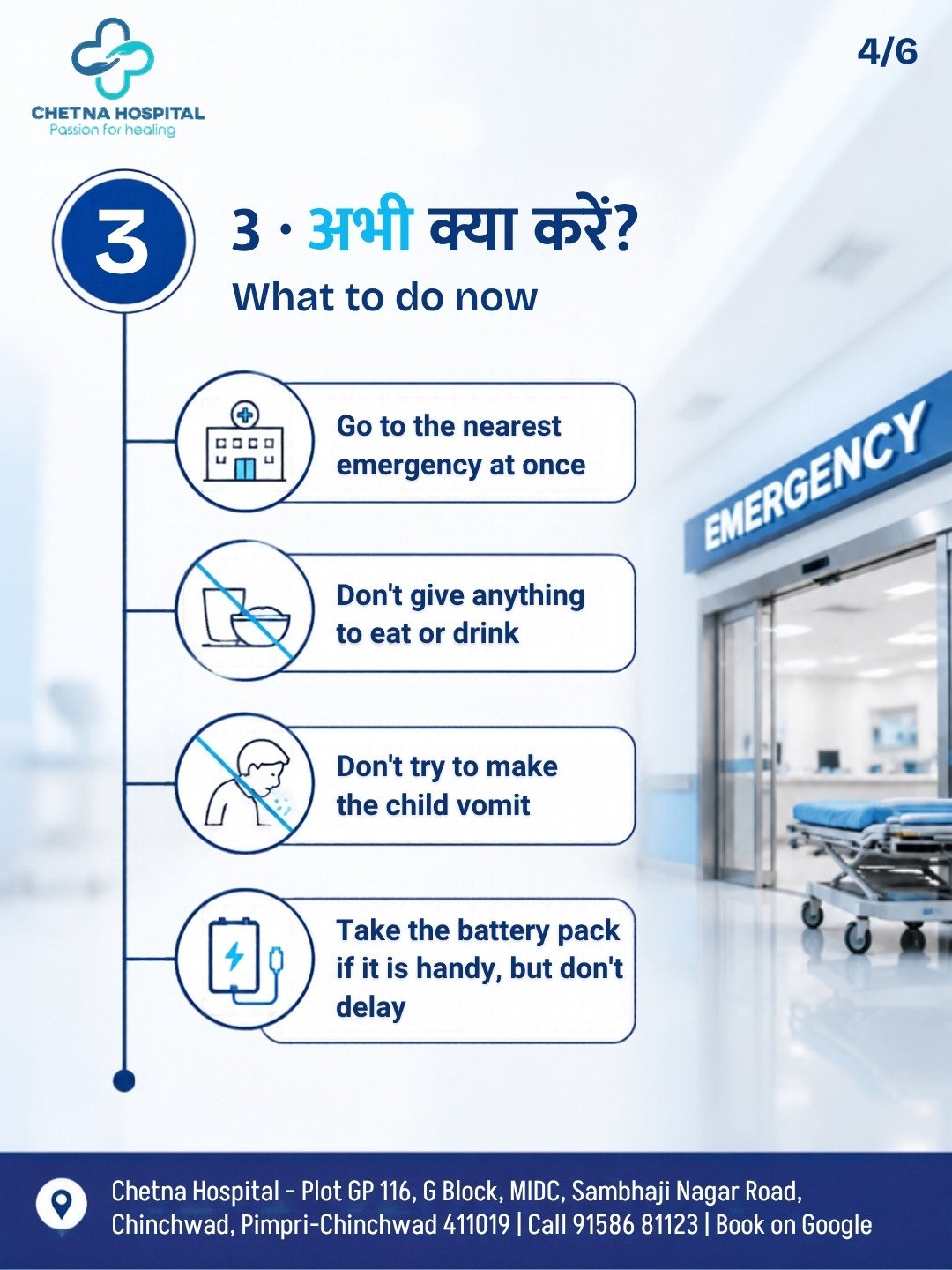
- Go to the nearest emergency department straight away, without waiting for signs.
- Do not try to make your child vomit.
- Also, give no food or drink unless a doctor or emergency helpline tells you to.
- Take the battery packet or the device if it is close at hand, but do not delay to find it.
- Call ahead on the way, so the team is ready.
Also, if another child was nearby, check that nobody else swallowed or pushed a battery into the nose or ear.
What happens at the hospital after a swallowed button battery?
First, the emergency doctor checks your child’s breathing, swallowing and general condition. Then an X-ray shows where the swallowed button battery is. A battery and a coin look different on it. Next, the team plans the next step. It depends on where the battery is and when it went down. A battery stuck in the food pipe needs urgent removal. Our radiology team does the X-ray, and children are seen with our paediatric team. For a battery in the nose or ear, our ENT department is involved.
Where are button batteries hiding this Diwali?
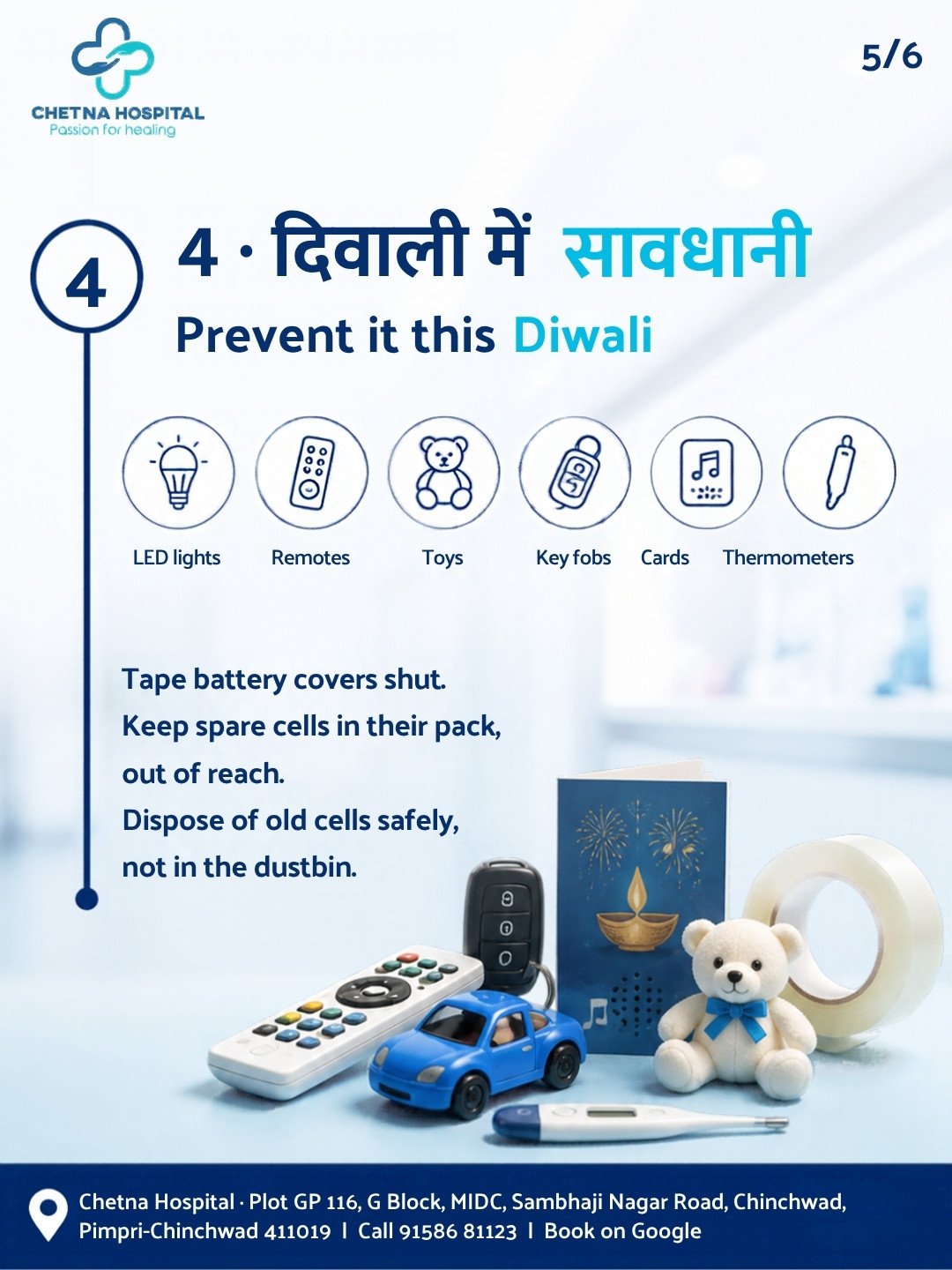
- LED diyas, light strings and other small decorations.
- Remote controls, key fobs and car keys.
- Electronic toys and musical greeting cards.
- Watches, calculators, digital thermometers and glucose meters.
To prevent a swallowed button battery, tape battery covers shut. Then keep spare cells in their original pack, out of reach, and dispose of old ones safely, not in the dustbin.
Slides to save and share
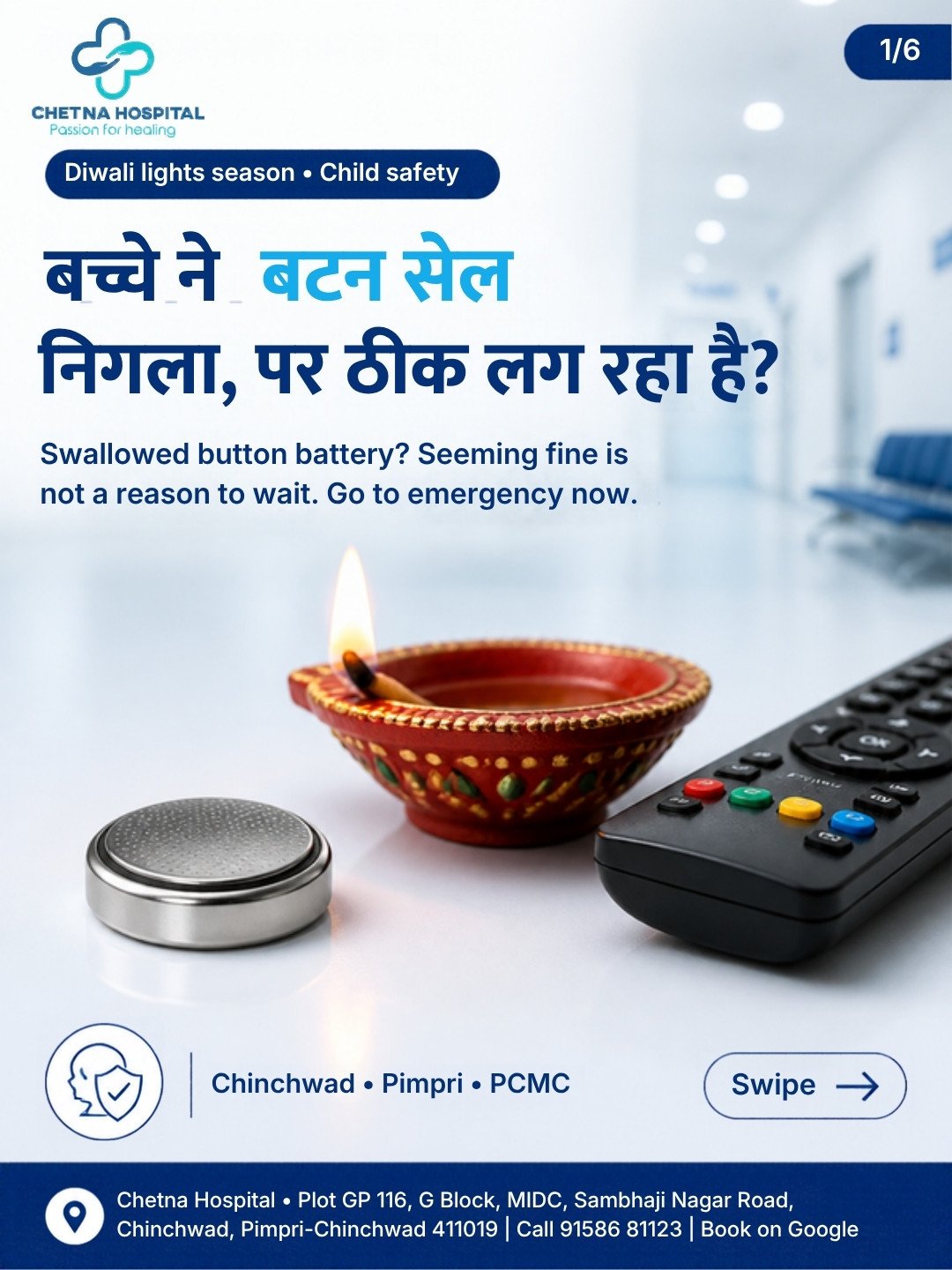
When is it an emergency? See a doctor urgently
Every swallowed battery needs emergency care. In addition, call an ambulance or rush to emergency if your child has:
- Trouble breathing, or noisy breathing.
- Blood in vomit or spit, or black stools.
- Severe chest, throat or tummy pain.
- Drowsiness, or is not able to swallow saliva.
Do not drive alone with a sick child. Instead, ask someone to drive while you watch the child. You can also read about our intensive care unit.
Where can you get help for a swallowed button battery in Chinchwad?
Chinchwad: Chetna Hospital, Plot GP 116, G Block, MIDC, Sambhaji Nagar Road, Chinchwad, Pimpri-Chinchwad 411019. Emergency open 24 hours. Call 91586 81123. Directions
Families come from Chinchwad, Pimpri, Akurdi, Nigdi, Ravet and Wakad. Others travel from Hinjewadi, Pimple Saudagar, Thergaon, Tathawade, Punawale, Moshi and Bhosari.
Swallowed button battery: questions parents ask
Is a swallowed button battery dangerous if the child seems fine?
Yes. A swallowed button battery can start burning the food pipe before any sign shows. So go to the nearest emergency department at once, even if your child is playing and eating normally.
Should I make my child vomit after swallowing a battery?
No. Vomiting can bring the battery back up and cause more damage. Also do not give food or drink unless a doctor tells you to. Just get to emergency quickly.
Can a swallowed button battery pass in the stool on its own?
Sometimes a battery that has already moved past the food pipe passes on its own, but only an X-ray and a doctor can tell where it is. Never wait at home to see if a swallowed button battery comes out.
Which things at home have button batteries?
Remote controls, LED lights, electronic toys, watches, key fobs, digital thermometers, glucose meters and greeting cards that play music. Also, many Diwali decorations with small lights use them.
Where can I get help for a swallowed button battery in Chinchwad?
Chetna Hospital on Sambhaji Nagar Road, MIDC, Chinchwad, has an emergency department that is open 24 hours. Call 91586 81123 on the way so the team knows you are coming.
Chetna Hospital – Multispeciality Hospital in Chinchwad, PCMC
Chetna Hospital, Plot GP 116, G Block, MIDC, Sambhaji Nagar Road, Chinchwad, Pimpri-Chinchwad 411019
Sources
- Great Ormond Street Hospital (NHS): Button batteries – using them safely
- Alder Hey Children’s Hospital (NHS): What to do if your child swallows a button battery
- Dekho Panchang: Diwali 2026 date
Disclaimer: This article is for general awareness. It does not replace a medical consultation. In an emergency, go to the nearest emergency department.
How this article was prepared: Chetna Hospital’s content team wrote it with the help of AI writing tools and checked it against the sources listed. It is general health information, not personal medical advice from the doctor named on this page.