








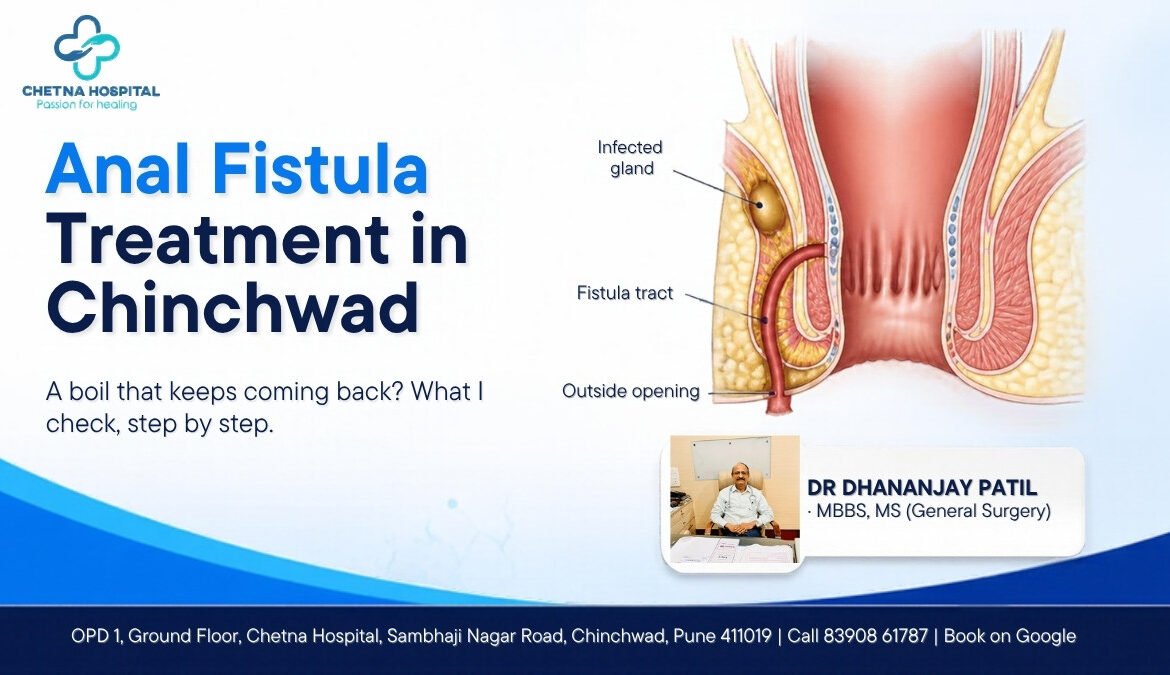
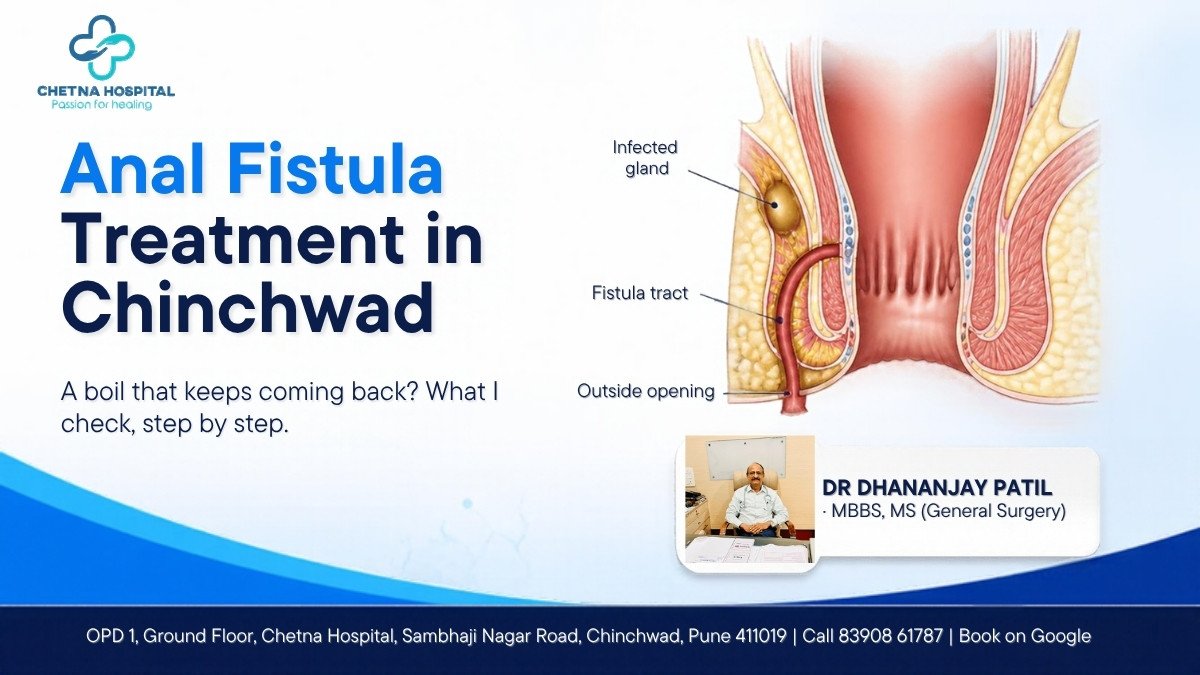
A boil near the anus that bursts, drains pus and comes back in the same spot is often an anal fistula: a small tunnel from inside the anal canal to the skin. Dr Dhananjay Patil, general and laser surgeon in Chinchwad, PCMC, advises an examination rather than repeated antibiotics, and same-day care for fever with a painful lump.
Dr Dhananjay Patil – Piles, Fissure, Fistula & General Surgeon in Chinchwad, PCMC
OPD 1, Ground Floor, Chetna Hospital, Sambhaji Nagar Road, next to Pimpri Chinchwad Sahakari Bank, Sambhajinagar, Chinchwad, Pune 411019
Many of the patients who come to me with a fistula have already finished more than one course of antibiotics. Each time the boil settled, they felt the problem was over. Then the same spot swelled again, burst, and the stain on the underwear came back. By the time they sit in my OPD, the question is no longer “what is this?” but “why does it keep happening?”
That question has a clear answer. Below, Dr Dhananjay Patil, Consultant General Surgeon at Chetna Hospital, explains each step in the order it happens in his clinic.
Why this is in the news now: on 13 October 2026, a company testing a new gel treatment for anal fistula reported early trial results (the study is listed on ClinicalTrials.gov). It is still experimental and not yet part of routine care, but the news has brought a condition people rarely talk about into the open.
Why a fistula keeps coming back
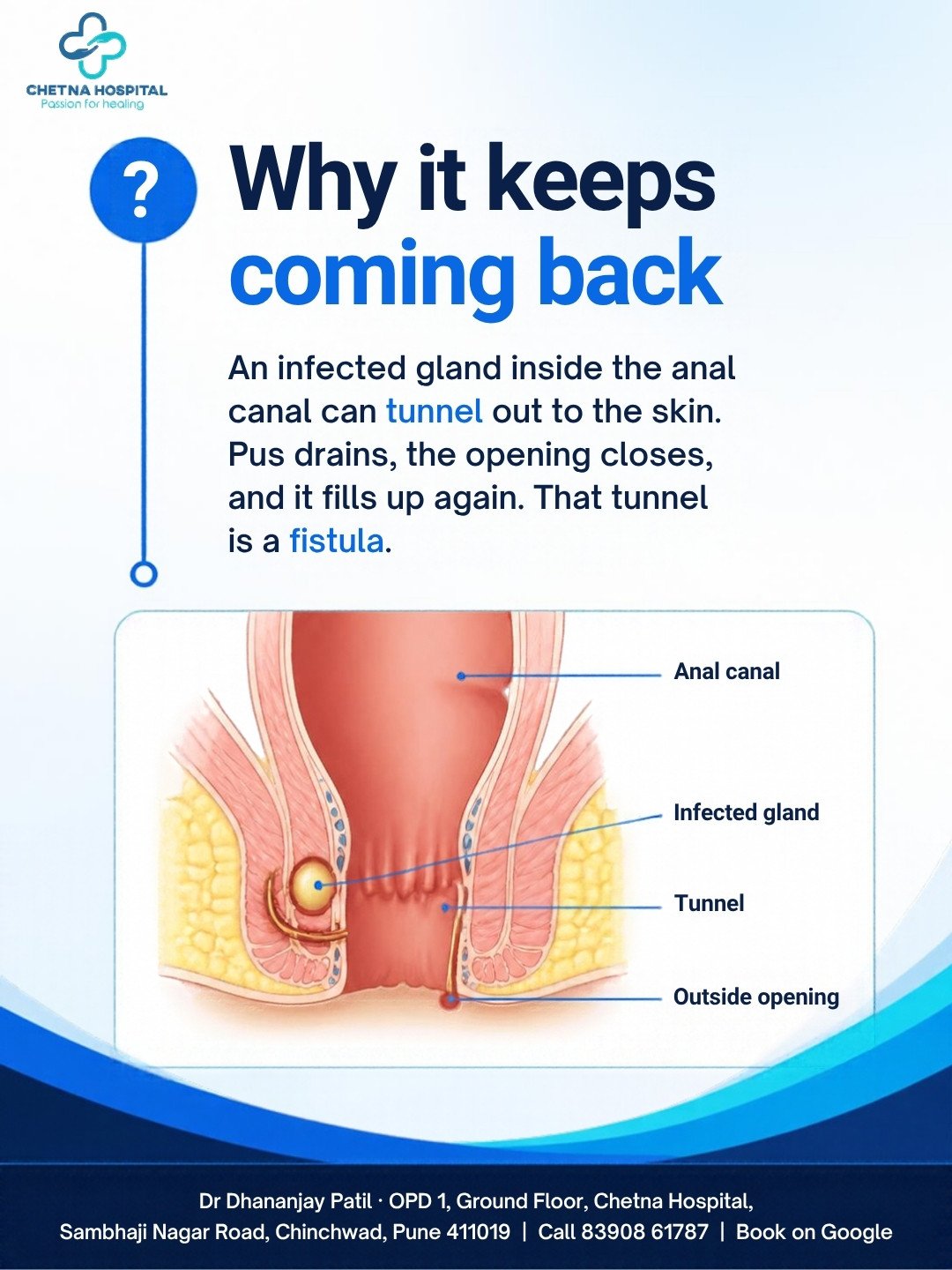
Inside the anal canal there are small glands. When one of them gets blocked and infected, pus collects and looks for a way out. It often tunnels through the tissue and opens on the skin near the anus. That first episode is an abscess, the painful boil. Once the pus drains, the swelling settles, but the tunnel it made can stay behind. That tunnel is the fistula.
The NHS describes anal fistula as usually developing after an anal abscess, and notes that it rarely heals on its own. Because the tunnel is still connected to the inside of the canal, it keeps refilling. Antibiotics can calm the infection for a while, but they cannot close a tunnel lined with tissue.
Signs that point to a fistula
- A boil or swelling near the anus that returns in the same place
- Pus, blood or a watery discharge staining your underwear
- Pain or throbbing when you sit, which eases once the boil drains
- Itching or soreness of the skin around the opening
- Fever or feeling unwell when the area swells up
A pattern I see often
A young man who works long hours at a desk notices a tender lump near the anus. It bursts on its own after a few days, and he feels relieved. A month later it is back. A chemist gives him tablets, it settles, and the cycle repeats. Six months on he has a small opening that leaks every few days, and he has stopped mentioning it at home because he assumes it is piles. It is not piles. Piles do not usually discharge pus, and they do not come and go as boils. When he finally gets examined, the opening and the tunnel are often easy to find.
Step 1: we talk
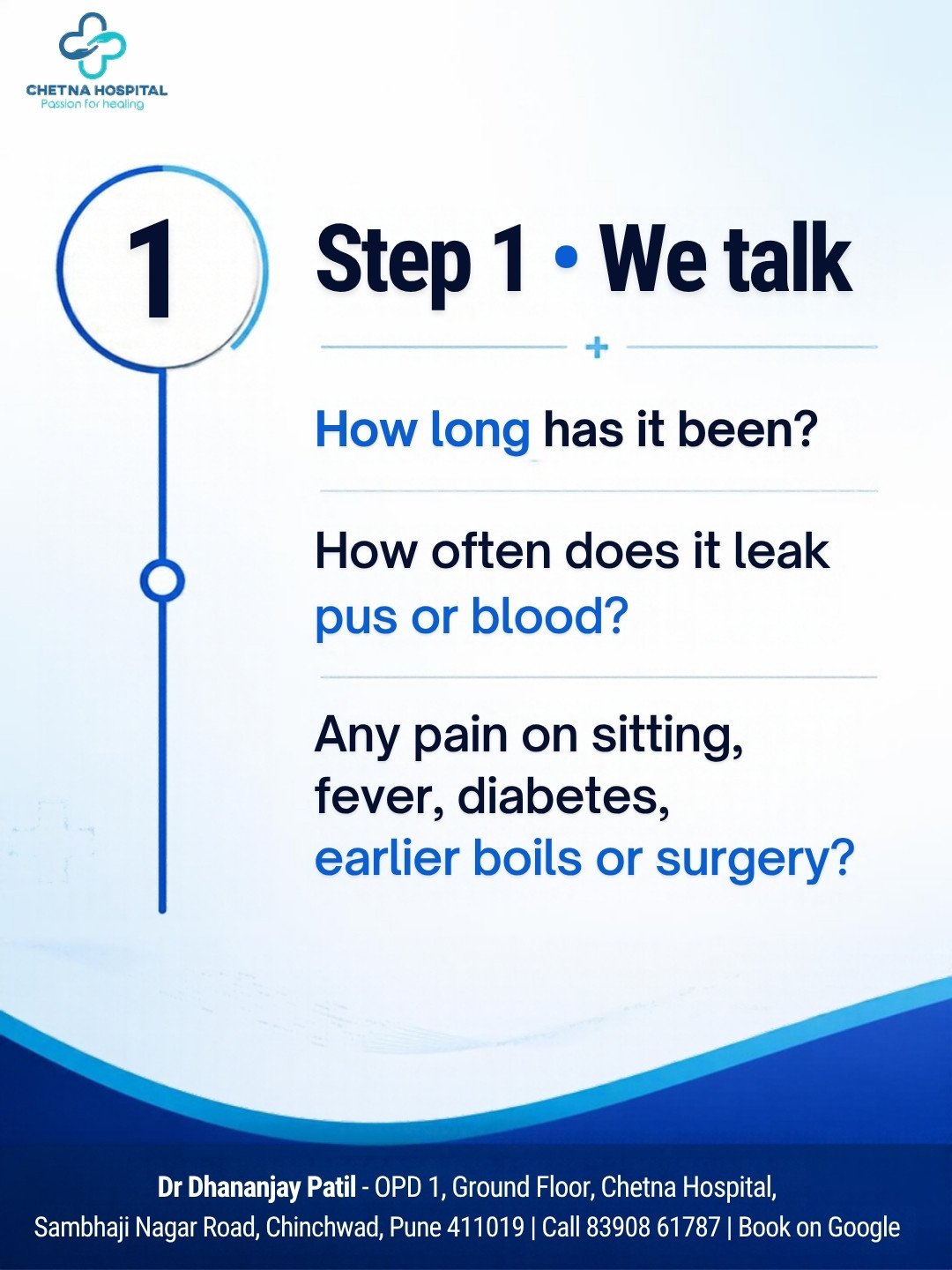
I start with questions, not an examination. How long has it been? How often does it swell or leak? Is it pus, blood or both? Do you get fever with it? Do you have diabetes, a long-standing bowel problem, or have you had a boil or surgery there before? Diabetes matters because infections spread faster and heal more slowly. Repeated diarrhoea, weight loss or a family history of bowel disease can point to a cause I need to rule out.
Step 2: I examine
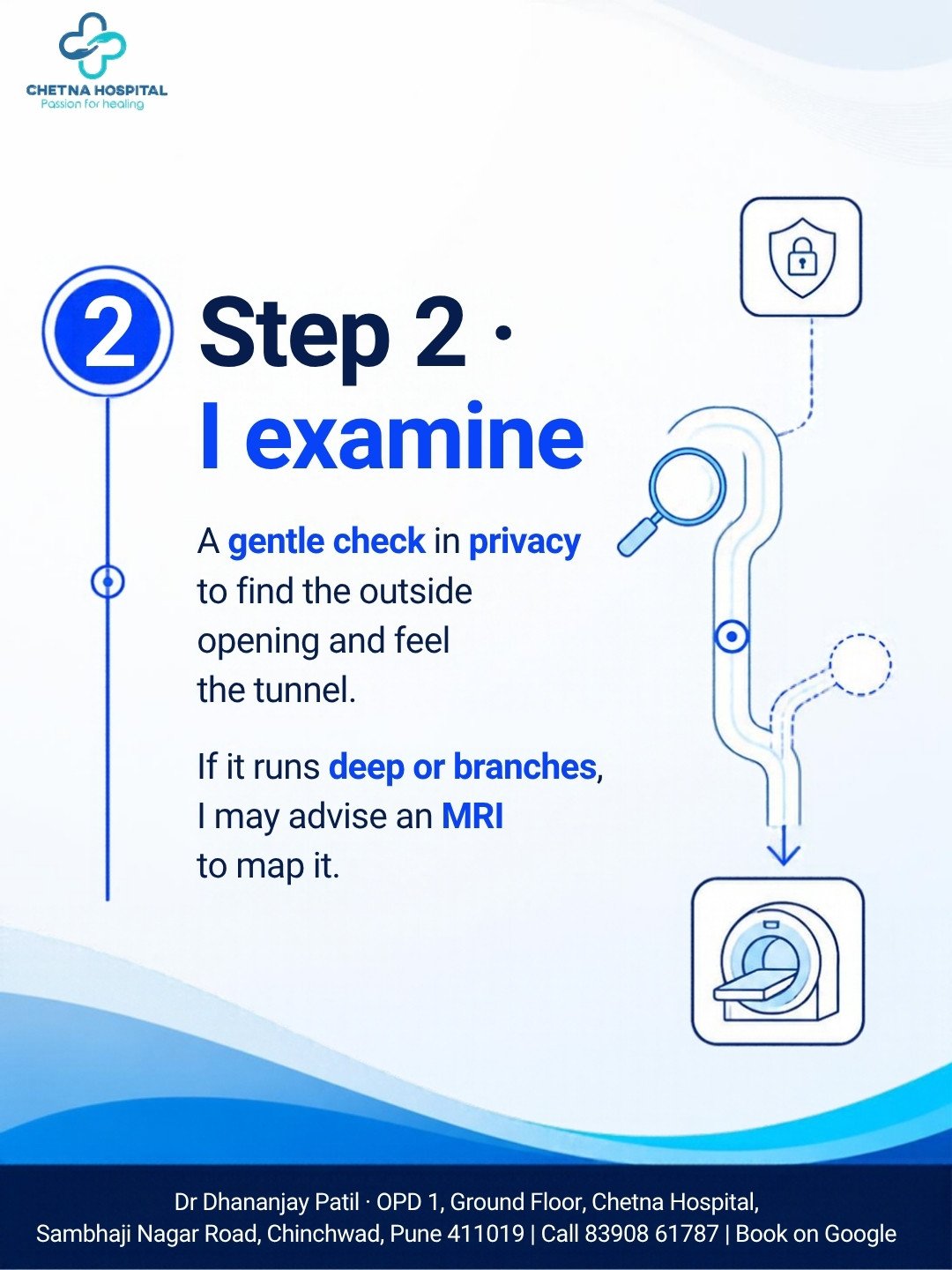
The examination is done in privacy, with a chaperone if you wish. I look for the outside opening and gently feel the tissue around it. A tunnel often feels like a firm cord under the skin, running towards the anus. [Dr Dhananjay: confirm whether you routinely do a proctoscopy at the first visit, and how long the examination usually takes in your OPD.]
Some tunnels are short and straight. Others run deep, branch, or cross a large part of the muscle that controls the passing of stool. If I suspect that, I advise an MRI of the anal region. The MRI works like a map: it shows the path of the tunnel, any hidden pockets of pus, and how much muscle is involved. Planning surgery without that map, in a complex fistula, raises the risk of the fistula coming back.
Step 3: we plan treatment
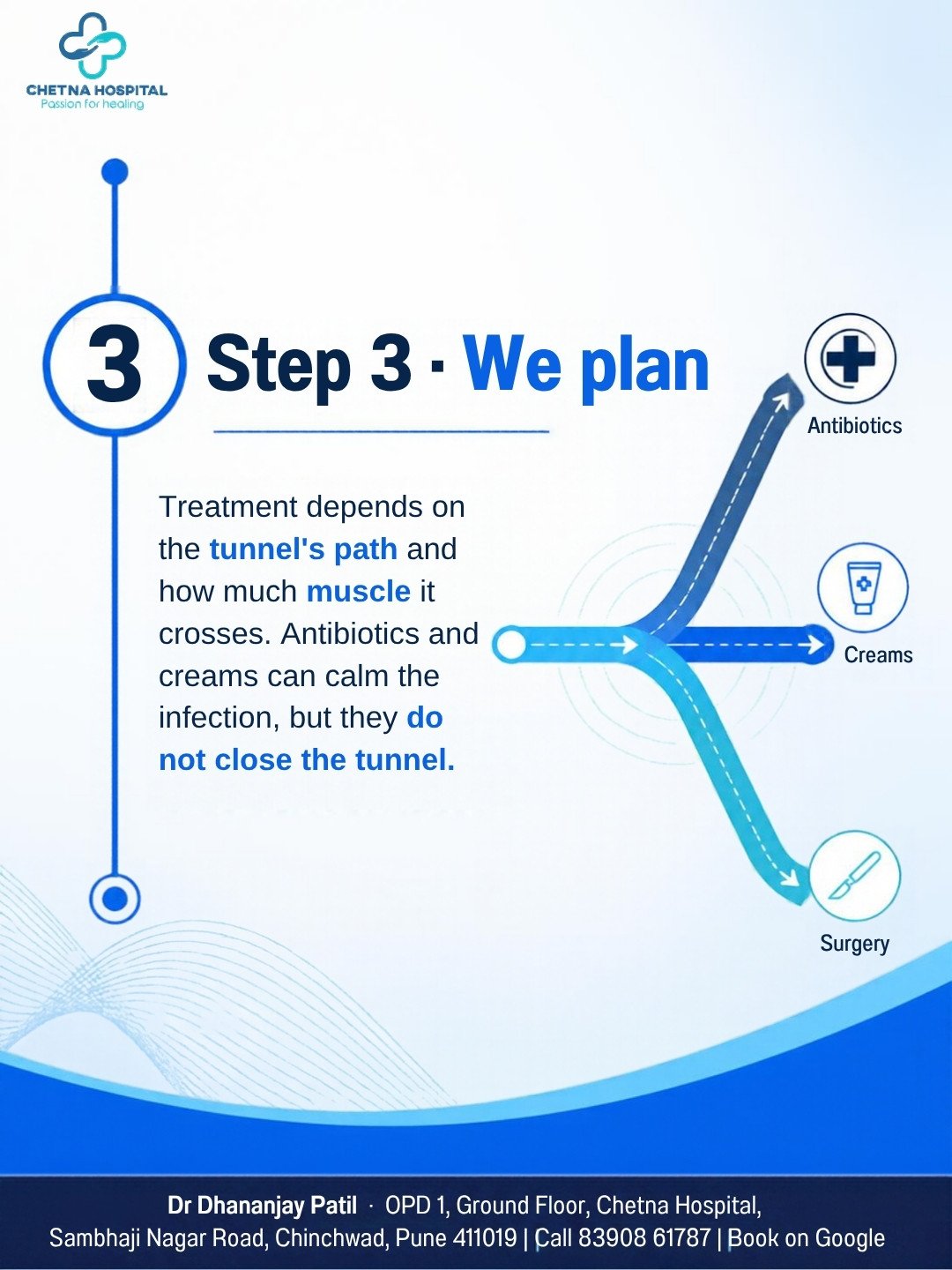
The right treatment depends on the tunnel’s path and how much muscle it crosses. A low, simple tunnel can often be laid open and allowed to heal from the inside out (fistulotomy). When the tunnel crosses more muscle, the aim is to clear the infection while protecting control of the bowel, which may mean staged treatment with a soft thread called a seton, or a sphincter-sparing procedure. The NHS lists these among the usual options. the other surgical techniques are fistulotomy, seton, LIFT or laser, and the usual hospital stay is around 2 days]
Whatever the plan, I explain it with your MRI or examination findings in front of you, including what recovery and dressings will look like. If you also have piles or a fissure, we look at those in the same visit. Our earlier guide on piles and fissure explains how those differ.
What to avoid while you wait for the visit
- Don’t squeeze or cut the boil yourself. It can push the infection deeper.
- Don’t keep repeating antibiotic courses without an examination. The tunnel stays, and the next episode is often worse.
- Don’t trust “permanent cure without surgery” wall ads. Unqualified treatment of the anal area can cause bleeding, infection and loss of control.
- Do keep the area clean and dry, and use warm sitz baths for comfort if a doctor has advised them.
When to come the same day
Go to hospital the same day if you have a painful, hot swelling near the anus with fever, if you cannot sit or pass urine because of the pain, or if you have diabetes and the swelling is spreading. An abscess needs to be drained, and MedlinePlus notes that delaying treatment can let the infection spread. Read when pain needs a surgical evaluation, and about our general surgery services. For hernia and gallbladder problems, Dr Patil also offers laparoscopic surgery in Chinchwad.
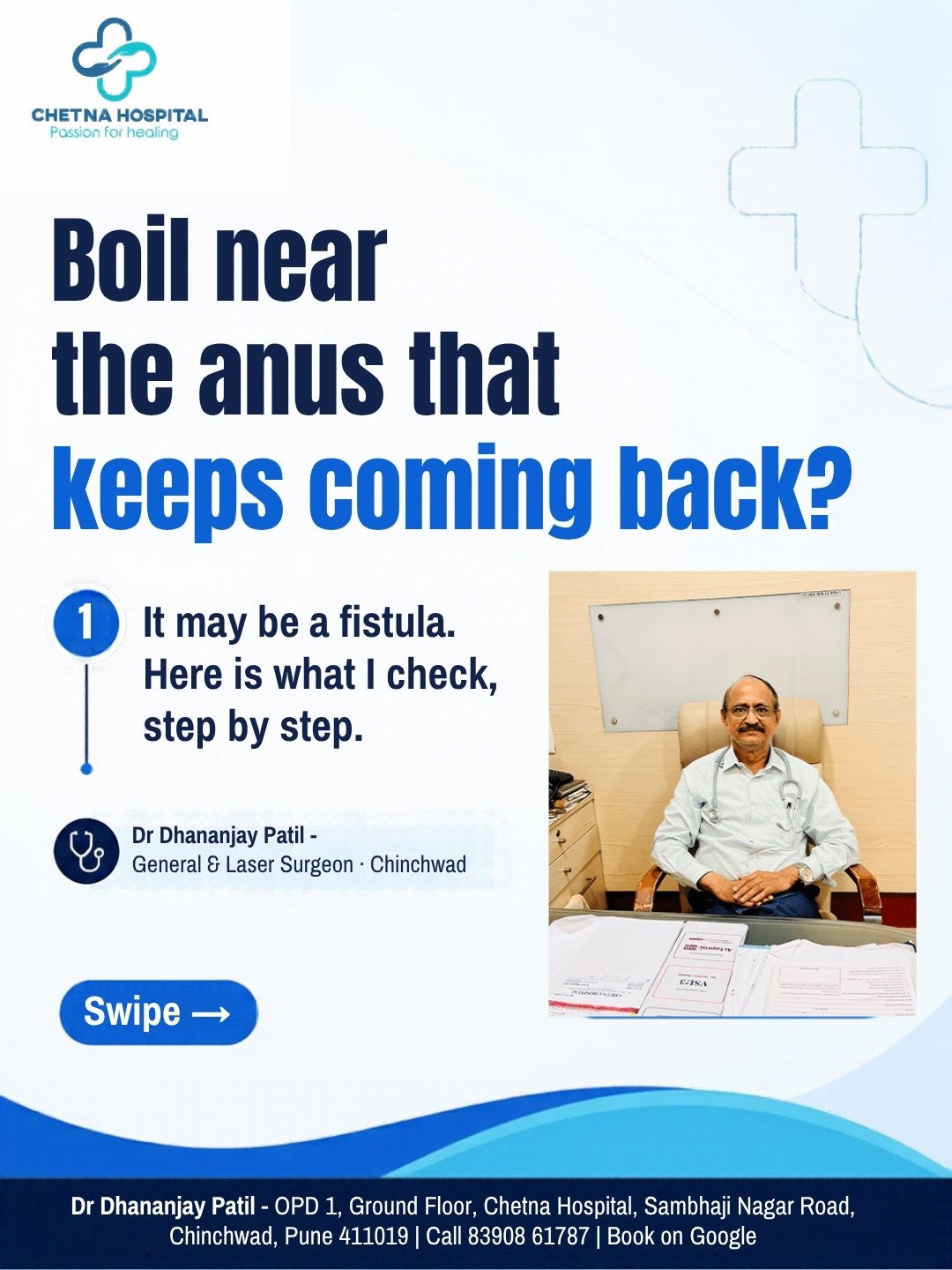
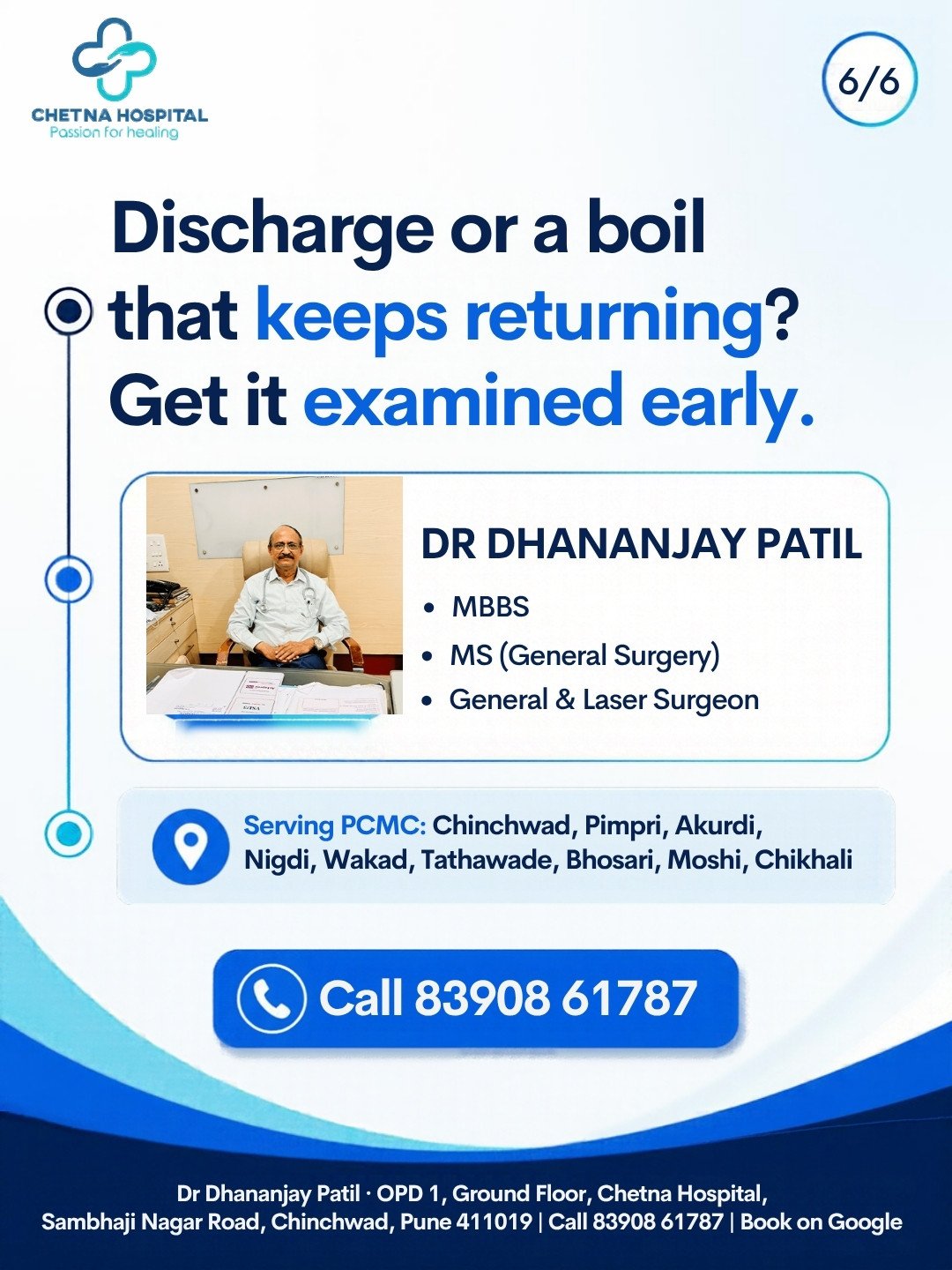
The six slides, in one strip
These slides are from our Instagram post. Save them, or send them quietly to someone who has been putting this off.
What patients say
Excerpts from Google reviews on Dr Dhananjay Patil’s profile:
⭐⭐⭐⭐⭐
“He listened to my concerns patiently and explained the condition and treatment options clearly. I liked his straightforward and calm approach.”
– Rekha, Google review, September 2026
⭐⭐⭐⭐⭐
“He accurately diagnosed my pain and treated it accordingly.”
– Rahul, Google review, May 2025
Read all reviews on Google → Individual experiences vary.
Consultation near you: fistula check-up in Chinchwad, PCMC
Dr Dhananjay Patil sees patients at OPD 1, Ground Floor, Chetna Hospital, Sambhaji Nagar Road, next to Pimpri Chinchwad Sahakari Bank, Sambhajinagar, Chinchwad, Pune 411019. Patients come from Chinchwad, Pimpri, Akurdi, Nigdi, Ravet, Wakad, Hinjewadi, Pimple Saudagar, Thergaon, Tathawade, Punawale, Moshi and Bhosari.
Frequently asked questions
Can an anal fistula heal without surgery?
Rarely. Antibiotics and creams can calm the infection, but the tunnel usually stays and the boil returns. Most fistulas need a procedure chosen after the tunnel’s path is known.
Is every boil near the anus a fistula?
No. A first boil is usually an abscess, which needs draining. If it keeps coming back in the same place or keeps leaking, a fistula is likely and should be examined.
Why do I need an MRI for a fistula?
An MRI maps the tunnel, shows any hidden pus and how much muscle the tunnel crosses. Not everyone needs one; it helps when the tunnel is deep, branched or has come back after treatment.
Is a fistula the same as piles?
No. Piles are swollen blood vessels that may bleed or prolapse. A fistula is a tunnel that leaks pus or blood from an opening near the anus and often follows a boil.
Where can I get anal fistula treatment in Chinchwad, PCMC?
Dr Dhananjay Patil, Consultant General Surgeon (MBBS, MS General Surgery), sees patients with fistula, piles and fissure at OPD 1, Ground Floor, Chetna Hospital, Sambhaji Nagar Road, Chinchwad, Pune 411019. Call or WhatsApp 83908 61787 to book.
A boil that keeps coming back? Get it examined before the next course of tablets.
OPD 1, Ground Floor, Chetna Hospital, Sambhaji Nagar Road, next to Pimpri Chinchwad Sahakari Bank, Chinchwad, Pune 411019
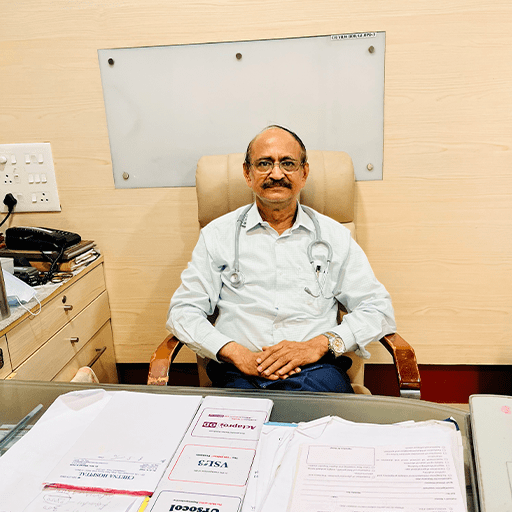
About the author: Dr Dhananjay Patil
Consultant General Surgeon
MBBS, MS (General Surgery)
Piles, fissure, fistula, hernia, gallbladder, kidney stones and general surgery at Chetna Hospital, Chinchwad. View full profile
Medically reviewed by Dr Dhananjay Patil. Last updated 17 October 2026.
Sources
- NHS. Anal fistula.
- MedlinePlus (US National Library of Medicine). Anorectal abscess.
- ClinicalTrials.gov. Study evaluating the safety and efficacy of an ECM hydrogel for the treatment of anorectal fistulas (NCT07035925).
- The Manila Times / GlobeNewswire, 13 October 2026. ECM Therapeutics reports promising results in fistula repair.
This article is general health information and does not replace a consultation. A painful, swollen lump with fever needs prompt medical care.