









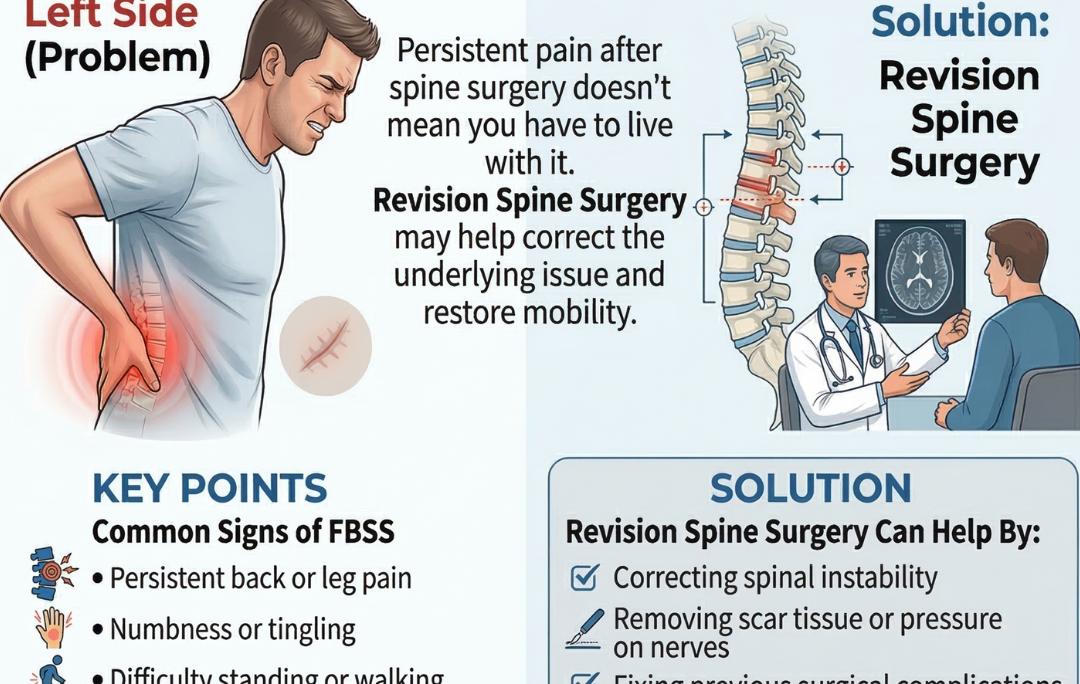
Leg Pain After Spine Surgery: Understanding Persistent Post-Surgical Nerve Pain
Are you still experiencing back or radiating leg pain after surgery? This condition, known as Failed Back Surgery Syndrome (FBSS), is a specialty of Dr. Nirmal Patil at Chetna Hospital. As a leading Spine Specialist in Chinchwad, Pune, Dr. Patil helps patients from Wakad, Hinjewadi, Ravet, and across PCMC find lasting relief through advanced revision treatments.
In certain cases, leg pain after spine surgery may linger during the healing period. At other times, symptoms appear to improve at first but gradually return months later. Occasionally, individuals even experience renewed nerve pain years after the original operation.
Consequently, persistent nerve discomfort following a spinal procedure can feel deeply frustrating. Patients who carefully follow rehabilitation programs and medical advice may struggle to understand why the pain persists.
Medical specialists frequently describe this situation as Failed Back Surgery Syndrome (FBSS). Clinical studies suggest that 10–40% of individuals who undergo spinal procedures may experience lingering or recurring symptoms.
Furthermore, when pain radiating into the leg develops long after spinal fusion, patients often assume the surgery failed. In reality, the spine continues to adapt and change over time, and new mechanical stresses may gradually produce symptoms. Failed Back Surgery Syndrome and Ongoing Leg Pain After Spine Surgery
Failed Back Surgery Syndrome refers to persistent or newly emerging pain following spinal surgery. Importantly, the term does not necessarily mean the procedure itself was unsuccessful.
Rather, FBSS describes a condition in which symptoms—such as chronic back pain or radiating leg pain after spine surgery—continue despite surgical intervention.
Doctors may also refer to the condition as:
- Post-Laminectomy Syndrome
- Persistent Spinal Pain Syndrome
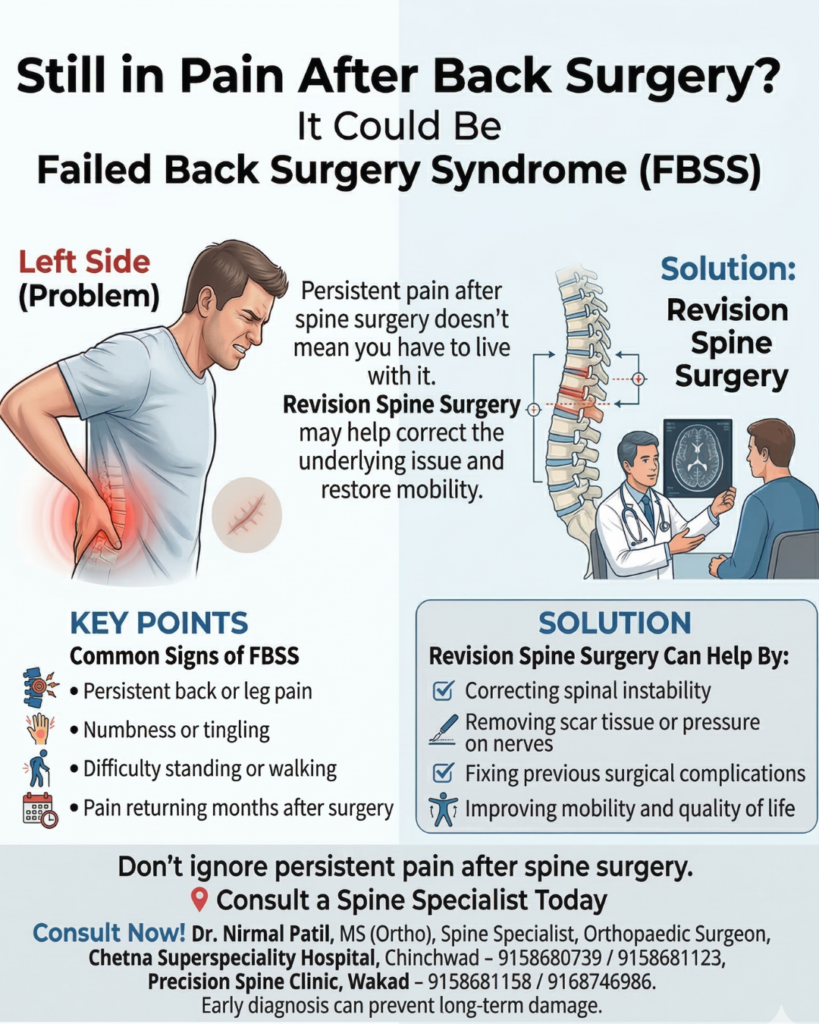
Typical Symptoms Associated With Persistent Nerve Pain After Spine Surgery
| Symptom | Possible Cause | Recommendation |
| Sharp Leg Pain | Recurrent Disc Herniation | Immediate MRI Scan |
| New Numbness | Nerve Compression | Clinical Evaluation |
| Difficulty Walking | Spinal Instability | X-ray & Stability Test |
| Pain after 1 year | Adjacent Segment Stress | Biomechanical Assessment |
Nevertheless, the spine is a complex biomechanical structure. Therefore, ongoing symptoms may develop even when the original procedure was technically successful.
Common Causes of Radiating Leg Pain Following Spine Surgery
Persistent nerve pain in the leg after spinal surgery can occur for several reasons. Consequently, identifying the exact cause is essential for effective treatment.
Incomplete Nerve Decompression Causing Leg Pain After Spine Surgery
Occasionally, the original surgery may not completely relieve pressure on the affected nerve root. Even slight compression can continue to produce pain, numbness, or tingling sensations that extend into the leg.
Scar Tissue Formation and Post-Surgical Nerve Pain
Scar tissue naturally forms during the healing process. However, excessive scar tissue—known as epidural fibrosis—can surround nerve roots.
When this occurs, the fibrous tissue may irritate nearby nerves and contribute to persistent pain radiating down the leg.
Hardware Problems Leading to Leg Pain After Spine Surgery
Spinal fusion procedures frequently involve implants such as rods, screws, or cages. Although these devices are generally reliable, complications may sometimes occur.
Potential issues include:
- Loosening of screws or rods
- Movement of implanted hardware
- Rare allergic reactions to metallic components
- Increased stress on adjacent spinal segments
These complications may eventually lead to renewed nerve irritation.
Recurrent Disc Herniation After Spine Surgery
Even after successful surgery, a spinal disc may herniate again. When this happens, disc material can compress nearby nerves and recreate familiar symptoms.
Adjacent Segment Degeneration Causing Radiating Leg Pain
Spinal fusion stabilizes one section of the spine. However, nearby vertebrae must compensate for the lost movement. Over time, this increased strain may accelerate degeneration in adjacent discs or joints.
Why Leg Pain Can Return Years After Spinal Fusion Surgery
Many patients feel surprised when symptoms reappear long after recovery. Nevertheless, delayed nerve pain can develop because of long-term spinal changes.
Biomechanical Stress and Late-Onset Leg Pain After Spine Surgery
Spinal fusion permanently alters the natural mechanics of the spine. While the fused segment becomes stable, it also loses mobility.
Consequently, nearby spinal segments absorb additional motion and stress. Over time, this compensation may lead to degeneration or nerve compression.
Natural Degeneration and Recurring Leg Pain
The spine gradually changes with age. Discs lose hydration, joints develop arthritis, and supporting muscles may weaken.
In patients with prior spinal fusion, these changes may progress more rapidly in surrounding segments.
Pseudoarthrosis and Persistent Nerve Pain After Spinal Surgery
In certain cases, the bones intended to fuse never fully unite. This condition—called pseudoarthrosis—allows subtle movement at the surgical site.
As a result, instability may produce ongoing back pain and radiating nerve discomfort.
Development of New Spinal Conditions
Additionally, new conditions such as spinal stenosis or disc degeneration may arise independently of the original surgical site.
Diagnosing Persistent Nerve Pain After Spine Surgery
When symptoms persist, a detailed evaluation is essential to determine the source of pain.
Medical History Review for Patients With Leg Pain After Spine Surgery
The specialist begins by reviewing key information, including:
- Details of the previous surgery
- Timeline of symptom development
- Location and intensity of pain
- Previous treatments and outcomes
Physical Examination for Radiating Leg Pain
A thorough physical assessment helps evaluate:
- Spinal flexibility and posture
- Muscle strength and balance
- Reflex responses
- Sensory nerve function
Imaging Tests for Persistent Pain After Spine Surgery
Advanced imaging helps identify structural abnormalities.
MRI Scans reveal soft tissue structures and nerve compression.
CT Scans with myelography provide detailed images of bone and hardware placement.
X-rays show spinal alignment and fusion status.
Diagnostic Injections for Identifying Nerve Pain Sources
Targeted injections can help determine which nerve or joint is responsible for symptoms. Temporary pain relief after an injection often confirms the source.
Treatment Options for Leg Pain After Spine Surgery and FBSS
Treatment usually begins with conservative methods before more invasive options are considered.
Non-Surgical Treatment for Persistent Leg Pain After Spine Surgery
Medication
Doctors may prescribe medications such as anti-inflammatory drugs, nerve-stabilizing medications, or muscle relaxants.
Physical Therapy
A carefully structured rehabilitation program can strengthen supporting muscles, improve flexibility, and restore healthy movement patterns.
Injection Therapies
Common treatments include:
- Epidural steroid injections
- Facet joint injections
- Trigger point injections
- Radiofrequency ablation for longer-lasting relief
Complementary Therapies
Some patients benefit from acupuncture, massage therapy, or TENS therapy to manage nerve pain.
When Revision Surgery Is Needed for Persistent Leg Pain After Spine Surgery
Revision surgery is generally recommended only after conservative treatments fail.
Indications for Revision Surgery
Doctors may consider additional surgery if:
- Symptoms persist after 6–12 months of non-surgical treatment
- Pain significantly affects daily activities
- Neurological symptoms worsen
- Imaging reveals structural abnormalities or hardware problems
Types of Revision Procedures
Additional decompression surgery removes tissue compressing nerves.
Hardware revision or removal addresses implant complications.
Adjacent-level surgery treats degeneration near the fused segment.
Scar tissue removal relieves nerve compression caused by fibrotic tissue.
Preventing Recurring Leg Pain After Spine Surgery
Although not every complication can be avoided, several steps may reduce the risk of persistent symptoms.
Prevention Strategies
- Choose an experienced spine specialist such as Dr. Nirmal Patil
- Follow all post-operative instructions carefully
- Attend regular follow-up visits
- Participate actively in rehabilitation programs
Supporting Long-Term Spine Health
Patients can also improve outcomes by maintaining a healthy weight, practicing good posture, staying physically active, and avoiding smoking.
Expert Spine Care With Dr. Nirmal Patil
If you are experiencing leg pain after spine surgery or persistent nerve symptoms, consulting an experienced spine specialist is essential.
Dr. Nirmal Patil, MS (Ortho), is a respected spine specialist and orthopedic surgeon practicing at Chetna Superspeciality Hospital in Chinchwad.
Why Patients Choose Dr. Nirmal Patil
- Extensive experience in complex spine surgery
- Expertise in revision spinal procedures
- Comprehensive diagnostic evaluation
- Advanced surgical techniques and technology
- Patient-focused treatment planning
Through thorough evaluation and individualized treatment strategies, Dr. Patil has helped many patients overcome persistent spinal pain and regain mobility.
Expert Revision Spine Care in Pimpri-Chinchwad
Dr. Nirmal Patil (MS Ortho) is a renowned Spine Specialist in Chinchwad with extensive experience in Revision Spine Surgery and Endoscopic Spine Procedures. At Chetna Hospital, we use advanced diagnostics to pinpoint the exact cause of your persistent pain.
Serving Patients Across Pune & PCMC: > We provide specialized spine consultations for residents, including Wakad, Hinjewadi, Ravet, Nigdi, Moshi, Bhosari, and Sangvi. If you are looking for a “Spine Surgeon near me” in the PCMC area, Chetna Hospital offers a central, high-tech facility for your recovery.
Contact Information
Dr. Nirmal Patil
MS (Ortho), Spine Specialist & Orthopedic Surgeon
Chetna Superspeciality Hospital, Chinchwad
Get Your Second Opinion Today. Don’t let chronic pain limit your life. Consult Dr. Nirmal Patil (MS Ortho), the preferred Spine Surgeon in Chinchwad for complex revision cases.
📞 Phone: 9158680739 / 9158681123
🌐 Website: www.chetnahospital.co.in
Dr. Nirmal Patil provides expert second opinions and revision spine surgery for patients across Pimpri-Chinchwad, including Wakad, Hinjewadi, Ravet, Nigdi, Moshi, and Bhosari. If you are traveling from Akurdi or Sangvi, Chetna Hospital is conveniently located within 15–20 minutes.
Frequently Asked Questions
Research suggests that 10–40% of patients may experience persistent symptoms following spinal procedures.
Yes. Biomechanical changes, adjacent segment degeneration, or new spinal conditions may cause symptoms to reappear.
If symptoms last longer than three to six months or worsen over time, consulting a spine specialist is recommended.
No. Many patients improve with non-surgical treatments such as physical therapy, medications, and injections.
Yes. Proper rehabilitation strengthens supporting muscles and improves spinal mechanics, which can significantly reduce symptoms.
Final Thoughts
Persistent nerve pain after spinal surgery can be discouraging. However, effective treatments are available. With accurate diagnosis and expert care from specialists like Dr. Nirmal Patil, many patients successfully overcome leg pain after spine surgery and return to an active, comfortable life.