Medically Reviewed By: Dr. Nirmal Patil
Specialty: Consultant Orthopaedic Spine Surgeon
Experience: 9 Years
Qualifications:
MBBS, MS (Orthopaedics), MRCS (UK), DNB (Orthopaedics), MNAMS, SICOT Orthopaedics Diploma (Belgium), Advanced Diploma in Spine Surgery (UK)
Areas of Clinical Expertise:
Cervical Spine Surgery, Disc Replacement Surgery, Spinal Endoscopic Surgery, Deformity Surgery, Minimally Invasive Spine Surgery, Tubular/Keyhole Spine Surgery, Back Pain Treatment and Neck Pain Treatment
Dr. Nirmal Patil is a Consultant Orthopaedic Spine Surgeon at Chetna Hospital, Chinchwad, PCMC, Pune. His clinical expertise includes minimally invasive, endoscopic and complex spine procedures. Patients with suspected spinal tumors can undergo specialist evaluation based on their symptoms, neurological findings and imaging.
For reliable information about spinal tumors and cancer-related conditions, patients can refer to the National Cancer Institute (NCI).
A spinal tumor is an abnormal growth that develops in or around the spinal cord, spinal nerves, or bones of the spine. Depending on its location, size, and type, a spinal tumor may cause back pain, weakness, numbness, difficulty walking, or other neurological symptoms.
Early evaluation is important because symptoms caused by spinal tumors can sometimes resemble common back pain or other spine problems. For patients in Pimpri-Chinchwad, PCMC, Chinchwad, and Pune, timely assessment by an experienced spine surgeon can help determine the appropriate next step.
Quick Answer: What Is the Treatment for a Spinal Tumor?
Spinal tumor treatment depends on the type, location, size, symptoms, and effect of the tumor on the spinal cord or nerves. Depending on the individual case, treatment may involve observation, medicines for symptoms, surgery, radiation therapy, chemotherapy, or a combination of treatments.
What Is a Spinal Tumor?
A spinal tumor is an abnormal growth that develops in or around the spine, including the spinal bones, spinal cord, nerve roots or surrounding tissues. Depending on its type and location, it may cause back pain, weakness, numbness, difficulty walking or other neurological symptoms.
A tumor may affect:
- The vertebrae or spinal bones
- The spinal cord
- The nerve roots
- Tissues surrounding the spinal cord
Not every spinal tumor is cancerous. Some tumors are benign, while others may be malignant.
Because the spine contains the spinal cord and important nerves, the location of a tumor can be as important as its size when determining treatment.
Types of Spinal Tumors
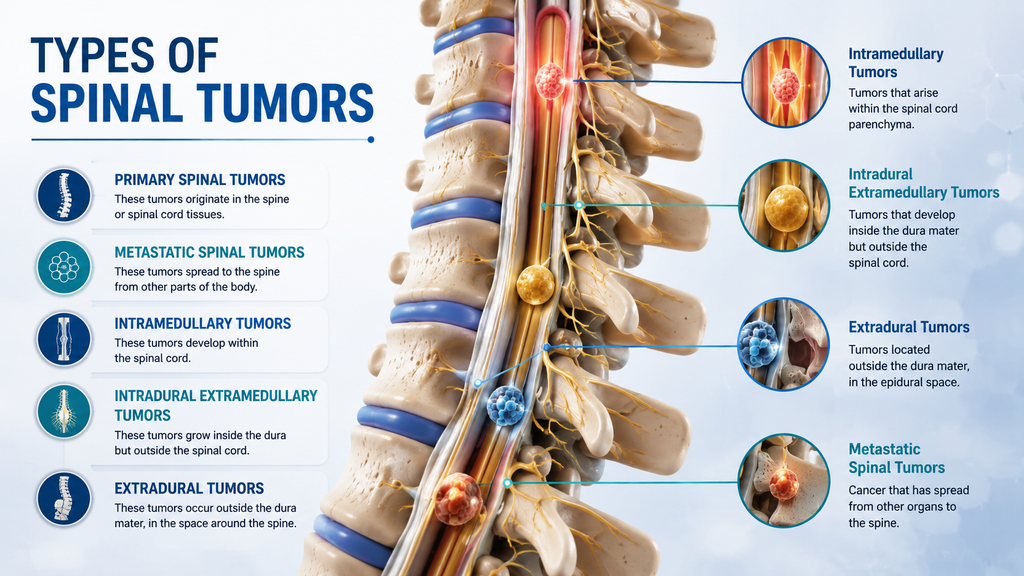
Spinal tumors can be classified based on where they originate and their location relative to the spinal cord. They may include primary spinal tumors, metastatic tumors, intramedullary tumors, intradural extramedullary tumors and extradural tumors.
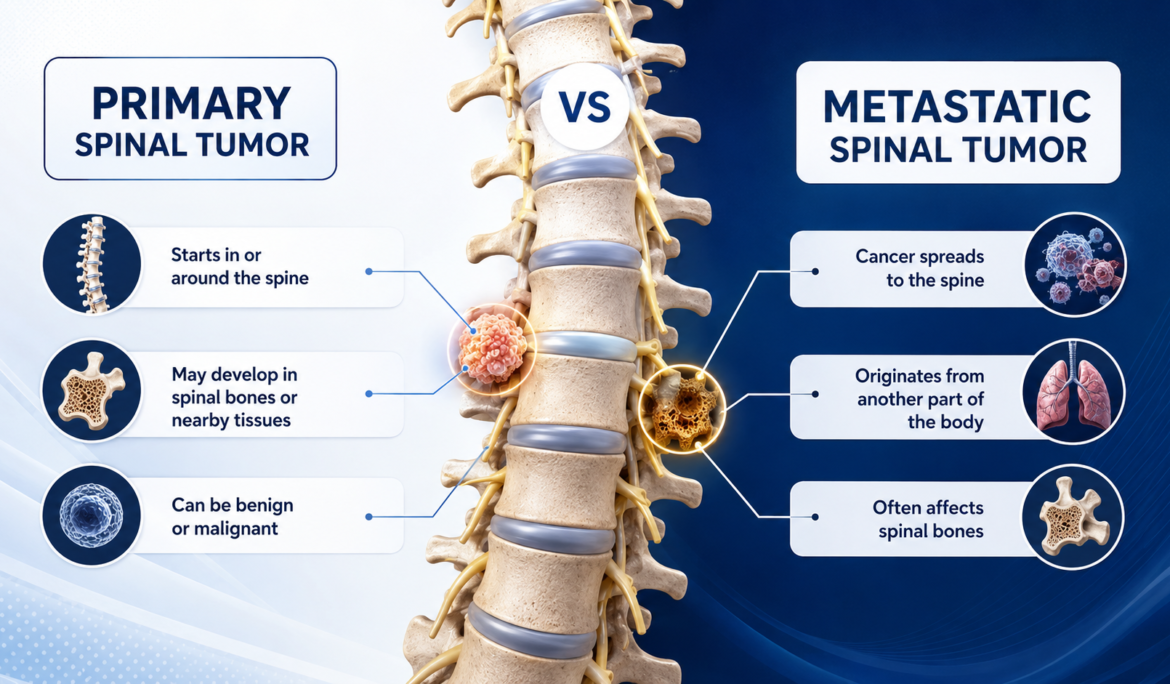
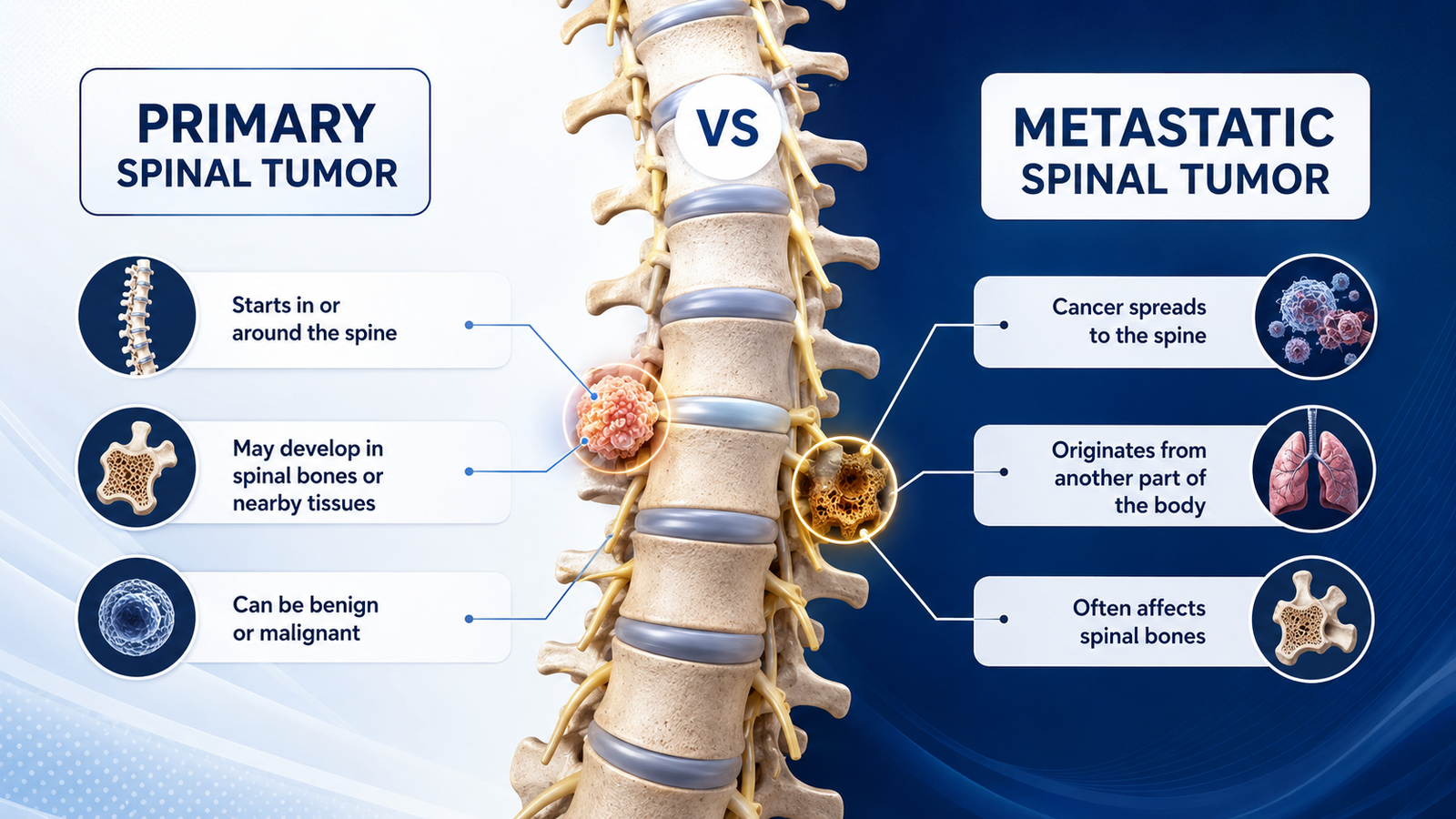
Primary Spinal Tumors
Tumors that originate in or around the spinal structures.
Metastatic Spinal Tumors
Tumors that develop when cancer from another part of the body spreads to the spine.
Intramedullary Tumors
Tumors that develop within the spinal cord.
Intradural Extramedullary Tumors
Tumors located inside the spinal cord’s protective covering but outside the spinal cord itself.
Extradural Tumors
Tumors located outside the dura and often involving the vertebrae or surrounding structures.
What Causes Spinal Tumors?
The exact cause of many spinal tumors may not always be known.
Some spinal tumors develop directly in the spine or surrounding tissues, while others may occur when cancer from another part of the body spreads to the spine.
A detailed medical evaluation is required to understand the nature and origin of the tumor.
Spinal Tumor Symptoms: What Should You Watch For?
Symptoms can vary depending on the location and characteristics of the tumor.
Common symptoms may include:
| Symptom | What the patient may experience |
|---|---|
| Back pain | Persistent or unusual pain in the back |
| Neck pain | Pain when the tumor affects the cervical spine |
| Numbness | Reduced sensation in the arms, legs or other areas |
| Weakness | Difficulty moving an arm or leg normally |
| Walking difficulty | Problems with balance or movement |
| Tingling | Pins-and-needles or abnormal sensations |
| Loss of coordination | Difficulty performing normal movements |
| Bladder or bowel changes | May occur when neurological structures are significantly affected |
Persistent or progressively worsening symptoms should not simply be assumed to be routine back pain.
One Important Warning: Progressive Weakness
Back pain accompanied by progressive weakness, significant numbness, difficulty walking or new bladder/bowel problems requires prompt medical evaluation.
These symptoms can indicate significant nerve or spinal cord involvement and should not be ignored.
Spinal Tumor vs Common Back Pain
Many spinal conditions can cause back pain, so symptoms alone cannot establish whether a tumor is present.
| Feature | Common Back Problem | Possible Spinal Tumor Concern |
| Back pain | Often related to movement or strain | May be persistent or unusual |
| Numbness | Can occur with nerve compression | May progressively increase |
| Weakness | Possible with nerve problems | Progressive weakness needs assessment |
| Walking difficulty | May occur in severe spine conditions | Can indicate neurological involvement |
| Night/persistent pain | Depends on condition | Should be medically evaluated when unexplained |
| Bladder/bowel changes | Not typical of simple back pain | Requires urgent medical assessment |
Important: This comparison does not diagnose a spinal tumor. Imaging and clinical evaluation are required when a tumor is suspected.
How Are Spinal Tumors Diagnosed?
A doctor may evaluate:
- Medical history
- Symptoms and duration
- Neurological examination
- Imaging studies
- MRI or other appropriate scans
- Additional investigations when required
- Tissue examination/biopsy in selected cases
The exact diagnostic approach depends on the suspected tumor and the patient’s clinical condition.
What Imaging Is Used for Spinal Tumors?
Imaging plays an important role in evaluating a suspected spinal tumor.
An MRI can help doctors assess structures such as the spinal cord, nerve roots and surrounding soft tissues.
Other imaging investigations may be recommended depending on the suspected location and nature of the tumor.
The treating medical team determines which investigations are appropriate for each patient.
Spinal Tumor Treatment Options
There is no single treatment that is suitable for every spinal tumor. Treatment depends on the tumor type, location, size, neurological involvement, symptoms and overall health.
There is no single treatment that is suitable for every spinal tumor. Treatment depends on the tumor type, location, size, neurological involvement, symptoms, and overall health.
1. Observation and Monitoring
Some tumors may be monitored with regular clinical assessment and imaging when immediate intervention is not required.
2. Surgery
Surgery may be considered when the tumor is causing significant compression, neurological symptoms, instability or other problems where surgical treatment is appropriate.
The surgical approach depends on the location and characteristics of the tumor.
3. Radiation Therapy
Radiation therapy may be used for selected spinal tumors, particularly when treatment is directed at controlling tumor cells or symptoms.
4. Systemic Cancer Treatment
Depending on the tumor type, chemotherapy, targeted therapy, immunotherapy or other cancer treatments may be considered by the relevant oncology team.
5. Multidisciplinary Care
Some patients may benefit from coordinated care involving spine surgery, oncology, radiology, pathology and radiation specialists.
When Is Spinal Tumor Surgery Considered?
Surgery is not automatically required for every spinal tumor.
A surgical approach may be considered when there is:
- Significant spinal cord compression
- Nerve compression
- Progressive neurological symptoms
- Spinal instability
- Significant pain related to the tumor
- A need for tissue diagnosis in selected cases
- A need to remove or reduce the tumor when clinically appropriate
The final decision depends on the individual patient’s diagnosis and imaging findings.
What Is Minimally Invasive Spine Surgery?
Minimally invasive spine surgery uses smaller access points and techniques designed to reduce disruption to surrounding tissues when the procedure is suitable for that approach.
Dr. Nirmal Patil’s stated areas of expertise include minimally invasive spine surgery, endoscopic spine surgery, tubular/keyhole spine surgery, and complex spine disorders and deformities.
However, whether a minimally invasive technique is appropriate for a spinal tumor depends on the tumor’s location, size, anatomy, and treatment objective.
When Should You See a Spine Specialist?
Consider a spine evaluation if you have:
- Persistent or unexplained back pain
- Progressive numbness
- Increasing weakness
- Difficulty walking
- Persistent neck pain with neurological symptoms
- Recurrent symptoms that are not improving
- Abnormal spinal imaging
- A known tumor involving the spine
- Suspected nerve or spinal cord compression
Emergency Warning Signs
Seek urgent medical attention if you develop:
Sudden or rapidly worsening weakness → Severe difficulty walking → New bladder/bowel dysfunction → Significant loss of sensation → Severe neurological deterioration
These symptoms may indicate serious spinal cord or nerve involvement.
What Happens During Spinal Tumor Evaluation?
A typical evaluation may involve:
Step 1: Medical History
The doctor reviews the symptoms, their duration and progression.
Step 2: Physical and Neurological Examination
Strength, sensation, reflexes, coordination, and movement may be assessed.
Step 3: Imaging Review
Available MRI or other imaging studies are reviewed to understand the spinal structures involved.
Step 4: Diagnosis and Treatment Planning
The medical team determines whether further investigations, monitoring, surgery or other treatment is appropriate.
Step 5: Specialist Coordination
When required, care may involve oncology, radiation oncology, radiology, pathology and other specialists.
Can Spinal Tumors Be Treated?
Yes, many spinal tumors can be treated, but the appropriate treatment and expected outcome vary depending on the tumor type, location, size, neurological involvement and overall health. Treatment may include monitoring, surgery, radiation therapy, systemic treatment or a combination of approaches.
Recovery After Spinal Tumor Treatment
Recovery varies from one patient to another.
Factors that can influence recovery include:
- Type of tumor
- Location of the tumor
- Type of treatment
- Extent of surgery where applicable
- Pre-existing neurological symptoms
- Overall health
- Rehabilitation requirements
Patients may require follow-up imaging, rehabilitation, physiotherapy or additional treatment depending on their condition.
No specific recovery timeline should be assumed without an individual medical assessment.
Spinal Tumor Treatment in PCMC & Pune
Patients from Chinchwad, Pimpri-Chinchwad, Nigdi, Akurdi and nearby Pune areas can seek specialist evaluation for persistent or concerning spine symptoms.
If imaging has identified an abnormality or a suspected spinal tumor, a spine specialist can help assess the spinal condition and determine the appropriate next step.
For complex cases, treatment may require coordination between multiple medical specialties.
Frequently Asked Questions About Spinal Tumor Treatment
There is no single treatment that is suitable for every spinal tumor. Treatment depends on the tumor type, location, size, neurological involvement, and the patient’s overall health. Depending on the case, treatment may include monitoring, surgery, radiation therapy, or other cancer treatments.
Yes, a spinal tumor can cause persistent or unusual back pain. However, back pain can have many other causes. Persistent, unexplained, or progressively worsening back pain should be evaluated by a qualified doctor.
Symptoms may include persistent back or neck pain, numbness, tingling, weakness, difficulty walking, loss of coordination, or changes in bladder or bowel function. Symptoms can vary depending on the location and effect of the tumor.
No. Not every spinal tumor requires surgery. The treatment approach depends on the tumor type, location, size, symptoms, neurological involvement, and overall health of the patient.
Minimally invasive surgery may be appropriate for selected spinal conditions and cases, but it is not suitable for every spinal tumor. The surgical approach depends on the tumor’s location, size, anatomy, and the specific treatment objective.
You should seek medical evaluation if back pain is persistent, unexplained, or associated with numbness, weakness, difficulty walking, or other neurological symptoms. Early assessment can help identify the underlying cause.
Yes. Some spinal tumors are malignant, while others are benign. Additional medical evaluation and appropriate investigations are required to determine the nature of a suspected spinal tumor.
Patients in PCMC and Pune can consult a qualified spine surgeon for clinical assessment and imaging review. Dr. Nirmal Patil is a Consultant Orthopaedic Spine Surgeon at Chetna Hospital, PCMC, with expertise in advanced, minimally invasive, and endoscopic spine procedures.
The Bottom Line for Pune & PCMC Patients
Spinal tumors require careful evaluation because they can affect the spinal cord, nerves, and structural stability of the spine.
Persistent back pain accompanied by weakness, numbness, walking difficulty, or bladder/bowel changes should not be ignored.
Treatment depends on the individual diagnosis and may include monitoring, surgery, radiation therapy, systemic treatment or a combination of approaches.
For patients in PCMC and Pune, timely evaluation by an experienced spine specialist can help establish the appropriate treatment pathway.
Medical Disclaimer
This article is intended for general health education and should not replace an examination, diagnosis or treatment plan from a qualified healthcare professional. Spinal tumors are complex conditions and treatment decisions depend on the individual’s diagnosis, imaging, medical history, and overall health.