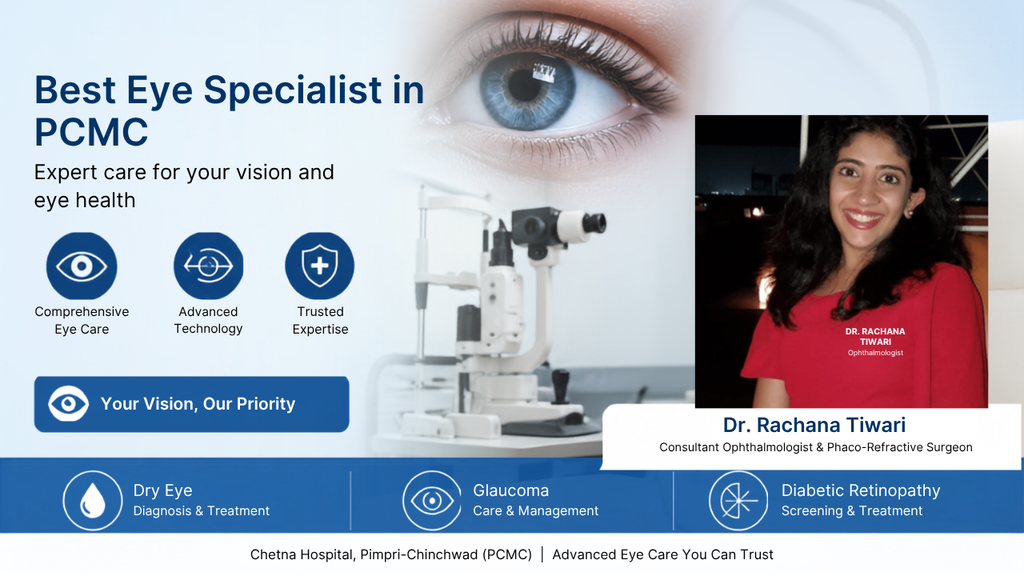
If you are looking for an eye specialist in Pimpri-Chinchwad, Dr. Rachana Tiwari is a Consultant Ophthalmologist and Phaco-Refractive Surgeon at Chetna Hospital, Chinchwad. She provides evaluation and treatment for common eye conditions including cataract, glaucoma, dry eye and diabetic eye problems.
Best Eye Specialist in PCMC: Dr. Rachana Tiwari | Ophthalmologist, Glaucoma & Cataract Care in Pimpri-Chinchwad
Eye health is an important part of overall health, yet many eye conditions may develop gradually without obvious symptoms in the early stages. Blurred vision, eye pain, redness, dry eyes, difficulty seeing at night, frequent changes in glasses prescription, and other vision changes should not be ignored.
If you are looking for an ophthalmologist in PCMC, an eye specialist in Pimpri-Chinchwad, or an eye doctor near Chinchwad, a qualified ophthalmologist can evaluate your symptoms, identify the underlying eye condition, and recommend appropriate treatment.
At Chetna Hospital, Dr. Rachana Tiwari is a Consultant Ophthalmologist and Phaco-Refractive Surgeon with 10 years of experience. She is fellowship-trained in phaco-refractive surgery and specialises in dry eye, glaucoma, and diabetic retinopathy management.
Quick Answer: When Should You See an Ophthalmologist?
An ophthalmologist is a medical doctor who diagnoses and treats eye and vision conditions. In Pimpri-Chinchwad, patients can consult Dr. Rachana Tiwari, Consultant Ophthalmologist and Phaco-Refractive Surgeon at Chetna Hospital, Chinchwad. Her clinical areas include cataract, glaucoma, dry eye, and diabetic retinopathy management.
About Dr. Rachana Tiwari
Specialization: Consultant Ophthalmologist & Phaco-Refractive Surgeon
Qualifications: MBBS, MS Ophthalmology, FCRS ICO (UK)
Experience: 10 Years
Clinical focus: Cataract, Dry Eye, Glaucoma, Diabetic Retinopathy
Hospital: Chetna Hospital, Chinchwad
Read Dr. Rachana Tiwari Full Profile →
Dr. Rachana Tiwari
- Blurred or reduced vision
- Sudden changes in eyesight
- Eye pain or persistent discomfort
- Persistent redness or irritation
- Dry, burning or gritty eyes
- Difficulty seeing at night
- Frequent changes in glasses prescription
- Flashes of light
- A sudden increase in floaters
- Diabetes with vision changes
- Difficulty reading or seeing distant objects
- Symptoms after an eye injury
- Some eye conditions can progress without obvious early symptoms. A professional eye examination can help identify vision problems and eye diseases and determine whether further testing or treatment is required.
What Is an Ophthalmologist?
An ophthalmologist is a medical doctor who specialises in the diagnosis, management and treatment of eye and vision problems.
Depending on the patient’s condition, an ophthalmologist may evaluate and manage:
- Refractive errors
- Dry eye
- Cataract
- Glaucoma
- Diabetic retinopathy
- Retinal conditions
- Corneal conditions
- Paediatric eye conditions
- Eye inflammation
- Ocular surface disorders
- Conditions requiring laser treatment
- Conditions requiring eye surgery
The appropriate treatment depends on the diagnosis, severity, age, medical history, and findings during the eye examination.
According to the World Health Organization (WHO) – Blindness and Vision Impairment, refractive errors, cataract, diabetic retinopathy, and glaucoma are among the important causes of vision impairment.
Dr. Rachana Tiwari – Professional Profile
Speciality:
Consultant Ophthalmologist and Phaco-Refractive Surgeon
Degrees:
MBBS, MS (Ophthalmology), FCRS ICO (UK)
Experience:
10 Years
Location:
Chetna Hospital, Chinchwad, Pimpri-Chinchwad, Pune, Maharashtra
Advanced Ophthalmology Training
Dr. Rachana Tiwari has received specialist training in ophthalmology and advanced eye-care procedures.
MS in Ophthalmology
She completed her MS in Ophthalmology from Maharashtra University of Health Sciences, Dhule.
Advanced Glaucoma Training
She received advanced training in Glaucoma from HV Desai Eye Institute, Pune.
This specialised training supports the evaluation and management of glaucoma and related optic nerve and visual-field concerns.
Phaco-Refractive Eye Surgery Training
She received training in phaco-refractive eye surgery from Wavikar Eye Institute, Mumbai.
Her training and clinical experience allow her to evaluate suitable patients for appropriate refractive and cataract-related surgical options.
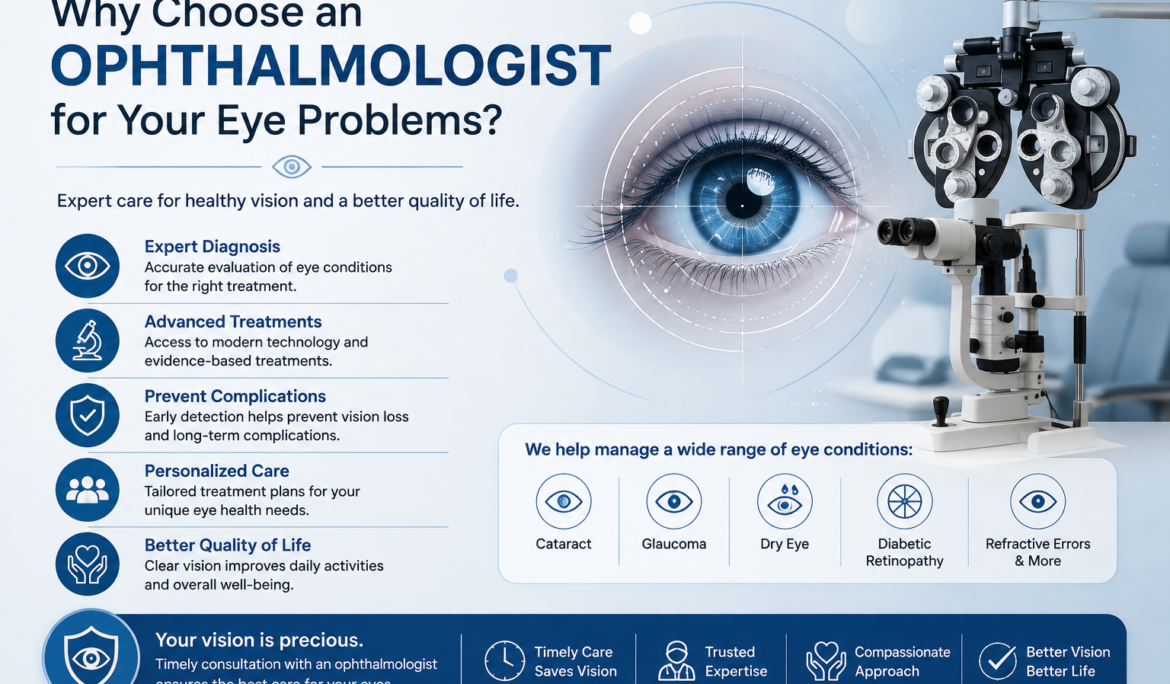
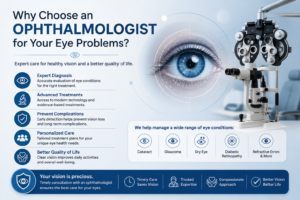
Why Choose an Ophthalmologist for Your Eye Problems?
Eye symptoms can have multiple causes. For example, blurred vision may be associated with refractive errors, dry eye, cataract, glaucoma, retinal conditions or other eye problems.
An ophthalmologist can perform an appropriate examination and recommend further diagnostic tests when required.
Choosing an eye specialist with relevant qualifications and focused clinical training is particularly important when you have an existing eye condition or symptoms that require detailed evaluation.
If you are experiencing persistent vision changes or other eye symptoms, an ophthalmologist can assess the underlying cause and recommend appropriate treatment. Patients in Chinchwad and nearby PCMC areas can consult Dr. Rachana Tiwari at Chetna Hospital.
Common Eye Problems Treated and Managed by an Ophthalmologist
1. Dry Eye
Dry eye can cause:
- Burning
- Stinging
- Grittiness
- Redness
- Watery eyes
- Eye fatigue
- Fluctuating vision
- Discomfort during prolonged screen use
Treatment depends on the cause and severity of dry eye. An ophthalmologist can assess the ocular surface and recommend appropriate management.
Dr. Rachana Tiwari specialises in dry eye management.
2. Glaucoma
Glaucoma refers to a group of eye conditions that can damage the optic nerve and may lead to permanent vision loss.
Some forms of glaucoma may develop gradually without obvious symptoms in the early stages.
An ophthalmic evaluation may include:
- Eye pressure measurement
- Optic nerve assessment
- Visual field testing
- Retinal and optic nerve imaging
- Other tests based on the patient’s condition
Dr. Rachana Tiwari has received advanced glaucoma training from HV Desai Eye Institute, Pune, and specialises in glaucoma management.
3. Diabetic Retinopathy
Diabetes can affect the blood vessels of the retina and may lead to diabetic retinopathy.
Some retinal changes may occur before a person notices significant vision problems. Therefore, people with diabetes should discuss appropriate eye examinations and screening with their healthcare professional.
Dr. Rachana Tiwari specialises in diabetic retinopathy management.
4. Cataract
A cataract occurs when the natural lens of the eye becomes cloudy.
Common symptoms may include:
- Blurred vision
- Glare
- Difficulty seeing at night
- Faded colours
- Difficulty reading
- Frequent changes in glasses prescription
When cataract significantly affects vision and daily activities, an ophthalmologist may discuss cataract surgery and suitable surgical options.
5. Refractive Errors
Refractive errors occur when the eye does not focus light correctly on the retina.
Common refractive errors include:
- Myopia
- Hyperopia
- Astigmatism
- Presbyopia
Depending on the individual patient, correction may involve glasses, contact lenses or selected refractive procedures.
For more information, see the WHO information on refractive errors.
What Eye Tests May Be Recommended?
An ophthalmologist may recommend different tests depending on symptoms, age, medical history and suspected eye condition.
Visual Acuity Test
This evaluates how clearly a person can see at different distances.
Refraction
Refraction helps determine whether glasses or other vision correction may be required.
Eye Pressure Test
Tonometry measures the pressure inside the eye and can be part of a glaucoma evaluation.
Visual Field Test
Visual field testing evaluates peripheral vision and may be useful in glaucoma assessment and monitoring.
Dilated Eye Examination
During a dilated eye examination, special eye drops enlarge the pupils, allowing the ophthalmologist to examine structures such as the retina and optic nerve.
OCT
Optical Coherence Tomography, commonly known as OCT, provides detailed images of structures inside the eye and can be useful when evaluating retinal and optic nerve conditions.
The National Eye Institute notes that comprehensive dilated eye examinations can help detect common vision problems and eye diseases, including conditions that may not produce noticeable early symptoms.
The National Eye Institute’s guide to dilated eye exams explains how a dilated examination can help detect eye diseases. It includes tests such as visual acuity, visual field testing, and tonometry.
NEI describes these components and explains the role of dilation in examining the inside of the eye.
Eye Treatment Options
Treatment depends on the specific diagnosis.
Depending on the condition, treatment may include:
Glasses
Glasses are commonly used to correct refractive errors.
Contact Lenses
Contact lenses may be recommended for selected patients depending on their vision requirements and eye health.
Eye Drops and Medicines
Certain eye conditions may require prescription eye drops or other medicines.
Cataract Surgery
Cataract surgery may be considered when cataract-related vision changes significantly interfere with daily activities.
Glaucoma Treatment
Depending on the type and severity of glaucoma, treatment may include medicines, laser procedures or surgery.
Retinal Treatment
Certain retinal conditions may require monitoring, medicines, laser treatment or other procedures depending on the diagnosis.
Phaco-Refractive Surgery
Selected patients may be evaluated for phaco-refractive procedures based on their eye condition, visual requirements and examination findings.
Refractive Surgery
Selected patients may be evaluated for procedures such as LASIK or PRK after a detailed eye examination.
Always decide on treatment after an appropriate ophthalmic evaluation.
When Is an Eye Problem an Emergency?
Some eye symptoms require urgent medical attention.
Seek urgent medical evaluation if you experience:
- Sudden loss of vision
- Sudden major change in vision
- Severe eye pain
- Serious eye injury
- Chemical exposure to the eye
- Sudden flashes with a significant increase in floaters
- A curtain or shadow-like area appearing in your vision
Do not delay professional evaluation when vision changes suddenly or severely.
Comprehensive Eye Care at Chetna Hospital, Pimpri-Chinchwad
Chetna Hospital’s Ophthalmology Department provides comprehensive eye-care services for different eye and vision conditions.
The department lists services including:
- Comprehensive Ophthalmology
- Glaucoma Services
- Retina OPD and Services
- Cornea Services
- Paediatric Ophthalmology and Strabismus
- Neuro-Ophthalmology
- Uveitis Clinic
- Oculoplasty
- Ocular Oncology
- Refractive Surgery
- LASIK
- PRK
- Nd-YAG Laser Procedures
- Retinal Laser Treatment
- Special Contact Lenses
- Automated Perimetry
- Optical Coherence Tomography (OCT)
- Low Vision Aids
- Vision Therapy
Patients can discuss their symptoms and undergo an appropriate eye evaluation based on their individual requirements.
Why Regular Eye Check-Ups Are Important
Not every eye disease produces noticeable symptoms at an early stage.
Regular eye examinations may help identify vision problems and certain eye diseases before they cause significant vision loss.
People with conditions such as diabetes or those with specific risk factors may require more regular eye assessments based on their doctor’s advice.
A comprehensive eye examination can help an ophthalmologist evaluate vision, eye pressure, the optic nerve, retina, and other structures depending on the tests required.
Eye Care Tips for Everyday Life
You can support your eye health by following simple habits:
- Take regular breaks during prolonged screen use.
- Maintain appropriate lighting while reading or working.
- Use prescribed glasses or contact lenses as advised.
- Avoid unnecessarily rubbing your eyes.
- Use protective eyewear during activities that may cause eye injury.
- Manage diabetes and other medical conditions with appropriate medical care.
- Avoid using prescription eye drops without professional advice.
- Seek medical evaluation for persistent or unexplained vision changes.
- Follow your ophthalmologist’s recommended examination schedule.
How to Choose the Right Eye Specialist in PCMC?
When choosing an ophthalmologist in Pimpri-Chinchwad, consider:
- Medical qualifications
- Specialist training
- Relevant clinical experience
- Expertise related to your eye condition
- Availability of appropriate diagnostic facilities
- Treatment and surgical facilities when required
- Follow-up care
- Clear communication about diagnosis and treatment
For glaucoma, diabetic retinopathy, dry eye, cataract and refractive surgery concerns, the appropriate specialist should be selected according to the patient’s individual diagnosis and requirements.
Eye Specialist Near Chinchwad, Pimpri and Nearby PCMC Areas
Patients looking for an eye specialist in PCMC may search for ophthalmology services around:
- Chinchwad
- Pimpri
- Akurdi
- Nigdi
- Sambhaji Nagar
- Thergaon
- Kalewadi
- Wakad
- Pimple Saudagar
- Tathawade
- Punawale
- Ravet
- Pradhikaran
Chetna Hospital, Chinchwad mein ophthalmology consultation available hai for patients from nearby areas including Chinchwad, Sambhaji Nagar, Pimpri, Akurdi, Nigdi, Pradhikaran and Thergaon. Patients from other PCMC areas such as Wakad, Kalewadi, Pimple Saudagar, Tathawade, Punawale and Ravet may also consider Chetna Hospital for eye consultation based on their location and appointment availability.
Frequently Asked Questions About Ophthalmology
Find answers to common questions about eye health, vision problems, glaucoma, cataract, dry eye and ophthalmology consultations.
Dr. Rachana Tiwari Patil is a Consultant Ophthalmologist and Phaco-Refractive Surgeon at Chetna Hospital in Pimpri-Chinchwad. She has 10 years of experience and specialises in dry eye, glaucoma and diabetic retinopathy management.
An ophthalmologist can diagnose and manage a wide range of eye and vision conditions, including refractive errors, dry eye, cataract, glaucoma, diabetic retinopathy and retinal conditions. Depending on the diagnosis, treatment may involve medicines, glasses, laser procedures or surgery.
You should consider an ophthalmology consultation for persistent blurred vision, eye pain, redness, difficulty seeing at night, frequent changes in glasses prescription, flashes, new floaters or any sudden or unexplained change in vision.
Glaucoma is a group of eye conditions that can damage the optic nerve and may result in permanent vision loss. Early detection and appropriate management can help reduce the risk of vision loss.
Yes. Diabetes can affect the retina and may cause diabetic retinopathy. People with diabetes should discuss appropriate eye screening with their healthcare professional.
Dry eye occurs when the eyes do not have adequate lubrication or when tears do not function properly. It may cause burning, irritation, redness, gritty sensation and fluctuating vision.
Cataract is clouding of the eye’s natural lens. It may cause blurred vision, glare, difficulty seeing at night and faded colours. Cataract surgery may be considered when vision loss affects daily activities.
OCT, or Optical Coherence Tomography, is a non-invasive imaging test that provides detailed images of structures inside the eye. It may be used to evaluate retinal and optic nerve conditions.
An eye examination can include eye-pressure measurement, optic nerve evaluation and visual-field testing. Additional imaging or tests may also be recommended depending on the patient’s risk factors and clinical findings.
Patients looking for an eye specialist in Pimpri-Chinchwad can consult Dr. Rachana Tiwari Patil, Consultant Ophthalmologist and Phaco-Refractive Surgeon at Chetna Hospital, Chinchwad.
Meet Dr. Rachana Tiwari
Dr. Rachana Tiwari
Consultant Ophthalmologist and Phaco-Refractive Surgeon
Qualifications:
MBBS, MS (Ophthalmology), FCRS ICO (UK)
Experience:
10 Years
Specialisation:
Dry Eye, Glaucoma, Diabetic Retinopathy Management and Phaco-Refractive Eye Surgery
Advanced Training:
- MS in Ophthalmology from Maharashtra University of Health Sciences, Dhule
- Advanced training in Glaucoma from HV Desai Eye Institute, Pune
- Phaco-Refractive Eye Surgery training from Wavikar Eye Institute, Mumbai
OPD Timings:
Monday to Saturday: 10:00 AM to 1:00 PM and 5:00 PM to 9:00 PM
Sunday: By Appointment
Consultation:
Chetna Hospital, Chinchwad, Pimpri-Chinchwad, Pune
Appointment Contact:
9168690448
Need an Eye Consultation in PCMC?
If you have persistent blurred vision, dry eyes, glaucoma concerns, diabetic eye problems, cataract symptoms or other changes in your eyesight, an ophthalmic examination can help identify the underlying cause.
Consult Dr. Rachana Tiwari , Consultant Ophthalmologist and Phaco-Refractive Surgeon at Chetna Hospital, Chinchwad.
Call for an appointment: 9168690448
📍 Easy Access & Convenient Location for PCMC Patients
Chetna Hospital (Sambhaji Nagar, Chinchwad MIDC — near Thermax Chowk) is centrally located for patients looking for an expert eye doctor within a 5 km core radius, including Akurdi, Pimpri, Nigdi, Pradhikaran, Kalewadi, and Chinchwad East.
For working professionals and families coming from extended 15 km feeder zones like Wakad, Hinjewadi IT Park, Pimple Saudagar, Ravet, and Bhosari, the hospital is easily accessible within 15–20 minutes via major PCMC link roads.
Medical Disclaimer
This article is provided for general educational purposes and should not replace an individual medical consultation, diagnosis or treatment plan.
Eye symptoms can have different causes. Appropriate treatment should be determined after examination by a qualified ophthalmologist.
If you experience sudden vision loss, severe eye pain, serious eye injury or another significant change in vision, seek urgent medical attention.
Medical References
World Health Organization (WHO)
WHO provides information on blindness and vision impairment, including refractive errors, cataract, glaucoma and diabetic retinopathy.
World Health Organization – Refractive Errors
Information about myopia, hyperopia, astigmatism and presbyopia and their impact on vision.
National Eye Institute (NEI)
Information about comprehensive and dilated eye examinations and the detection of eye diseases.
Chetna Hospital – Ophthalmology Department
Information about ophthalmology services, diagnostic facilities and eye-care treatments available at Chetna Hospital.
Chetna Hospital – Dr. Rachana Tiwari
Doctor profile including qualifications, experience, specialty and training.
Author and Medical Review Information
Content: Chetna Hospital
Medically Reviewed By: Dr. Rachana Tiwari
Designation: Consultant Ophthalmologist and Phaco-Refractive Surgeon
Qualifications: MBBS, MS (Ophthalmology), FCRS ICO (UK)
Experience: 10 Years
Last Reviewed: August 2026