









Medically Reviewed By: Dr. Rachana Tiwari
Specialty: Consultant Ophthalmologist and Phaco-Refractive Surgeon
Experience: 16 year
Qualifications:
MBBS, MS (Ophthalmology), FCRS ICO (UK)
Training:
- MS in Ophthalmology from Maharashtra University of Health Sciences, Dhule
- Advanced Training in Glaucoma from HV Desai Eye Institute, Pune
- Phaco-Refractive Eye Surgery from Wavikar Eye Institute, Mumbai
Areas of Clinical Expertise:
Dry Eye, Glaucoma and Diabetic Retinopathy Management, Phaco-Refractive Eye Surgery
Last Updated: August 2026
Cataract Treatment in Pimpri-Chinchwad depends on the severity of the cataract and how much it affects your vision and daily activities. Common symptoms may include blurred vision, glare at night, difficulty reading, and frequent changes in glasses.
Cataracts occur when the normally clear lens inside the eye becomes cloudy, causing vision to become less clear. Not every cataract requires immediate surgery. An ophthalmologist can evaluate your eyes and recommend monitoring, glasses, or cataract surgery depending on your condition.
If you are looking for cataract treatment in Pimpri-Chinchwad, Dr. Rachna Tiwari can evaluate your symptoms, diagnose the cause of vision changes and discuss suitable treatment options.
About the Expert
Dr. Rachana Tiwari is a fellowship-trained Consultant Ophthalmologist and Phaco-Refractive Surgeon in PCMC, Pune, with 10 years of experience. She specialises in Dry Eye, Glaucoma and Diabetic Retinopathy management, along with phaco-refractive eye surgery.
Specialty: Consultant Ophthalmologist and Phaco-Refractive Surgeon
Experience: 10 Years
Areas of Expertise: Cataract & Phaco-Refractive Surgery, Dry Eye, Glaucoma, Diabetic Retinopathy
She completed MBBS and MS (Ophthalmology) and holds FCRS ICO (UK). Her advanced training includes Glaucoma training from HV Desai Eye Institute, Pune, and Phaco-Refractive Eye Surgery training from Wavikar Eye Institute, Mumbai.

Table of Contents
- Understanding Cataract and Vision Changes
- Signs and Symptoms of Cataract
- When Should You See an Eye Doctor?
- Diagnosis and Eye Examination
- Planning Cataract Treatment in Chinchwad
- What Happens During Cataract Surgery?
- Recovery After Cataract Surgery
- Lifestyle Tips for Better Eye Health
- Nutrition for Eye Health
- Exercise and Healthy Habits
- Symptoms You Should Never Ignore
- Myth vs Fact
- Wellness Checklist
- Eye Care for Patients Across Pimpri-Chinchwad
- Frequently Asked Questions
- Why Choose Dr. Rachna Tiwari?
- Conclusion
Why Cataract and Vision Care Matters
Clear vision plays an important role in everyday life. It helps us read, work, recognise faces, move around safely and perform routine activities.
Cataracts are a common cause of vision impairment. The World Health Organization identifies cataract and uncorrected refractive error among the leading causes of vision impairment worldwide.
Cataracts often develop slowly. Some people first notice difficulty seeing at night or increased glare from headlights. Others may find that colours appear less bright or that their glasses no longer provide the same clarity.
However, these symptoms are not specific to cataract. Other eye conditions can also cause blurred or reduced vision. Therefore, an eye examination is important before deciding on treatment.
Who May Need an Eye Evaluation?
An eye examination may be useful if you have:
- Gradually worsening distance or near vision
- Increasing difficulty reading
- Glare around headlights or bright lights
- Difficulty seeing in low light
- Frequent changes in spectacle prescription
- Cloudy or faded vision
- Diabetes or another condition that may affect eye health
- A history of eye injury
- Previous eye surgery
Early assessment can help identify the cause of vision changes and determine whether treatment is required.
Understanding Cataracts and Vision Changes
A cataract develops when the natural lens inside the eye becomes cloudy. The lens normally helps focus light onto the retina. When it becomes cloudy, vision may become blurred or less clear.
Common Factors Associated With Cataract
Factors associated with cataract can include:
- Increasing age
- Diabetes
- Previous eye injury
- Tobacco use
- Prolonged ultraviolet exposure
- Certain medicines, including some long-term steroid use
- Previous eye surgery
- Other eye conditions
Having one or more of these factors does not automatically mean that cataract surgery is necessary.
Cataract Versus Refractive Error
A refractive error occurs when the eye does not focus light correctly. Myopia, hyperopia and astigmatism are common examples.
Glasses or contact lenses can correct many refractive errors. Cataract is different because it involves clouding of the eye’s natural lens.
When cataract begins to interfere with daily activities, an ophthalmologist may discuss cataract surgery as a treatment option.
Signs and Symptoms of Cataract
Common Symptoms
Cataract may cause:
- Blurred or cloudy vision
- Difficulty seeing at night
- Glare from headlights or bright lights
- Faded or less vivid colours
- Difficulty reading
- Difficulty recognising objects clearly
- Double vision in one eye in some cases
- Frequent changes in glasses prescription
Symptoms can develop gradually. Some people may adapt to reduced vision without realising how much their eyesight has changed.
Warning Signs
Arrange an eye examination if vision changes persist or interfere with reading, work, walking or driving.
Symptoms Requiring Medical Attention
Sudden vision changes should not automatically be attributed to cataract.
Sudden vision loss, new flashes of light, a sudden increase in floaters, or a dark curtain or shadow across the field of vision can indicate a serious eye problem and require prompt medical assessment.
When Should You See an Eye Doctor?
You should see an eye doctor when vision changes persist, worsen or interfere with daily activities. Sudden vision changes require prompt medical assessment.
A consultation may be particularly useful if your current glasses no longer provide comfortable vision, night driving becomes difficult or you notice increasing glare.
People with diabetes or other conditions that can affect the eyes may also need regular eye examinations based on their individual medical needs.
Do not rely only on home remedies or repeated changes in spectacle power when vision continues to decline. An eye examination can help determine whether the cause is cataract, refractive error or another eye condition.
Diagnosis and Eye Examination
Cataract evaluation usually begins with a discussion about your symptoms and medical history. The ophthalmologist then examines your eyes and assesses your vision.
Depending on your symptoms and clinical findings, an eye examination may include:
- Visual acuity testing
- Refraction to assess spectacle power
- Examination of the front of the eye
- Dilated eye examination
- Eye pressure measurement
- Examination of the retina and optic nerve
- Additional measurements before cataract surgery when appropriate
Not every patient needs every test. The examination is selected according to the person’s symptoms, age, medical history and eye findings.
Before cataract surgery, measurements of the eye may be taken to help plan the procedure and select an appropriate intraocular lens.
Cataract Treatment and Vision Correction
Not every vision problem requires an operation. If your main concern is spectacle power, the first step is to establish whether you have a refractive error, cataract or another eye condition.
Because the services provided by Dr. Rachna Tiwari have been supplied as cataract and general eye care, this article does not claim that every type of laser or refractive surgery is available.
Patients interested in a particular vision-correction procedure should confirm its availability and suitability during consultation.
Need Cataract Treatment in Chinchwad?
Consult Dr. Rachna Tiwari at Chetna Multispecialty Hospital, Sambhaji Nagar, Chinchwad, Pimpri-Chinchwad.
Phone: 9168690442
Address: Sambhaji Nagar, Chinchwad, Pimpri-Chinchwad, Maharashtra 411019
OPD: Contact the hospital for current availability.
Recovery After Cataract Surgery
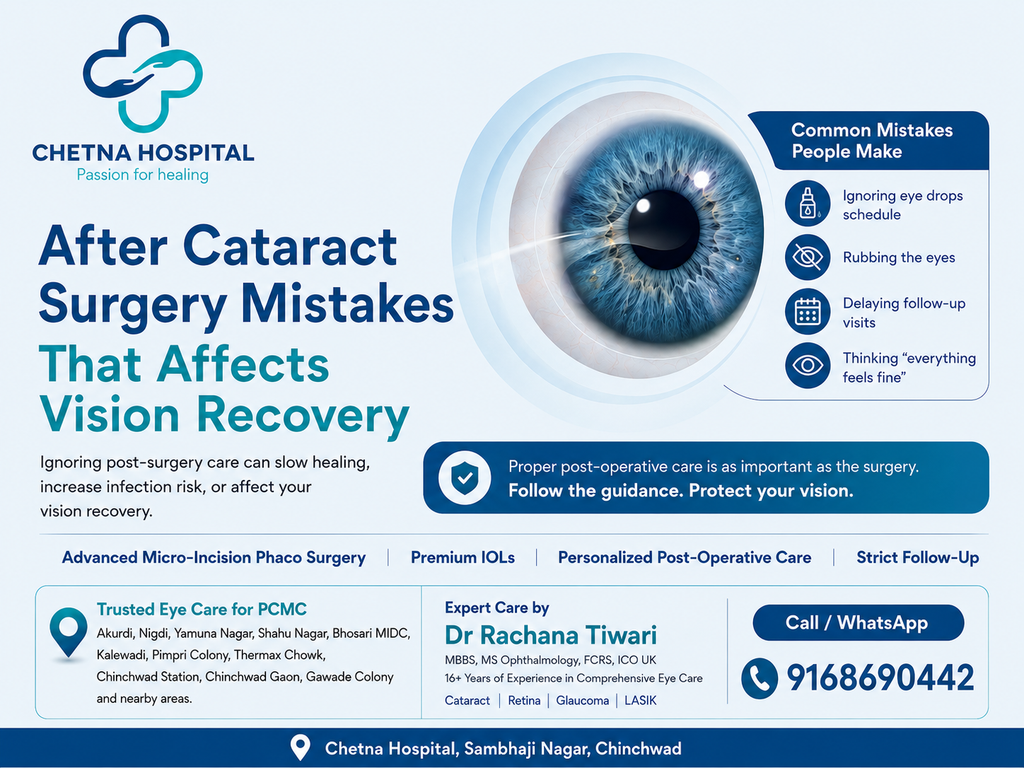
Many people recover relatively quickly after cataract surgery, although recovery can vary between individuals.
Temporary blurred vision or mild discomfort may occur after surgery. Your doctor may prescribe eye drops and provide instructions about protecting the eye and returning to normal activities.
During recovery:
- Use prescribed medicines or eye drops as directed.
- Avoid rubbing the operated eye.
- Attend recommended follow-up appointments.
- Protect the eye according to your doctor’s instructions.
- Avoid strenuous activities until you are advised that they are safe.
- Do not drive until your vision is adequate and your doctor has cleared you.
- Contact your eye-care team if symptoms worsen rather than improve.
Cataract surgery is commonly performed, but complications are possible. Your ophthalmologist should explain the risks relevant to your individual case.
Lifestyle Tips for Better Eye Health
Healthy habits cannot prevent every eye condition. However, they can support general health and help reduce avoidable risks.
- Schedule eye examinations when appropriate. Do not wait until vision loss becomes severe.
- Manage diabetes and blood pressure. Follow your treating doctor’s advice.
- Protect your eyes from strong sunlight. Appropriate UV protection can reduce unnecessary exposure.
- Avoid smoking. Tobacco use is associated with several health problems, including eye disease.
- Use comfortable lighting while reading. Good lighting can make close-up tasks easier.
- Take regular breaks from prolonged screen use. Look away periodically and blink normally.
- Use contact lenses correctly. Follow the cleaning and replacement instructions provided by your eye-care professional.
- Avoid using leftover eye drops without medical advice.
- Protect your eyes from injury. Use suitable protective eyewear when required.
- Eat a balanced diet. Include vegetables, fruits, whole grains and adequate protein.
- Stay physically active. Regular physical activity supports overall health.
- Take prescribed medicines correctly. Discuss concerns about medicines with your doctor.
Nutrition for Eye Health
Food is not a replacement for an eye examination or prescribed treatment. However, a balanced diet provides nutrients that support general health.
| Nutrient | Potential Role | Food Sources |
|---|---|---|
| Vitamin A | Supports normal vision and eye function | Carrots, pumpkin, sweet potato, leafy greens |
| Vitamin C | Antioxidant nutrient supporting normal tissue health | Citrus fruits, guava, amla, capsicum |
| Vitamin E | Provides antioxidant activity | Nuts, seeds and vegetable oils |
| Protein | Supports tissue maintenance and general health | Dal, beans, eggs, dairy, fish and lean meats |
| Zinc | Supports normal cellular functions | Pulses, nuts, seeds, dairy and meat |
| Omega-3 fats | Supports general nutritional health | Fish, flaxseed, chia seeds and walnuts |
People with specific medical conditions may have different nutritional needs. Ask your doctor or dietitian for personalised advice.
Planning Cataract Treatment in Chinchwad
Cataract treatment depends on how much the cataract affects your vision, daily activities and overall eye health. Cataract surgery is generally considered when reduced vision begins to interfere with activities such as reading or driving. The NHS notes that adults do not necessarily need cataract surgery immediately and that the decision should be discussed with an eye-care specialist. NHS – Cataract Surgery
What Happens During Cataract Surgery?
Cataract surgery involves removing the cloudy natural lens and replacing it with an artificial intraocular lens. The NHS explains that cataract surgery is commonly performed under local anaesthesia and that the cloudy lens is removed before an artificial lens is placed inside the eye. NHS – Cataract Surgery
Recovery varies between patients. Your ophthalmologist will provide individual instructions about eye drops, follow-up appointments, activity restrictions and when it is safe to resume normal activities. The NHS provides patient guidance on common recovery expectations and symptoms that may require further medical assessment. NHS – Cataract Surgery and Recovery
WHO -. WHO – Ultraviolet Radiation and Eye Health
Symptoms You Should Never Ignore
Sudden vision changes should not automatically be attributed to cataract. The NHS advises urgent assessment for symptoms such as sudden flashes, a sudden increase in floaters, a dark curtain or shadow across vision, or sudden blurred vision because these can be associated with retinal problems. NHS – Cataract Surgery: Complications and Urgent Symptoms
Myth vs Fact
| Myth | Fact |
| Cataract always needs immediate surgery. | Surgery is generally considered when cataract affects vision and daily activities. |
| Cataract can always be treated with stronger glasses. | Glasses may improve vision caused by refractive error, but they do not remove a cloudy cataractous lens. |
| Cataract only affects very old people. | Age is a major risk factor, but cataracts can occur earlier for several reasons. |
| Everyone needs the same type of lens after cataract surgery. | Lens selection depends on the patient’s eyes, visual needs and discussion with the ophthalmologist. |
| Good vision after surgery is guaranteed. | Cataract surgery is commonly performed, but outcomes and risks vary between individuals. |
| Eye drops can remove an established cataract. | Established cataract may require surgery when the cataract significantly affects vision and surgery is considered appropriate. |
| Sudden vision loss can wait for a routine appointment. | Sudden vision changes can signal an urgent eye problem and should be assessed promptly. |
Eye Care for Patients Across Pimpri-Chinchwad
Chetna Multispecialty Hospital is located in Sambhaji Nagar, Chinchwad, Pimpri-Chinchwad, Maharashtra.
Patients from nearby areas such as Chinchwad, Sambhaji Nagar, Akurdi, Nigdi, Chinchwad Gaon, Thergaon, Kalewadi, Ravet, Walhekarwadi and Pradhikaran may consider the hospital when looking for local cataract and general eye-care services.
Patients from the wider PCMC and Pune region, including Wakad, Pimple Saudagar, Tathawade, Punawale, Hinjewadi, Moshi, Sangvi, Dapodi, Kasarwadi and Dehu Road, may also consider consultation depending on their healthcare needs and travel preferences.
If you are searching for cataract treatment in Chinchwad, consider checking the doctor’s services, hospital location, appointment availability and the type of eye evaluation provided before booking a consultation.
Why Choose Dr. Rachna Tiwari?
Dr. Rachna Tiwari provides cataract and general eye care at Chetna Multispecialty Hospital in Pimpri-Chinchwad.
This article does not make claims about rankings, success rates or treatment outcomes that have not been supplied or independently verified.
Doctor Information
Doctor Name: Dr. Rachna Tiwari
Specialization: Cataract and general eye care
Hospital: Chetna Multispecialty Hospital
Address: Sambhaji Nagar, Chinchwad, Pimpri-Chinchwad, Maharashtra 411019
Phone: 9168690442
Website: chetnahospital. in
Doctor Profile: Dr Rachana Tiwari
Need Cataract Treatment in Chinchwad?
If you have persistent blurred vision, suspect a cataract or another eye-health concern, arrange an appropriate eye examination.
Chetna Multispecialty Hospital
Sambhaji Nagar, Chinchwad, Pimpri-Chinchwad, Maharashtra 411019
Phone: 9168690442
OPD: Contact the hospital for current availability.
Frequently Asked Questions
Common symptoms include blurred or cloudy vision, difficulty seeing at night, glare around lights, faded colours, difficulty reading and frequent changes in spectacle prescription.
You should consider an eye examination if blurred or cloudy vision persists, worsens or starts affecting reading, driving, work, or other daily activities. Sudden vision changes require prompt medical assessment.
Cataract is diagnosed through an eye examination that may include visual acuity testing, refraction, examination of the eye, eye pressure measurement, and a dilated examination when appropriate.
Cataract surgery may be considered when the cataract significantly affects vision or daily activities. The decision depends on your symptoms, eye examination, and overall eye health.
During cataract surgery, the cloudy natural lens is removed and replaced with an artificial intraocular lens. The exact procedure and anaesthesia plan depend on the patient’s individual eye condition.
Recovery varies between individuals. Your ophthalmologist will provide instructions about eye drops, follow-up visits, activity restrictions, and when you can safely return to normal activities.
Patients looking for cataract treatment in Pimpri-Chinchwad can consult Dr. Rachna Tiwari at Chetna Multispecialty Hospital in Sambhaji Nagar, Chinchwad. Patients can contact the hospital for current consultation availability.
You can contact Chetna Multispecialty Hospital at 9168690442 to enquire about consultation availability with Dr. Rachna Tiwari. The hospital is located in Sambhaji Nagar, Chinchwad, Pimpri-Chinchwad, Maharashtra 411019.
Conclusion
Cataracts and other vision problems can develop gradually, making it easy to adjust to reduced vision without realising how much it affects daily life.
A proper eye examination can help identify the likely cause and determine whether monitoring, glasses, medical care or cataract surgery is appropriate.
For patients looking for cataract treatment in Chinchwad, consultation with an eye-care professional can help clarify the diagnosis and available treatment options.
Dr. Rachna Tiwari provides cataract and general eye care at Chetna Multispecialty Hospital in Sambhaji Nagar, Chinchwad, Pimpri-Chinchwad. Patients can contact the hospital at 9168690442 for current appointment information.


1 Comment
Eye Specialist in Chinchwad – Dr. Rachana Tiwari Chetna Hospital
[…] Cataract Surgery […]