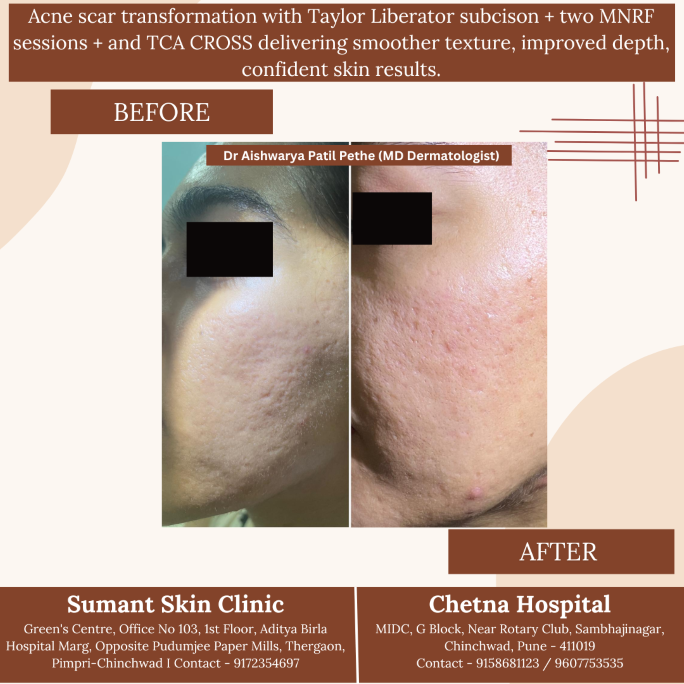
Acne scars are one of the most common yet emotionally distressing skin concerns faced by teenagers and adults alike. Even after active acne is controlled, scars can remain for years, affecting skin texture, confidence, and overall appearance. Fortunately, modern dermatology now offers advanced, evidence-based treatments that can significantly improve acne scars.
At Chetna Hospital, Pimpri-Chinchwad, Dr. Aishwarya Patil (MD Dermatologist) provides comprehensive and customized acne scar treatments using a combination of Taylor Liberator subcision, Microneedling Radiofrequency (MNRF), and TCA CROSS, helping patients achieve visible texture improvement and healthier skin.
Understanding Acne Scars: Why Do They Occur?
Acne scars form when inflammation damages the deeper layers of the skin. Improper healing leads to loss or excess of collagen, resulting in uneven texture. Common types of acne scars include:
- Rolling scars
- Box scars
- Ice pick scars
- Mixed acne scars
Each scar type requires a different treatment approach. This is why acne scar treatment should always be performed by a qualified MD dermatologist after a detailed skin evaluation.
Why Combination Treatment Is the Gold Standard for Acne Scars
No single treatment can address all types of acne scars. Dermatologists worldwide now recommend combination therapy, which targets scars at multiple levels of the skin. At Chetna Hospital, Dr. Aishwarya Patil designs personalized protocols combining:
- Taylor Liberator Subcision
- MNRF (Microneedling Radiofrequency)
- TCA CROSS (Chemical Reconstruction of Skin Scars)
This approach leads to better, long-lasting, and natural-looking results.
Taylor Liberator Subcision: Releasing Deep Acne Scars
What is Subcision?
Subcision is a minor surgical dermatology procedure used to treat deep rolling and tethered acne scars. Scar tissue bands pull the skin downward, creating depressions. Subcision works by releasing these fibrotic bands.
Why Taylor Liberator Subcision?
The Taylor Liberator is a specialized, advanced instrument that allows precise and controlled subcision. Compared to conventional needles, it offers:
- Better scar release
- Uniform collagen stimulation
- Reduced trauma
- Improved safety and effectiveness
Benefits of Taylor Liberator Subcision
- Lifts depressed acne scars
- Stimulates new collagen formation
- Improves skin texture gradually
- Ideal for moderate to severe acne scars
At Chetna Hospital, Dr. Aishwarya Patil performs subcision under strict aseptic conditions, ensuring patient safety and comfort.
MNRF (Microneedling Radiofrequency): Remodeling Skin from Within
What is MNRF?
Microneedling Radiofrequency (MNRF) combines microneedles with radiofrequency energy, delivering controlled heat into deeper skin layers. This stimulates collagen and elastin production without damaging the skin surface.
How MNRF Helps Acne Scars
- Improves skin texture and firmness
- Reduces acne scar depth
- Tightens pores
- Enhances overall skin quality
MNRF is particularly effective for box scars, rolling scars, and post-acne texture irregularities.
Number of Sessions
Most patients require 2–4 MNRF sessions, spaced 4–6 weeks apart, depending on scar severity and skin type.
TCA CROSS: Targeting Deep Ice Pick Scars
What is TCA CROSS?
TCA CROSS (Trichloroacetic Acid Chemical Reconstruction of Skin Scars) is a targeted chemical technique used for deep ice pick and narrow box scars.
How It Works
A high-strength TCA solution is carefully applied only inside the scar. This causes controlled injury, stimulating collagen formation from within and gradually filling the scar.
Benefits of TCA CROSS
- Highly effective for ice pick scars
- Improves scar depth
- Minimal damage to surrounding skin
- Performed safely by trained dermatologists
At Chetna Hospital, TCA CROSS is performed by Dr. Aishwarya Patil, ensuring precision and optimal results.
Every patient’s skin is unique. At Chetna Hospital, Pimpri-Chinchwad, acne scar treatment begins with:
- Detailed skin and scar analysis
- Identification of scar types
- Customized treatment planning
- Combination therapy for best outcomes
Dr. Aishwarya Patil believes in ethical dermatology, realistic expectations, and gradual improvement rather than exaggerated claims.
Who Is an Ideal Candidate for These Treatments?
You may be a suitable candidate if you:
- Have acne scars despite acne control
- Experience rolling, box, or ice pick scars
- Want non-surgical scar improvement
- Are looking for safe, dermatologist-performed procedures
Patients from Chinchwad, Pimpri, Wakad, Nigdi, Akurdi, Bhosari, Ravet, Thergaon, and PCMC areas frequently visit Chetna Hospital for advanced acne scar treatments.
Recovery, Downtime, and Results
Downtime
- Subcision: Mild swelling or bruising for a few days
- MNRF: Redness for 24–48 hours
- TCA CROSS: Scab formation that heals in 5–7 days
Results
- Gradual improvement over 3–6 months
- Enhanced skin texture
- Reduced scar depth
- Natural collagen remodeling
Proper post-procedure care and sunscreen use are essential for optimal results.
Why Choose Dr. Aishwarya Patil for Acne Scar Treatment?
- MD Dermatologist with clinical expertise
- Evidence-based treatment protocols
- Advanced dermatology equipment
- Focus on safety, hygiene, and patient education
- Trusted skin specialist in Pimpri-Chinchwad, Pune
Dr. Aishwarya Patil treats not only acne scars but also acne, pigmentation, hair loss, melasma, skin allergies, and aesthetic dermatology concerns.
Acne Scar Treatment in Pimpri-Chinchwad, Pune
If you are searching for:
- Acne scar treatment in Pimpri
- Dermatologist near Chinchwad
- Subcision treatment in Pune
- MNRF treatment near PCMC
- TCA CROSS for acne scars in Pune
Chetna Hospital is a reliable destination for advanced dermatology care.